中文简体
中文简体 English
 日本語
日本語 русский
 Español
Baby wet wipes are used many times each day for cleaning, refreshing, and caring for delicate skin. As consumers and manufacturers become more aware of plastic pollution, wastewater challenges, and the environmental impact of disposable hygiene products, the demand for plastic-free and responsibly designed wipe materials continues to grow. At the same time, a baby wipe must remain soft, absorbent, strong enough for practical use, and suitable for efficient high-speed converting. Balancing these requirements is one of the most important challenges in the development of flushable nonwoven materials.
Lyocell and wood pulp flushable fabric offers a practical material solution for baby wet wipe manufacturers, private label brands, converters, and other professional buyers. This wet-laid spunlace material combines approximately 30% lyocell fiber with 70% wood pulp fiber as a standard formulation, while the blending ratio can be adjusted according to the required performance. The material is designed to provide a soft and fluffy hand feel, rapid liquid absorption, effective water retention, plastic-free construction, and biodegradability.
When properly engineered and tested for the intended market, the fabric can support flushable wipe applications. Its structure is designed to disperse in water more readily than conventional plastic-based nonwovens, helping reduce the risk of persistent material accumulation in wastewater systems. However, flushability is not determined by fiber content alone. Finished wipes must be evaluated according to applicable regional standards, wastewater conditions, packaging instructions, and disposal requirements.
For commercial buyers, the value of this product extends beyond the fiber blend. The manufacturing system supports customized roll widths, fabric weights, embossing patterns, finishing treatments, testing, sampling, mass production, and private label development. An integrated supply chain from nonwoven substrate production to finished hygiene products can also simplify procurement and improve consistency across product programs.
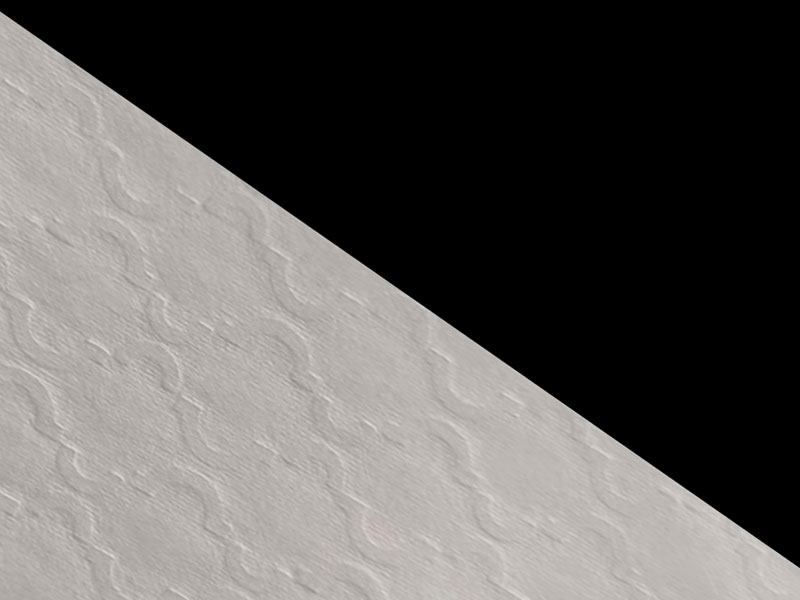
Lyocell/Pulp Flushable Fabric For Baby Wet Wipes
Why Flushable Baby Wipe Materials Require Specialized Engineering
A baby wet wipe is a carefully balanced product rather than a simple sheet of absorbent material. It must pick up moisture and soil, release lotion or cleansing solution evenly, remain comfortable against sensitive skin, resist tearing during use, and maintain acceptable appearance after packaging and transportation. If the wipe is marketed as flushable, it must also lose structural integrity in water under appropriate conditions without becoming difficult to manufacture or use.
These requirements can conflict with one another. A highly durable wipe may be difficult to disperse after flushing. A very weak wipe may break during dispensing or cleaning. A material that absorbs water quickly may not retain sufficient liquid for comfortable use. A material with a smooth surface may lack the softness or bulk expected in the baby care category. The design of the fiber blend, web structure, bonding process, finishing treatment, and converting conditions must therefore be considered as one integrated system.
Traditional nonwoven fabrics may use synthetic fibers such as polypropylene or polyester to obtain strength and dimensional stability. These materials can perform well during wiping, but they are not generally biodegradable and may remain in the environment for long periods. A plastic-free combination of cellulosic fibers provides an alternative approach. Lyocell contributes high wet strength and fiber performance, while wood pulp contributes absorbency, softness, and rapid water interaction.
The purpose of the lyocell and pulp blend is not simply to replace one fiber with another. It is to create a structure that works during the complete product life cycle. During production, the web must be formed consistently and converted efficiently. During use, the wipe must remain intact and pleasant to handle. After disposal, the material should be capable of dispersing and biodegrading under the conditions for which it has been designed and tested.
Material Composition: The Role of Lyocell Fiber
Lyocell is a regenerated cellulose fiber derived from plant-based cellulose. In the proposed fabric, it serves as a high-performance component that improves wet strength and helps the sheet maintain dimensional stability. This is especially important in baby wipes because the product is normally saturated with liquid before use and may be pulled from a container, folded, unfolded, or stretched during cleaning.
Higher wet strength helps reduce premature tearing when the wipe is handled. It can also support more consistent roll processing, slitting, folding, and packaging. Compared with a material composed only of loose pulp fibers, a lyocell-containing web can provide a more stable balance between softness and usability. The exact performance depends on fiber properties, blend ratio, basis weight, web formation, bonding conditions, and the final lotion or liquid formulation.
Lyocell also contributes to the soft and textile-like feel of the material. This tactile quality is valuable in baby care because parents often associate a smooth, fluffy surface with comfort and gentle cleaning. A soft surface may help reduce the perception of harsh rubbing, although finished wipe safety always depends on the complete product, including the liquid formulation, preservatives, pH, texture, and intended use.
The standard composition is approximately 30% lyocell and 70% wood pulp, but the ratio is not fixed for every project. A buyer may require more strength, faster dispersion, greater softness, increased absorbency, a different wet-handling performance, or compatibility with a particular wipe liquid. Adjusting the blend can help the manufacturer develop a material that is more closely matched to the customer’s converting equipment and market positioning.
Material Composition: The Role of Wood Pulp Fiber
Wood pulp is a cellulose-based fiber valued for its absorbency and ability to interact quickly with water. Within the blended fabric, pulp helps create a porous, fluffy structure capable of taking up liquid at a high rate. This characteristic is important for baby wipes, which must absorb cleansing solutions evenly and retain enough liquid to support effective cleaning.
Pulp fibers can also contribute to the soft hand feel expected in disposable hygiene products. Their short, flexible structure allows the finished sheet to feel less dense and more cushion-like than some tightly bonded synthetic fabrics. When combined with lyocell, pulp can help create a material that offers both comfortable contact and practical wet-use performance.
The pulp content also supports the objective of developing a plastic-free flushable material. Cellulosic fibers can biodegrade more readily than conventional petroleum-based fibers when suitable environmental conditions are available. Nevertheless, biodegradability and flushability are separate technical properties. A material may be biodegradable without being suitable for flushing, and a material intended for flushing must be evaluated for dispersion, disintegration, strength loss, and downstream wastewater behavior.
For that reason, the pulp source, fiber preparation, moisture management, web uniformity, and finished product testing all matter. Professional development should assess the complete wipe rather than making performance decisions from the composition label alone.
Wet-Laid Spunlace Technology
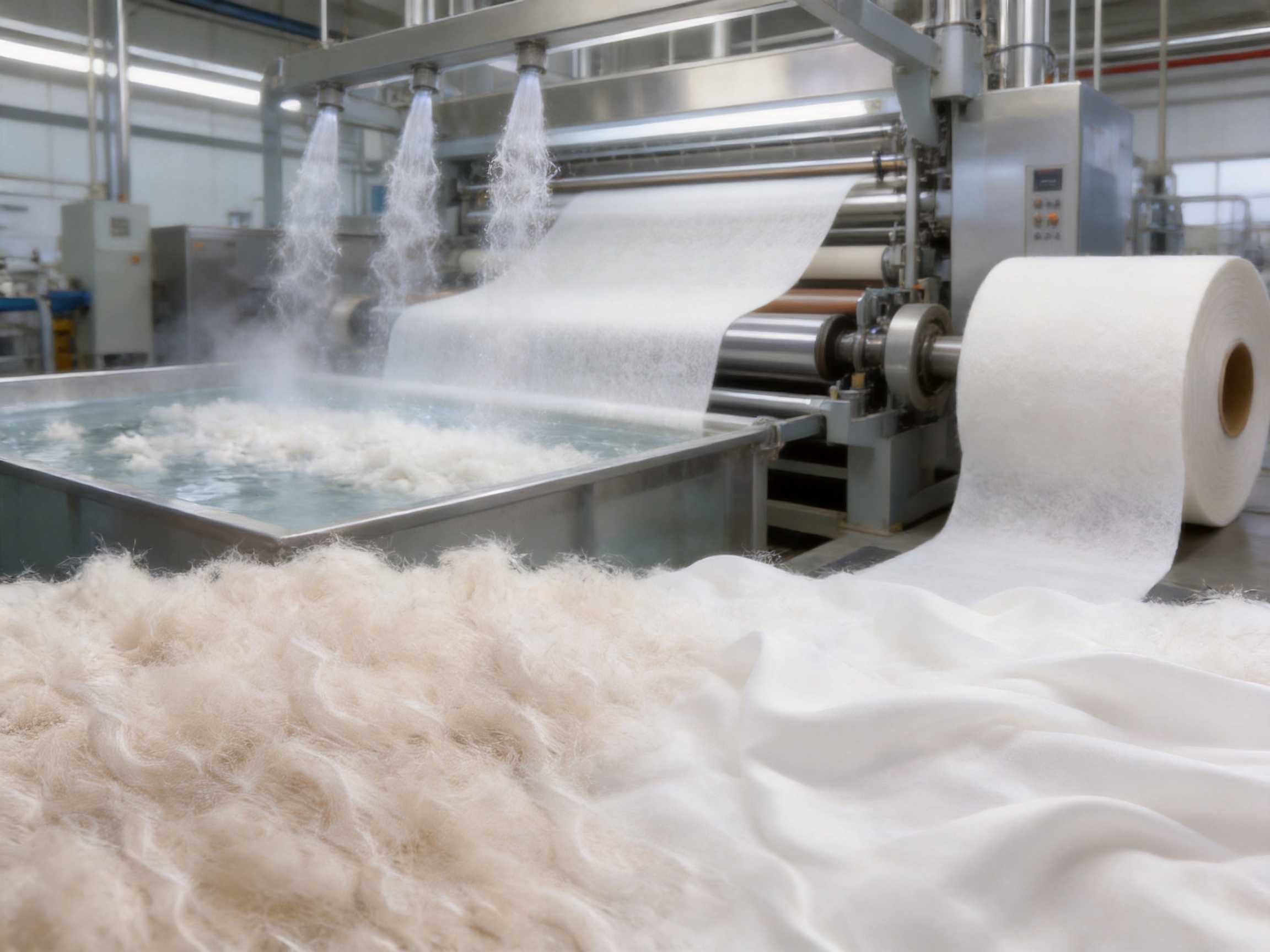
The fabric is produced using wet-laid spunlace technology. Wet-laid formation disperses fibers in a water-based medium to create a relatively uniform web before the material is consolidated. This method is well suited to cellulosic fiber blends because it can distribute pulp and lyocell throughout the sheet and support the development of a controlled, absorbent structure.
After the web is formed, high-pressure water jets entangle the fibers. This hydroentanglement process creates mechanical bonding without relying on conventional chemical binders as the primary means of holding the web together. The result is a flexible nonwoven sheet with a textile-like surface, useful softness, and a structure that can be engineered for different strength and absorbency targets.
Water-jet entanglement is particularly valuable for baby wipe materials because it can preserve a soft surface while providing enough cohesion for converting and use. The process can also support a range of surface patterns, basis weights, and roll formats. Production parameters such as water pressure, jet sequence, line speed, fiber distribution, drying conditions, and winding tension must be controlled carefully to maintain consistent quality.
Uniformity is critical for manufacturers. Variations in basis weight can produce inconsistent absorbency, liquid loading, tensile strength, and cutting behavior. Uneven fiber distribution may create weak areas or visible differences in the finished wipe. A stable wet-laid spunlace process helps reduce these risks and supports predictable performance during high-volume production.
Advantages of Hydroentangled Cellulosic Construction
Hydroentanglement can provide a favorable combination of flexibility, softness, and wet integrity. It creates a fabric that can be folded, stacked, rolled, or converted into different wipe formats without feeling excessively stiff. Because the bonding mechanism is based on fiber entanglement, the fabric can be designed to retain a relatively open structure that supports liquid uptake.
The process also allows manufacturers to adjust the relationship between softness and strength. A more open structure may support faster dispersion and higher absorbency, while a more consolidated structure may provide improved handling strength. Development work is required to identify the correct balance for a particular wipe size, liquid add-on, package format, and disposal claim.
For flushable applications, the ability of the web to lose strength and separate in water is an important design consideration. The same structure that provides sufficient integrity during use must be capable of breaking down after disposal under relevant test conditions. This balance is one reason why flushable wipe materials should be designed specifically for the intended application rather than adapted from conventional durable nonwovens.
Key Product Advantages for Baby Wet Wipes
Softness for Delicate Skin
Baby skin requires careful product selection because it can be more sensitive to friction, excessive moisture, fragrance, preservatives, and other formulation factors. The fluffy, soft texture of the lyocell and pulp fabric is intended to provide a comfortable surface for routine cleaning. The material can be supplied with a plain, pearl, mesh, or customized embossing pattern, allowing brands to adjust both tactile performance and visual appearance.
Softness is influenced by more than fiber selection. Fiber fineness, web density, embossing depth, hydroentanglement intensity, drying conditions, and lotion loading all affect the final feel. During product development, sensory evaluation should be combined with objective testing so that softness targets are consistent from sample stage to mass production.
Rapid Absorption and Liquid Retention
The combination of lyocell and pulp creates a high-absorbency cellulosic structure. Pulp supports quick liquid uptake, while the overall web structure helps distribute moisture across the sheet. Effective liquid distribution is important because a wipe that absorbs unevenly may have dry areas, excessive wet spots, or inconsistent cleaning performance.
Good liquid retention also supports packaging efficiency. A wipe should hold its intended lotion or cleansing solution without excessive dripping during storage and dispensing. The ideal liquid add-on depends on wipe dimensions, basis weight, folding configuration, package design, and the required level of wetness. These parameters can be evaluated during laboratory sampling and pilot production.
Improved Wet Dimensional Stability
Although a flushable wipe must eventually disperse in water, it still needs sufficient wet integrity during normal use. Lyocell contributes higher wet strength and can help the sheet maintain its dimensions while saturated. This can reduce the likelihood of premature tearing when the wipe is removed from a pack or used for cleaning.
Wet dimensional stability is especially relevant for parents who expect a wipe to remain intact throughout a cleaning task. It is also important for automated packaging lines, where unstable material may cause feeding problems, uneven folding, or inaccurate stacking. The correct strength target should be established based on the intended wipe format and the product’s disposal instructions.
Plastic-Free Material Platform
The fabric is designed as a plastic-free cellulosic material. This gives manufacturers an opportunity to develop baby wipes that respond to consumer interest in reducing plastic content in disposable hygiene products. A plastic-free claim should be supported by appropriate raw material verification and clear communication about any additives, coatings, packaging components, or product-level exceptions.
Moving away from synthetic fibers can also help brands differentiate their product ranges. Many retailers and consumers are looking for wipe materials that better align with sustainability goals. A cellulosic platform may support marketing positions such as plant-fiber-based, plastic-free, biodegradable, or flushable, provided that each claim is verified according to applicable regulations and test methods.
Biodegradability Potential
Lyocell and wood pulp are cellulose-based fibers that are capable of biodegradation under suitable conditions. This characteristic can reduce the long-term persistence associated with conventional plastic nonwovens. However, the rate and extent of biodegradation depend on the environment, microorganisms, temperature, moisture, oxygen availability, and the presence of coatings or other ingredients.
Responsible product communication should distinguish between biodegradable raw materials and the environmental behavior of the finished wipe. Manufacturers should evaluate the complete product, including liquid formulation, packaging, printing, and any finishing technology. Clear technical documentation helps customers make accurate claims and avoid overstatement.
Flushable Application Development
The fabric can be designed for flushable baby wipe applications according to customer specifications and target market requirements. Its cellulosic construction and water-dispersible design provide a foundation for this purpose. Compared with many durable plastic-based nonwovens, it is intended to break apart more readily when exposed to water and agitation.
Flushability must always be verified at the finished product level. Testing may include toilet and drain line passage, disintegration, dispersion, settling behavior, biodegradation, and effects on wastewater treatment systems, depending on the standard or market requirement. Product instructions should also tell consumers to flush only the recommended number of wipes and to follow local wastewater guidance.
Customizable Technical Specifications
| Specification | Standard or Available Range | Customization Considerations |
|---|---|---|
| Composition | Approximately 30% lyocell and 70% wood pulp | Blend ratio can be adjusted for strength, softness, absorbency, and dispersion |
| Technology | Wet-laid spunlace | Process settings can be developed for the required web structure and converting performance |
| Pattern | U-style pattern | Plain, pearl, mesh, and customized embossing options are available |
| Basis weight | Approximately 50 to 100 grams per square meter | Final weight depends on wipe size, wetness, strength, and product positioning |
| Roll width | Approximately 10 to 320 centimeters | Width can be matched to converting equipment and jumbo-roll requirements |
| Finishing | Hydrophilic, coating, antistatic, and related treatments | Finishing should be selected according to liquid absorption, surface feel, and end use |
| Applications | Baby wet wipes and related hygiene products | Suitable formats can be developed for private label, OEM, and ODM projects |
The available basis weight range allows buyers to select a material appropriate for different wipe formats. A lighter fabric may be useful for compact, economical, or highly folded wipes, while a heavier fabric may provide increased bulk and a more substantial hand feel. Basis weight should not be considered in isolation because absorbency, wet strength, softness, and dispersion also depend on fiber ratio and web construction.
Roll width can be customized from narrow formats to jumbo widths suitable for industrial converting. This flexibility helps customers align the nonwoven roll with slitting, folding, cutting, and packaging equipment. Roll length, core size, winding tension, packaging method, and labeling can also be discussed during project planning.
Embossing patterns influence surface texture, appearance, cleaning contact, and perceived quality. Plain surfaces may be selected for a simple and economical product. Pearl or mesh patterns can provide a distinctive hand feel and visual identity. Customized patterns may help private label brands create a recognizable product format while maintaining the underlying material platform.
Finishing Technologies and Product Performance
Hydrophilic finishing can help the fabric accept water and water-based liquids more readily. This is useful for wipes that must become wet quickly during lotion application or finished-product impregnation. The treatment level should be optimized so that the fabric absorbs and distributes liquid efficiently without compromising softness or the targeted disposal performance.
Coating technology may be considered when a project requires a specific surface effect or functional property. Any coating must be selected carefully for baby care applications and assessed for compatibility with the flushability and biodegradability objectives. A coating that improves one property may negatively affect water dispersion, so product-level testing is essential.
Antistatic finishing can be useful in certain manufacturing and converting environments. Reducing static may improve handling, feeding, stacking, and packaging consistency. Its value depends on production speed, humidity, equipment configuration, and the behavior of the selected fiber blend. Technical teams can evaluate whether antistatic treatment is necessary for a particular customer’s process.
Finishing choices should never be separated from the intended use. Baby wipes may require a combination of softness, absorbency, wet integrity, surface cleanliness, low odor, and formulation compatibility. The right solution is developed through sample evaluation, laboratory testing, pilot runs, and customer feedback.
Quality Control from Fiber to Finished Roll
Consistent quality begins with raw material management. Lyocell and pulp fibers should be checked for identity, cleanliness, moisture, fiber length, and other properties relevant to web formation. Incoming material controls help reduce variation before production begins.
During wet-laid web formation, process monitoring helps maintain uniform fiber distribution and basis weight. Water quality, slurry concentration, flow stability, and equipment condition can influence the final sheet. In the spunlace stage, water pressure and jet performance must be controlled to create a consistent entangled structure without producing excessive damage or unwanted stiffness.
Drying and winding are also important. Inadequate drying may affect storage stability, microbial control, and roll quality. Excessive drying or tension may alter softness and dimensional behavior. Incorrect winding can create telescoping, wrinkles, edge damage, or uneven roll density, making the material difficult to convert.
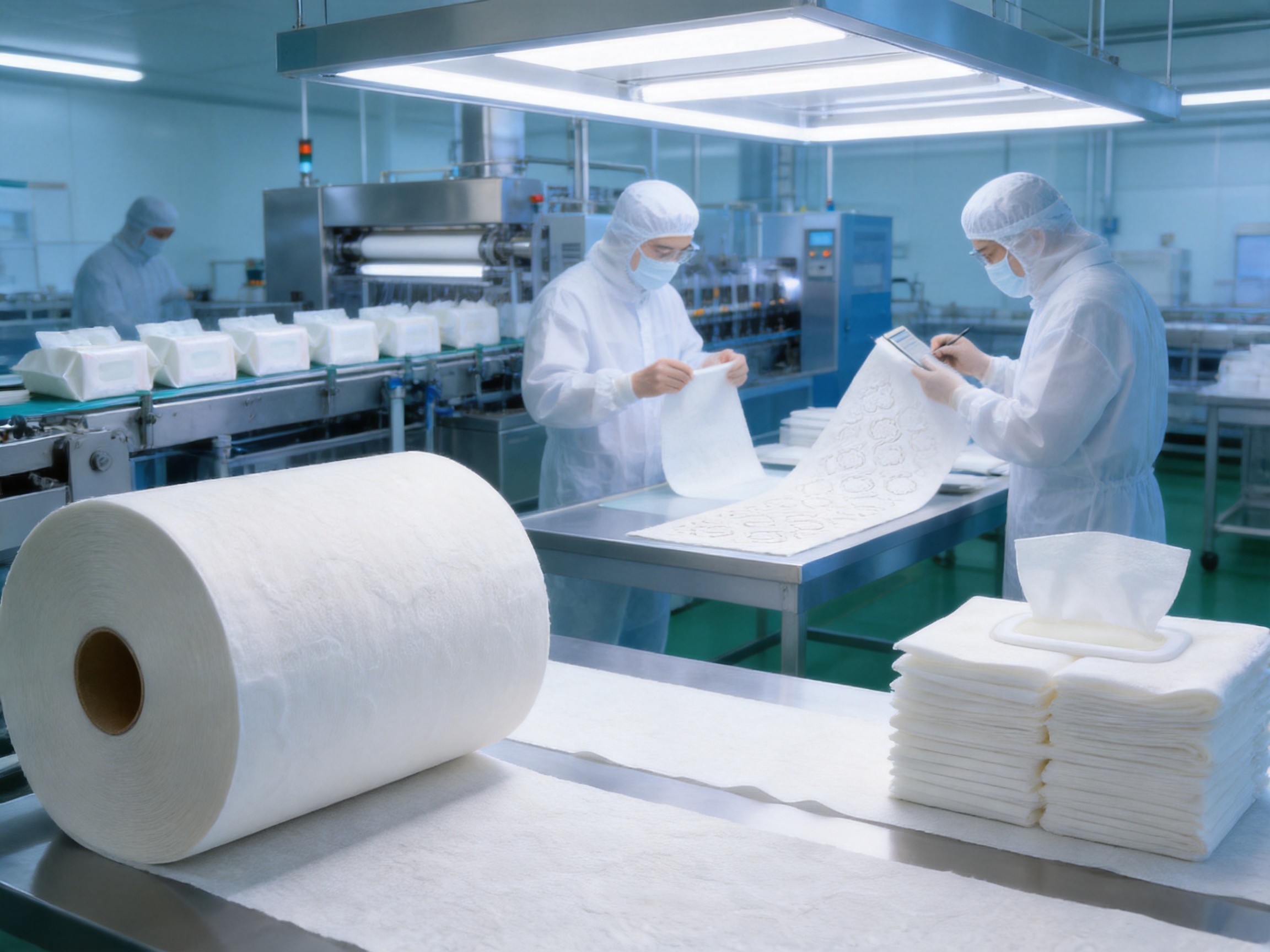
Finished-roll inspection may include basis weight, width, moisture, tensile strength, elongation, thickness, absorbency, wet strength, surface appearance, and roll hardness. Depending on the project, customers may also request testing for dispersion, flushability, biodegradation, lint, pH compatibility, or other application-specific properties.
Manufacturing in controlled clean workshops and the use of purified water systems support hygiene-oriented production. A comprehensive testing center allows technical and quality teams to evaluate materials before shipment and to investigate any performance variation. These systems are particularly valuable for international buyers who require reliable documentation and repeatable supply.
Integrated Manufacturing Strengths
The manufacturer behind this material has a long operating history in medical and hygiene nonwovens, nursing products, and related textile materials. Since its establishment in 1987, the company has developed production capabilities covering nonwoven substrates and finished hygiene products. Its manufacturing network includes multiple bases in China and an expanding footprint in Vietnam, supporting capacity planning and international supply requirements.
An integrated production chain can provide advantages over a purely trading-based supply model. When the same organization manages fiber selection, nonwoven production, testing, converting support, and finished-product development, technical feedback can move more quickly between departments. This may shorten development cycles and help resolve issues involving absorbency, roll handling, liquid loading, or packaging.
Multiple production locations can also support supply continuity and capacity flexibility. Buyers often need stable deliveries across seasonal demand changes, promotional programs, new market launches, and long-term private label contracts. A broad manufacturing footprint can help manage production scheduling while maintaining consistent specifications through centralized technical and quality procedures.
Internationally sourced production equipment and process experience further strengthen the manufacturing platform. Advanced machinery from established European suppliers can support precise web formation, spunlace consolidation, slitting, winding, and converting. Equipment alone does not guarantee quality, but it provides a strong foundation when combined with trained operators, engineering controls, preventive maintenance, and documented procedures.
The company’s experience extends across medical, maternal and baby care, beauty, household, industrial cleaning, clothing, and flushable nonwoven applications. This broad product knowledge can be useful when developing a new baby wipe because lessons from adjacent categories may help optimize fiber blends, surface patterns, packaging formats, and production efficiency.
OEM and ODM Support for Professional Buyers
Private label and branded hygiene manufacturers often require more than a standard roll of nonwoven fabric. They may need help selecting a basis weight, confirming a fiber blend, creating an embossing pattern, preparing a sample, verifying a liquid add-on, and coordinating final packaging. OEM and ODM support allows these tasks to be handled as part of one structured development program.
For an OEM project, the customer may provide a detailed specification and require production to match an existing product. The technical team can review the required wipe dimensions, folding pattern, wetness level, strength, surface feel, roll format, and packaging process. Sample rolls or sheets can then be prepared for evaluation before mass production.
For an ODM project, the customer may begin with a market concept rather than a complete technical design. In this case, the manufacturer can support material selection, performance optimization, testing, and specification development. The objective is to transform a broad product idea into a repeatable nonwoven and finished wipe specification.
Customization may include the lyocell-to-pulp ratio, basis weight, width, roll length, embossing, hydrophilic treatment, antistatic treatment, packaging, and private label requirements. Flushability performance can be developed according to the customer’s target market and relevant testing expectations. Samples allow buyers to confirm the material’s behavior on their own converting and packaging lines.
A structured development process can reduce commercial risk. It gives the buyer an opportunity to assess softness, wet handling, absorption, dispersion, appearance, package compatibility, and consumer positioning before committing to a large order. It also creates a technical record that can be used to maintain consistency in future production.
Advantages Compared with Conventional Plastic-Based Wipe Fabrics
The most obvious difference is the fiber platform. Conventional synthetic nonwovens can deliver high durability, but they generally contain plastic fibers that do not biodegrade readily. The lyocell and pulp fabric is designed to provide a cellulose-based, plastic-free alternative for buyers seeking a different environmental profile.
The second advantage is the balance between wet strength and dispersibility. Some highly durable fabrics remain intact for a long time after disposal, which can be undesirable for flushable applications. The lyocell and pulp structure is developed to provide sufficient use strength while supporting more rapid dispersion in water when tested under appropriate conditions.
The third advantage is absorbency and surface comfort. Cellulosic fibers naturally interact well with water, and the wet-laid spunlace structure can create a soft, porous sheet. This can provide a pleasant user experience while supporting efficient liquid loading. The exact result depends on the final construction, but the material platform is well suited to products where softness and absorbency are major purchase factors.
Another advantage is formulation and format flexibility. Buyers can customize fiber ratio, weight, width, embossing, and finishing. This is important because baby wipes vary widely by market: some are compact travel wipes, some are thick premium wipes, some are fragrance-free sensitive-skin products, and others are designed for everyday value segments.
There are also practical supply advantages. An integrated manufacturer can supply nonwoven rolls while supporting finished wipes, diapers, training pants, dry wipes, cleansing wipes, and related hygiene products. This allows a buyer to consolidate sourcing or develop a coordinated product family with compatible technical support.
However, product comparison should be based on measured performance rather than broad claims. A conventional synthetic fabric may offer higher tensile strength, while a cellulosic flushable fabric may offer better biodegradability potential and dispersion. The correct choice depends on the intended use, disposal route, regulatory environment, converting equipment, and consumer expectations.
Application and Development Considerations
Before selecting the final specification, buyers should define the intended wipe size, fold, liquid formulation, package type, dispensing method, and disposal instructions. A wipe designed for a flip-top plastic tub may require different roll and folding characteristics from a wipe packed in a soft refill pouch. The amount of liquid and the time the product remains in storage can also influence fabric performance.
Baby skin positioning should be considered from the beginning. If the product is intended for sensitive skin, the buyer may request a fragrance-free formulation, a gentle pH range, low lint, a smooth embossing pattern, and compatibility with dermatological testing. The nonwoven fabric is only one component of the overall product, so material selection should be coordinated with the liquid and packaging teams.
Flushable products require especially clear disposal communication. The finished wipe should be tested against the requirements of the target region, and packaging should provide practical instructions. Consumers should not flush excessive quantities at once, and local wastewater guidance should always be followed. In areas with older plumbing, septic systems, or restricted wastewater capacity, disposal recommendations may differ.
International buyers should also review regulatory expectations for fiber claims, biodegradable claims, flushable labeling, baby-care safety, chemical additives, and packaging. Documentation may include raw material declarations, technical data sheets, safety information, quality certificates, test reports, and batch traceability records. Early review of these requirements can prevent delays during product registration or retailer approval.
Recommended Buyer Evaluation Process
Step One: Define the Product Brief
The first step is to identify the target market and product position. Buyers should specify whether the wipe will be premium, value-oriented, sensitive-skin, fragrance-free, travel-sized, household-sized, or part of a broader baby care range. The product brief should also include target wipe dimensions, basis weight, wetness, packaging, and expected annual volume.
Step Two: Select a Preliminary Fiber Blend
The standard 30% lyocell and 70% pulp blend provides a useful starting point. The ratio can then be adjusted after reviewing strength, softness, absorbency, and dispersion results. Buyers should avoid selecting the highest possible strength or the lowest possible basis weight without considering the complete product performance.
Step Three: Test Sample Rolls or Sheets
Sample material should be evaluated both in the laboratory and on the customer’s converting equipment whenever possible. Important observations include roll feeding, cutting, folding, stacking, lotion absorption, wet tensile behavior, lint, surface feel, and package fit. Samples can also reveal whether a particular embossing pattern is compatible with the customer’s machinery.
Step Four: Verify Flushability and Environmental Claims
Flushability should be tested using recognized methods relevant to the target market. Testing should be performed on the finished wipe, not only on the dry nonwoven roll. The liquid formulation, package storage time, wipe dimensions, folding, and number of wipes flushed can influence results.
Biodegradability and plastic-free claims should likewise be supported by appropriate evidence. Documentation should clearly identify the material composition and any finishes or coatings. If the product includes a non-cellulosic component, the claim should be reviewed carefully by the customer’s regulatory and legal teams.
Step Five: Confirm Mass Production Controls
Before placing a large order, buyers should confirm the approved specification, inspection plan, packaging method, lead time, shipment terms, and change-control process. Retained samples and batch records can help compare future production with the original approval sample. Clear communication is especially important when customized fiber ratios or embossing patterns are involved.
Commercial Applications and Target Customers
The fabric is developed primarily for baby wet wipe manufacturers that need a plastic-free, soft, and absorbent substrate. It can be used in private label products for supermarkets, pharmacies, online retailers, baby care specialists, and regional distributors. The range of available specifications supports both premium and mainstream market positions.
Nonwoven converters can use the material as a jumbo-roll substrate for slitting, folding, impregnation, and packaging. Customized widths and lengths can help reduce conversion waste and improve line efficiency. Converters may also request specific surface patterns or finishing treatments to match existing product families.
Importers and distributors can benefit from a stable supply program supported by technical documentation and sample development. This is useful when serving multiple customers with different specifications. A flexible manufacturer can provide standard material for routine orders while also supporting custom projects for larger or more specialized accounts.
OEM and ODM brands can use the product as the foundation for new flushable baby wipe concepts. The manufacturer can assist with material selection, performance testing, roll supply, finished wipe development, and international delivery. This integrated approach can be particularly valuable for companies entering the hygiene market for the first time.
Frequently Asked Questions
Can the lyocell and wood pulp ratio be customized?
Yes. The standard composition is approximately 30% lyocell and 70% wood pulp, but the ratio can be adjusted according to the project’s requirements. The development target may include higher wet strength, greater softness, faster dispersion, increased absorbency, or a specific converting behavior. Any adjustment should be validated through sample testing.
Is the material suitable for flushable baby wipes?
Yes. The material is designed for flushable applications and can be developed for baby wipes according to customer specifications. Its plastic-free cellulosic construction and wet-laid spunlace structure provide a suitable starting point. The finished wipe must be tested against the relevant standards and regional requirements before a flushable claim is made.
Does flushable mean that the wipe can always be disposed of through a toilet?
No. Flushability depends on the finished product, local plumbing, wastewater infrastructure, and applicable testing requirements. Packaging should provide clear disposal instructions. Consumers should flush only the recommended amount and should follow local guidance, especially when using septic systems or older plumbing.
What basis weights are available?
The available range is approximately 50 to 100 grams per square meter. The most suitable basis weight depends on wipe size, liquid loading, desired thickness, strength, softness, and market positioning. A technical sample evaluation is recommended before final selection.
What roll widths can be supplied?
Roll widths can range from approximately 10 to 320 centimeters. The final width, length, core, winding, and packaging format can be customized to match the customer’s slitting, folding, and converting equipment.
Which embossing patterns are available?
Plain, pearl, mesh, U-style, and customized patterns can be discussed. The embossing choice affects surface feel, appearance, bulk, liquid behavior, and converting performance. A customer’s preferred pattern should be confirmed through samples and production trials.
Can the fabric be treated for improved hydrophilicity?
Yes. Hydrophilic finishing is available for projects that require faster wetting and more efficient liquid distribution. The treatment should be optimized together with the wipe liquid because excessive or unsuitable finishing may affect softness, storage stability, or disposal performance.
Are antistatic treatments available?
Yes. Antistatic finishing can be considered when static affects roll handling, feeding, stacking, or packaging. Its necessity depends on production conditions, equipment, humidity, and the selected material specification.
Can jumbo rolls be supplied?
Yes. Jumbo rolls can be produced with customized widths, lengths, winding configurations, and packaging formats. The roll design should be coordinated with the customer’s converting line to support efficient processing and reduce material waste.
What is the minimum order quantity?
Minimum order quantity depends on the composition, basis weight, roll width, embossing, finishing, packaging, and other customization requirements. Buyers should provide project details so that the appropriate production and quotation plan can be prepared.
Are samples available before mass production?
Yes. Sheet samples and sample rolls can be supplied for material evaluation. Buyers are encouraged to test the samples for softness, absorption, wet strength, converting behavior, liquid compatibility, packaging, and, where applicable, flushability performance.
Can the manufacturer support a new product from concept to launch?
Yes. Technical teams can support raw material selection, fiber ratio development, basis-weight selection, embossing, finishing, sampling, testing, production, inspection, and international delivery. OEM and ODM services are available for brand owners, converters, private label companies, and hygiene product factories.
How should environmental claims be verified?
Environmental claims should be supported by reliable technical evidence and reviewed against the regulations of the target market. Plastic-free, biodegradable, and flushable are different claims and should not be treated as interchangeable. Testing should be performed on the finished product whenever the claim relates to finished-product behavior.
Conclusion
Lyocell and wood pulp flushable fabric provides a versatile platform for the development of modern baby wet wipes. Its combination of plant-based cellulose fibers, wet-laid spunlace technology, softness, absorbency, wet dimensional stability, and plastic-free construction addresses several important market requirements at the same time.
The material is especially valuable because it can be customized rather than limited to one fixed specification. Buyers can adjust the lyocell and pulp ratio, basis weight, roll width, roll length, embossing pattern, hydrophilic treatment, antistatic treatment, and flushability performance. This flexibility allows the fabric to serve different wipe formats, price levels, packaging systems, and regional requirements.
Its strongest competitive advantage is the balance between practical use performance and environmental design objectives. Lyocell helps maintain wet integrity, while pulp supports absorption, softness, and water interaction. The resulting fabric is intended to remain functional during use while dispersing more readily after disposal than many conventional plastic-based nonwovens.
The manufacturing platform adds further value. Long-term experience in nonwoven and hygiene products, multiple production bases, advanced equipment, clean workshops, purified water systems, testing capabilities, and integrated OEM and ODM support provide a strong foundation for reliable supply. From early samples to large-scale production, technical and quality teams can help customers develop specifications that are consistent, testable, and commercially practical.
For baby wipe manufacturers, private label brands, distributors, converters, and international sourcing companies, the material offers an opportunity to build products around softness, absorbency, plastic reduction, and responsible disposal. The most successful projects will combine a carefully selected fabric with appropriate liquid formulation, controlled converting, accurate labeling, and complete finished-product testing.
References
1. General principles of cellulose fiber science and regenerated cellulosic fiber production.
2. Technical literature on wet-laid nonwoven web formation and hydroentanglement processes.
3. Industry guidance concerning flushable wipes, dispersibility, wastewater compatibility, and consumer disposal instructions.
4. International and regional standards applicable to flushability testing and nonwoven hygiene products.
5. Technical guidance on biodegradability assessment for cellulose-based disposable products.
6. Professional literature on absorbency, wet strength, softness, and liquid retention in nonwoven hygiene materials.
7. Product development principles for baby care wipes, including material compatibility, skin comfort, liquid formulation, packaging, and quality control.
8. Manufacturing quality practices for nonwoven substrates, jumbo rolls, finished wet wipes, and private label hygiene products.