中文简体
中文简体 English
 日本語
日本語 русский
 Español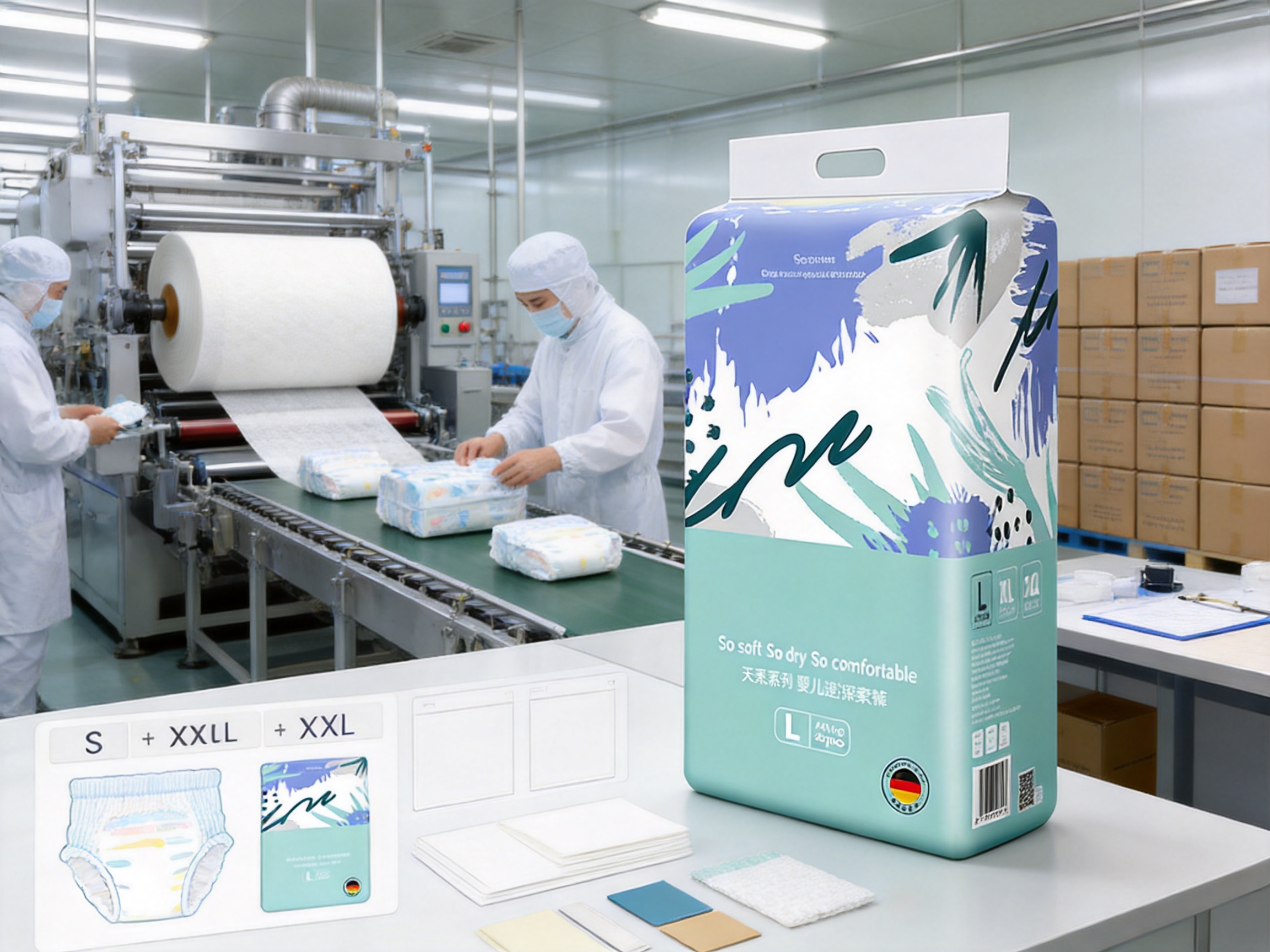
Baby pull-up pants are designed to make everyday diaper changes easier while giving infants the freedom to move, crawl, stand, and explore. Unlike traditional taped diapers, pull-up pants have a pant-like structure with an elastic waistband and flexible leg openings. This design allows caregivers to pull the product on quickly and remove it by tearing the side seams when necessary. For active babies, this can make a significant difference during changing routines.
Modern baby pants must do more than provide basic absorbency. Parents and caregivers expect reliable leakage protection, a dry surface, comfortable materials, secure fitting, soft elastic components, and convenient handling. Retailers, importers, baby-care brands, and distributors also require stable quality, consistent specifications, packaging flexibility, and dependable large-scale supply. A successful baby pants product must therefore combine thoughtful product engineering with disciplined manufacturing and quality control.
The baby pants introduced in this article are developed for daily infant care and are suitable for B2B purchasing programs, private-label projects, and long-term supply cooperation. The product combines an absorbent core, a clothlike back sheet, embossed topsheet technology, elastic waist and leg components, a wetness indicator, and leakage-control structures. Available sizes range from S to XXL, allowing buyers to create product lines for different stages of infant growth.
With more than three decades of experience in nonwoven materials, nursing products, and hygiene manufacturing, Zhejiang Uniquality Nursing Products Technology Co., Ltd. provides product development, OEM, ODM, packaging customization, and finished-product manufacturing services. The company operates within the Kingsafe and Uniquality industrial system, supported by multiple production bases, professional equipment, and an established supply chain for hygiene products.
Understanding the Design of Baby Pull-Up Pants
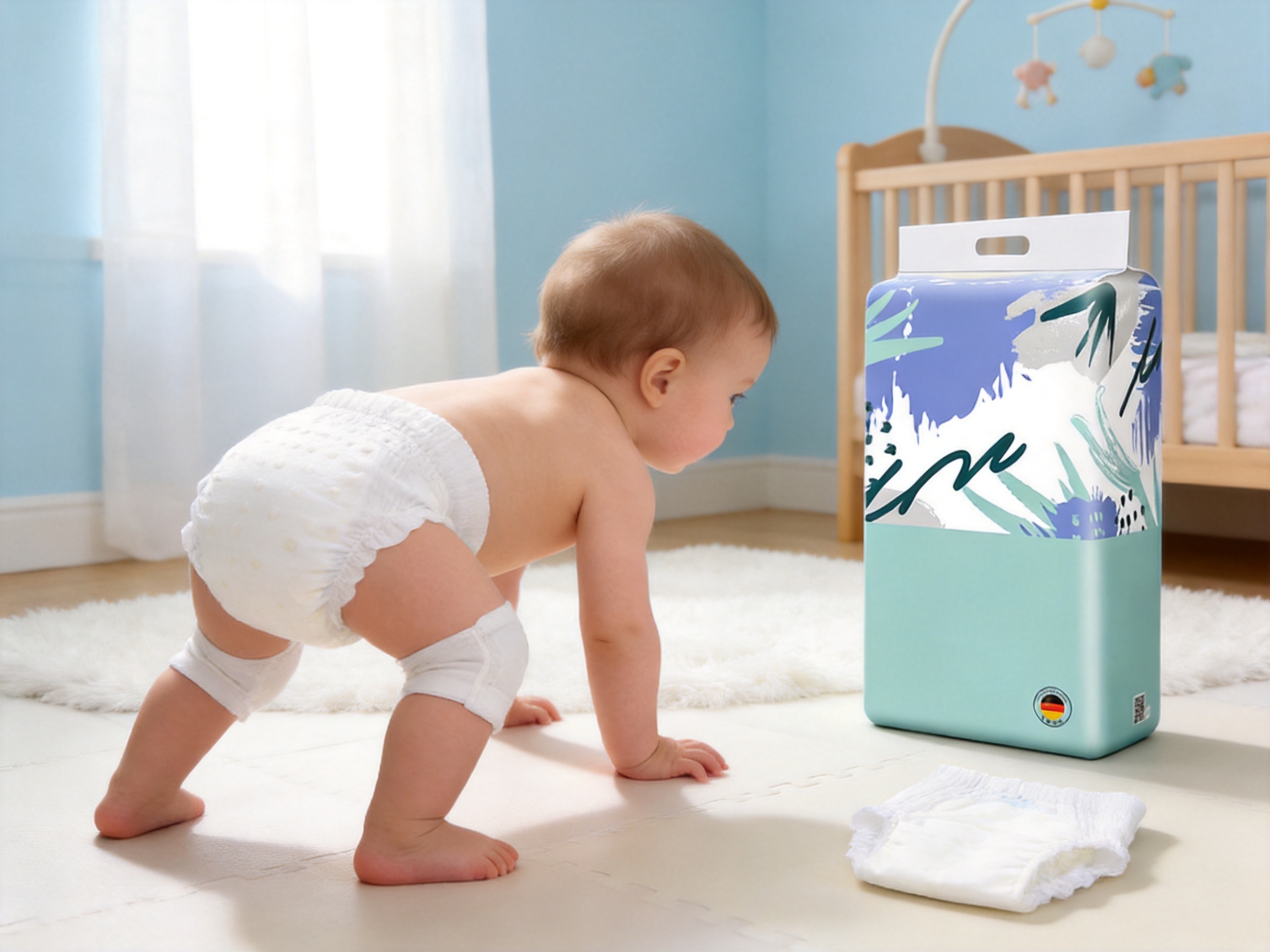
Baby pull-up pants are absorbent disposable hygiene products shaped similarly to underwear. They are intended for babies who are becoming more active, including infants who are beginning to roll over, sit independently, crawl, pull themselves up, or walk. At these stages, a conventional diaper change may become difficult because the child may turn, crawl away, or resist lying still.
The pull-up format addresses this challenge through a 360-degree elastic waistband. Caregivers can pull the pants up from the legs and adjust them around the baby’s waist without positioning multiple fastening tabs. When the product needs to be removed, the side seams can be torn open, allowing the caregiver to take it off efficiently whether the baby is standing or lying down.
This structure also supports a more natural fit during movement. Babies can crawl, sit, stand, and walk without the rigid feeling that may occur when a diaper is fastened too tightly or positioned incorrectly. Properly designed leg cuffs and elastic components help keep the product close to the body while allowing sufficient flexibility around the waist, hips, and thighs.
For B2B buyers, the pull-up structure provides an opportunity to build a product range around convenience and mobility. Brands can offer different sizes, absorbency levels, packaging formats, and visual designs according to the needs of their target markets. The same basic platform can be adapted for different retail channels, from premium baby-care programs to value-oriented bulk packs.
Key Product Advantages
Easy to Put On and Take Off
The most recognizable advantage of baby pull-up pants is their ease of use. Traditional taped diapers require the caregiver to position the baby correctly, open the product, place the child on top of it, and fasten the waist tabs evenly. This process can be challenging when the baby is moving continuously.
Pull-up pants simplify the process. The caregiver places the baby’s legs through the openings and pulls the product upward. The elastic waistband helps the pants return to their intended shape and remain in position. There is no need to align multiple waist stickers, and the product can be applied while the baby is standing, sitting, or lying down.
Removal is equally convenient. When the pants are wet or soiled, the side seams can be torn open by hand. The product can then be removed without pulling it down over the baby’s legs. This is particularly helpful when changing a child after a bowel movement or when the baby is wearing clothing that makes conventional removal less convenient.
For parents, easier changes can reduce interruption to play and rest. For childcare centers, hospitals, and family-care environments, the design can help caregivers complete more changes in a limited period. For brands and distributors, convenience is a clear product benefit that can be communicated easily on packaging and in sales materials.
Superior Dryness and Absorption
A baby’s skin is sensitive to prolonged moisture exposure. An effective diaper must draw liquid away from the surface and distribute it through the absorbent core. The baby pants use a specialized absorption core designed to take in urine and help maintain a drier contact area.
The absorbent system can include high-performance superabsorbent polymer and carefully selected cellulose pulp. The supplied product information identifies Sumitomo and BASF SAP together with Domtar pulp as available core-material sources. These materials are selected for their ability to support liquid absorption, retention, and distribution within the core structure.
Absorbency is not determined by one material alone. Product performance also depends on the amount and placement of absorbent material, the acquisition and distribution layer, the density of the core, the topsheet, the back sheet, and the way each layer is bonded. A balanced structure allows liquid to move away from the skin and reduces the risk of localized saturation.
The product also includes an ADL, or acquisition and distribution layer. This layer helps receive liquid rapidly and distribute it across a wider area before it reaches the main absorbent core. By supporting faster acquisition and more even distribution, the ADL can contribute to improved dryness and help reduce the possibility of leakage caused by liquid concentration in one area.
Comfortable and Close-Fitting Construction
Comfort is essential because babies may wear a diaper for extended periods during the day or night. A product that is too loose may leak, while one that is too tight may cause pressure marks or restrict movement. Baby pull-up pants therefore require a carefully balanced fit around the waist and legs.
The product uses an elastic and super-soft waistband intended to follow the baby’s body without creating unnecessary pressure. The waist component helps the pants remain in position as the child changes posture. It also supports ease of movement during crawling, walking, and active play.
Leg cuffs are another important part of the fit. The leak guard and leg cuff structure creates a closer barrier around the thighs. Properly designed cuffs can help contain liquid and reduce the chance of leakage through the leg openings while still allowing flexibility.
The outer construction is supported by a clothlike back sheet. Compared with a hard or noisy outer layer, a clothlike surface can provide a softer hand feel and improve the overall wearing experience. It also contributes to the product’s underwear-like appearance, which is one of the defining characteristics of pull-up pants.
Leak Guard and Leg Cuff Protection
Leakage is one of the most important concerns for parents and purchasing organizations. A high-quality pull-up pant must protect not only the front and rear areas but also the sides and leg openings. Leakage can occur when the baby changes position, when the product becomes heavily loaded, or when the fit is not appropriate for the child’s body shape.
The product incorporates leak guards and leg cuffs to provide additional containment. These components work with the absorbent core, back sheet, and elastic system. The cuffs help maintain contact with the thighs, while the internal barriers help direct liquid toward the absorbent area rather than allowing it to move directly toward the edges.
Performance depends on selecting the correct size. A product that is too small may create excessive tension, while a product that is too large may leave gaps around the legs. For this reason, a complete size range from S through XXL is valuable for both consumers and B2B buyers. It allows distributors to offer a more precise fit as the child grows.
Wetness Indicator for Easier Monitoring
The wetness indicator provides a visual reference that helps caregivers determine when a diaper may need to be changed. This feature is particularly useful for newborns, sleeping infants, and caregivers who want to check the product without fully removing clothing.
A clear indicator can improve changing efficiency and help prevent unnecessary changes when the product remains dry. It may also support better care routines by reminding caregivers to inspect the diaper after extended wear or feeding periods. For brands, a wetness indicator is a practical feature that strengthens the product’s value proposition.
Embossed Dots Topsheet
The topsheet is the layer that comes into closest contact with the baby’s skin. It must be soft, comfortable, and capable of transferring liquid quickly into the layers beneath it. The embossed dots topsheet adds a distinctive surface pattern while supporting the product’s comfort and liquid-management design.
Embossing can influence the surface feel and contact pattern between the topsheet and the skin. A well-designed embossed surface can help reduce the amount of flat surface directly touching the skin and may contribute to a more comfortable wearing experience. The topsheet must also be processed carefully so that embossing does not compromise liquid transfer or create rough edges.
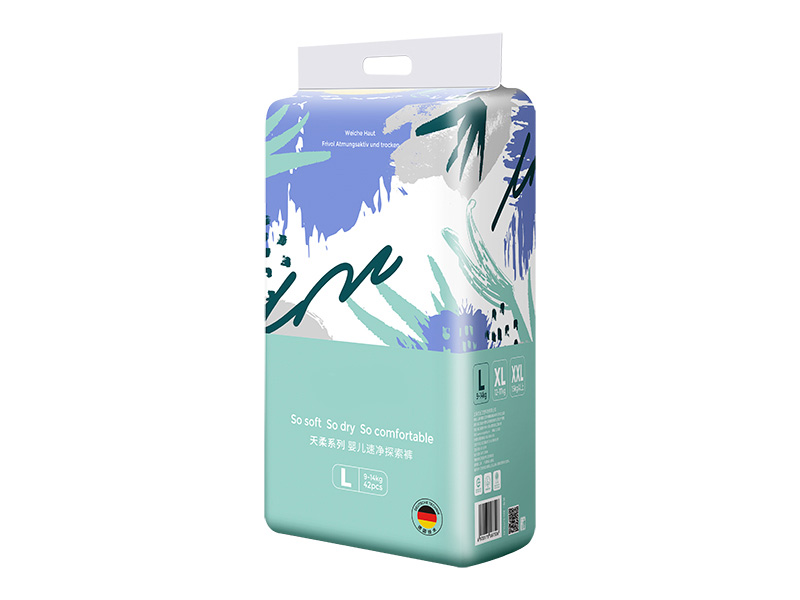
For private-label programs, the topsheet and outer appearance can be considered together. Buyers may choose different visual patterns, colors, or printed designs according to brand positioning, market preferences, and age-specific product lines.
Baby Pants
Product Structure and Functional Materials
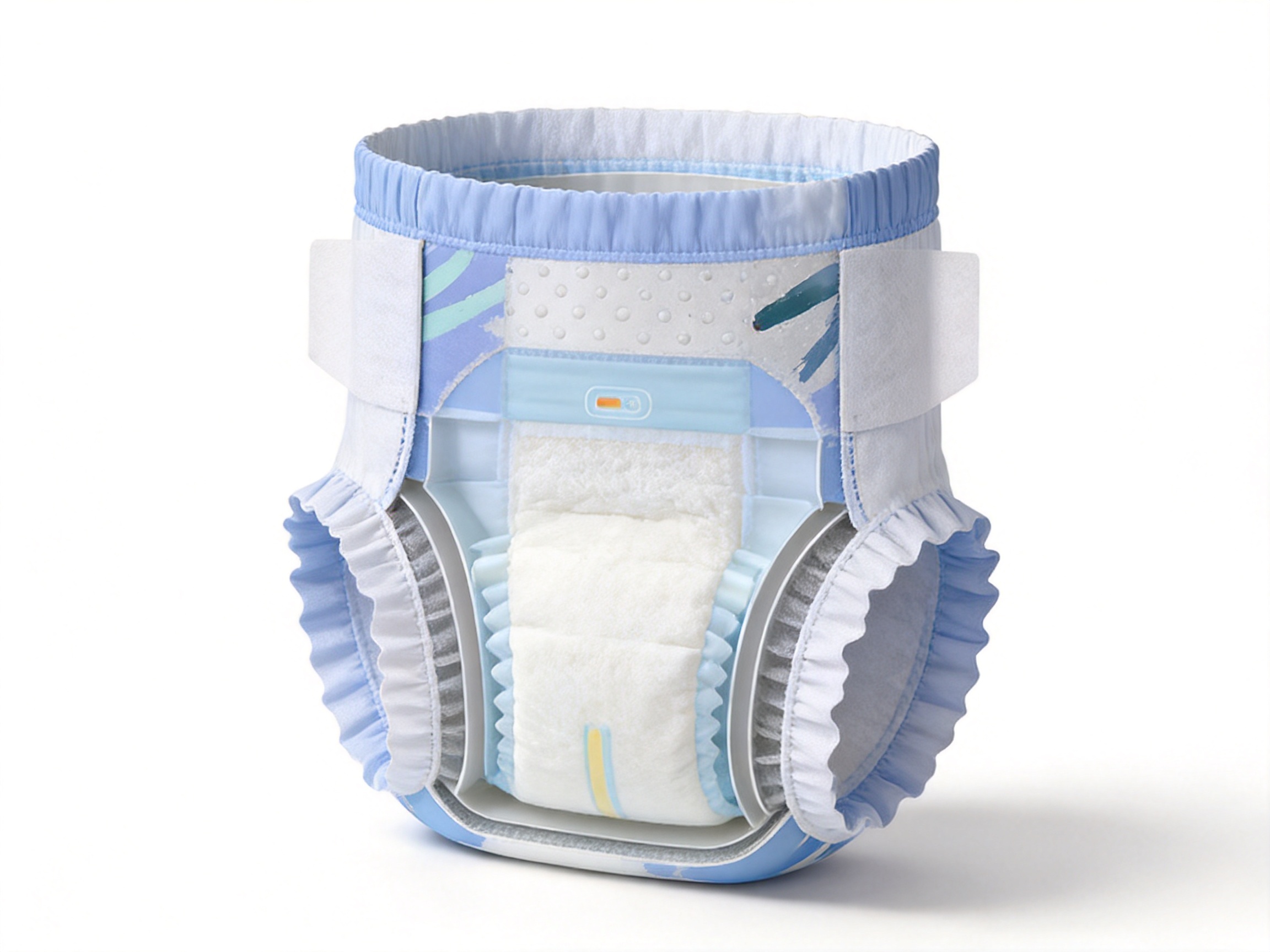
A disposable baby pant is a multilayer product. Each layer has a specific purpose, and the final performance depends on how those layers work together. A typical structure may include a topsheet, acquisition and distribution layer, absorbent core, leak-control components, back sheet, elastic materials, and bonding systems.
| Product Component | Primary Function | Customer Benefit |
|---|---|---|
| Embossed dots topsheet | Provides a soft contact surface and transfers liquid to lower layers | Supports skin comfort and rapid liquid passage |
| ADL | Receives and distributes liquid across the absorbent core | Helps improve acquisition and reduce localized saturation |
| SAP and pulp absorbent core | Absorbs and retains urine | Supports dryness and extended wearing performance |
| Leak guard and leg cuffs | Creates additional containment around the legs | Helps reduce side leakage during movement |
| Clothlike back sheet | Forms the outer layer and helps prevent liquid transmission | Provides a soft, underwear-like exterior |
| Elastic waistband | Maintains fit around the waist | Improves comfort, stability, and ease of application |
| Wetness indicator | Provides a visual signal of moisture | Helps caregivers decide when a change may be needed |
The topsheet, ADL, and absorbent core must be compatible. If liquid is not transferred quickly from the topsheet, the surface may feel wet even when the core has remaining capacity. If the ADL does not distribute liquid effectively, saturation may remain concentrated in one location. If the core is not formed consistently, the product may perform differently from one unit to another.
The back sheet must provide an appropriate balance between liquid protection, softness, breathability, and production stability. The clothlike back sheet used in the product supports a softer external feel and can make the pants more comfortable against clothing and the baby’s body.
Elastic components must also be selected and applied carefully. Too much tension can cause discomfort and pressure marks. Too little tension may create gaps and reduce leakage protection. Manufacturing control is therefore essential to maintain consistent elastic placement, elongation, and bonding strength.
Advantages Compared with Conventional Taped Diapers
Improved Convenience During Active Stages
Taped diapers are useful for newborns and younger babies who remain relatively still during changing. As the child becomes mobile, however, fastening multiple tabs may take longer. Pull-up pants are designed for this later stage, when the child’s activity level makes conventional changing more difficult.
The pant-style shape allows a caregiver to complete a change with fewer positioning steps. This can be especially useful in homes with more than one child, childcare facilities, travel settings, and retail product programs focused on toddlers or active infants.
More Flexible Fit
The 360-degree waistband gives pull-up pants a continuous elastic fit instead of relying primarily on separate fastening tabs. This helps distribute pressure more evenly around the waist. The product can flex as the baby changes position, reducing the likelihood that a single fastening point will become loose or misaligned.
The flexible structure also supports the transition from diapers to underwear. Children may find the pull-up design more familiar and easier to manage as they begin to participate in dressing and toileting routines.
Less Disruption to Play
Diaper changes can interrupt a child’s activity and create frustration for both the caregiver and the baby. Because pull-up pants can be applied and removed quickly, they may reduce the time required for each change. This allows the child to return to crawling, walking, and exploration sooner.
For brands, this benefit is commercially meaningful. Product messaging can focus on mobility, independence, comfort, and everyday convenience rather than absorbency alone. A well-positioned pull-up pant can therefore appeal to consumers who are looking for a complete care solution for active babies.
Manufacturing Capabilities and Industrial Strengths
Long-Term Experience in Hygiene and Nonwoven Products
Zhejiang Uniquality Nursing Products Technology Co., Ltd. was founded in 1987 and has developed extensive experience in medical and hygienic nonwoven materials, nursing products, and related textile applications. This background is important because baby pants depend heavily on nonwoven technology. Topsheets, back sheets, acquisition layers, cuffs, and other components must be engineered for softness, liquid handling, flexibility, and manufacturing stability.
The company’s broader industrial system includes research and development, production, and sales of nonwoven materials and nursing products. This vertical experience can support closer coordination between raw-material development and finished-product manufacturing. Rather than treating the diaper as an isolated assembly, the manufacturer can evaluate how materials interact across the complete structure.
According to the supplied company information, Kingsafe and Uniquality have established multiple production bases in China, including facilities associated with Zhejiang, Guangdong, Jiangsu, and Hubei. A multi-base structure can support production capacity, regional coordination, supply continuity, and the ability to serve different customer programs.
Advanced International Production Equipment
The company has introduced production equipment and technology from Germany, France, and Italy. International equipment can provide advantages in process precision, automation, material handling, component placement, and production efficiency. In baby pants manufacturing, accurate equipment operation is essential because a small deviation in core placement, elastic tension, or seal alignment may influence comfort and leakage performance.
Automated production lines can help standardize high-volume operations. These may include material unwinding, core forming, component assembly, elastic application, cutting, shaping, inspection, counting, and packing. Automation does not eliminate the need for skilled personnel; instead, it allows trained teams to monitor process performance and intervene when deviations occur.
Modern production equipment also supports repeatability. B2B customers need the same product specifications to be maintained across multiple shipments. Consistent equipment settings, documented procedures, and systematic inspection help reduce variation between production batches.
GMP-Standard Production Environments
Baby hygiene products require clean and controlled manufacturing conditions. The company’s supplied information states that its production environments follow GMP standards. A controlled environment supports hygiene management through personnel procedures, material handling, equipment cleaning, production zoning, and documented sanitation practices.
GMP-oriented production is especially valuable for international customers because it provides a structured framework for manufacturing discipline. Buyers can review process documentation, quality procedures, testing records, and production controls as part of their supplier evaluation.
Clean manufacturing is not limited to the final inspection. It begins with the receipt and storage of raw materials and continues through line preparation, component feeding, assembly, packing, warehousing, and shipment. Each stage must be managed to protect product integrity and reduce the risk of contamination or mix-ups.
Comprehensive Quality Testing
Quality testing for baby pants should cover both materials and finished products. Raw materials may be checked for physical properties, appearance, weight, width, softness, absorbency-related performance, and compliance with agreed specifications. In-process controls may monitor core position, product dimensions, elastic placement, bonding, cutting, and packaging accuracy.
Finished-product inspections can include appearance checks, size measurements, weight verification, absorbency evaluation, rewet assessment, leakage testing, waistband and leg-cuff performance, seal strength, and package inspection. The precise testing plan can be adjusted according to customer requirements and target-market regulations.
A comprehensive quality system gives B2B buyers greater confidence in long-term procurement. It also creates traceability. If a deviation is identified, production records and inspection data can help the manufacturer investigate the cause and implement corrective action.
OEM and ODM Customization Services
Many baby-care brands do not want to purchase a generic product. They need a diaper that reflects their brand positioning, price range, market requirements, and consumer expectations. The company supports OEM and ODM services from product design through finished-product manufacturing.
Product Size and Size Combinations
Baby pants can be developed in S, M, L, XL, and XXL or other size systems requested by the customer. Size specifications may vary by region, so buyers should confirm waist range, weight guidance, leg opening measurements, product length, and fit expectations before mass production.
Customers may also select different size combinations for retail packs or wholesale cartons. For example, a brand may require separate packs for each size, mixed-size trial cartons, or age-stage bundles. Packaging and carton quantities can be planned around the target distribution channel.
Absorbent Core Structure
The absorbent core can be adjusted according to the required performance and target cost. Possible considerations include core dimensions, SAP-to-pulp ratio, acquisition layer configuration, absorbency level, distribution design, and product thickness. A daytime product may use a different balance from a product intended for extended overnight wear.
Any core adjustment should be evaluated through laboratory testing and practical performance assessment. Absorbency must be considered together with rewet, leakage, fit, and comfort. Increasing absorbent material alone does not automatically create a better product if the core becomes excessively bulky or does not distribute liquid effectively.
Outer Nonwoven and Elastic Components
Customers may choose outer nonwoven materials, surface textures, softness levels, colors, and printing effects according to their brand concept. The elastic waistband design may also be adjusted for different fit preferences. Softness, rebound, elongation, and bonding strength should be assessed together so that the finished product remains comfortable and stable.
Appearance and Packaging Design
Packaging is an important part of a baby-care product’s commercial performance. The company can support individual packaging, multipack formats, outer carton packaging, and private-label presentation. Buyers may provide their own artwork or request support with product layout and packaging development.
Packaging customization may include brand graphics, size information, usage instructions, feature icons, language versions, barcode placement, carton marks, and regulatory information. The final design should be reviewed carefully to ensure that all claims, symbols, and instructions are appropriate for the target market.
Supply Chain and B2B Cooperation
Baby diaper brands, importers, wholesalers, retail suppliers, and cross-border maternal-and-infant product operators often need more than a single shipment. They need a supplier capable of supporting product development, repeat production, quality consistency, packaging coordination, and delivery planning.
The company’s complete industrial chain capability extends from nonwoven material research and development to finished-product manufacturing. This can simplify communication for customers who are developing a new product line. Instead of coordinating multiple unrelated suppliers for the topsheet, back sheet, absorbent core, and finished assembly, buyers can work with one manufacturing partner for a broader range of requirements.
Long-term supply cooperation also benefits from standardized specifications. Once a product is approved, the supplier and buyer can establish technical files covering materials, dimensions, tolerances, artwork, packing methods, inspection standards, and shipment procedures. This documentation helps protect consistency when future orders are placed.
Large-scale production capability is particularly important for retailers and brand owners. A product launch may require coordinated inventory across several regions. If a supplier cannot maintain capacity, stock shortages may damage the brand’s relationship with distributors and consumers. A manufacturer with multiple production resources and established operational experience may be better positioned to support planned growth.
Global delivery also requires attention to export packaging, carton strength, container loading, labeling, documentation, and lead-time planning. These practical details are part of a successful B2B hygiene-product program and should be discussed before order confirmation.
Applications and Target Customers
Baby Diaper Brand Owners
Brand owners can use the product as the foundation for a private-label baby pants line. The product may be positioned around comfort, mobility, dryness, easy changes, or premium material selection. OEM and ODM services allow the brand to control product specifications and visual identity.
Importers and Wholesalers
Importers and wholesalers may require stable product supply for regional distribution. They can select sizes, packaging formats, carton quantities, and product specifications according to local demand. A broad size range helps them serve more retailers and age groups.
Retail and Supermarket Suppliers
Retail and supermarket suppliers need products that are easy to merchandise, clearly labeled, reliably packed, and suitable for repeat replenishment. Customized packaging can help align the product with a retailer’s category strategy while standardized manufacturing supports consistent shelf availability.
Cross-Border Maternal-and-Infant Operators
Cross-border sellers often need a manufacturing partner that can support artwork preparation, multilingual packaging, product customization, and export coordination. The product can be adapted for different online and offline sales channels, subject to the specifications and regulatory requirements of the destination market.
The product is intended primarily for mass production, customized development, and supply chain cooperation. It is not designed as a small-batch consumer purchase service for individuals or families. Customers seeking only a small trial quantity should discuss minimum order quantities and sampling arrangements before proceeding.
How the Product Supports Infant Mobility
Infant development involves continuous physical change. A baby may move from rolling to sitting, then crawling, standing, and walking within a relatively short period. Each stage changes the practical requirements of diaper care.
When the baby is lying still, a taped diaper can be simple to apply. Once the child begins to turn or crawl, the caregiver may need to hold the baby in position while fastening the diaper. Pull-up pants are designed for this more active stage. Their pant-like construction allows the product to be pulled upward quickly and adjusted through its elastic fit.
Freedom of movement is supported by the combination of soft materials, flexible side areas, elastic waist construction, and close-fitting leg cuffs. The product should remain secure without creating unnecessary bulk around the hips or thighs. This is useful during crawling, walking, play, travel, and everyday household activities.
It is important to avoid unsupported medical claims. Baby pants are hygiene products intended to improve convenience, comfort, and leakage protection. They should be selected according to the child’s size and changed regularly. Product performance can vary according to fit, usage conditions, body shape, activity level, and the amount of liquid involved.
Quality Considerations for Buyers
B2B buyers should evaluate several areas before approving a baby pants supplier. Product appearance is important, but it should not be the only consideration. A complete evaluation should include raw-material consistency, absorbency, rewet, leakage protection, softness, fit, packaging, quality documentation, and production capacity.
Sampling should be conducted using agreed specifications. Buyers may compare the product against their current supplier or against benchmark products in the target market. Tests should be performed under repeatable conditions, and results should be documented rather than judged only by visual inspection.
Fit evaluation is especially important. The same nominal size may feel different depending on the waistband, leg cuff, core thickness, side panel elasticity, and product shape. Trial users or professional evaluators can help identify issues such as gapping, excessive tightness, slipping, bunching, or difficulty during application.
Packaging quality should also be reviewed. Individual packages must be sealed correctly, printed information must match the product inside, and outer cartons must withstand handling during transportation. Carton dimensions and weight should be suitable for warehouse storage and container loading.
Regulatory requirements differ by destination market. Buyers should identify applicable standards for hygiene products, chemical restrictions, labeling, packaging, and product claims. The manufacturer can then work with the buyer to provide suitable documents and adjust materials or packaging where necessary.
Production Process from Materials to Finished Goods
Material Preparation
Production begins with the inspection and preparation of raw materials. Nonwoven rolls, absorbent pulp, SAP, elastic components, film, adhesives, packaging materials, and other components are checked against approved specifications. Materials should be stored under appropriate environmental conditions and identified clearly to prevent mixing.
Core Formation
The absorbent core is formed by combining cellulose pulp and superabsorbent material according to the approved design. The distribution of materials must remain consistent across the product width and length. Core shape, density, and position influence liquid acquisition, retention, comfort, and leakage performance.
Layer Assembly
The topsheet, ADL, absorbent core, back sheet, leak guards, and elastic elements are assembled in a controlled sequence. Adhesive application and component alignment must be managed carefully. If the adhesive is insufficient, layers may separate; if excessive, the product may become stiff or uncomfortable.
Elastic Application and Shaping
Waistband and leg elastics are applied with controlled tension. The product is then shaped and cut into the pull-up format. Precise cutting helps maintain consistent dimensions and reduces variation between units. The side seams must be secure during use but capable of being torn open by hand when the product is removed.
Inspection and Packing
Finished products pass through appearance and quality inspections. Defective units may be removed through manual or automated inspection systems, depending on the production line. Accepted products are counted, folded or arranged, packed, sealed, and placed into outer cartons according to customer requirements.
Production records, inspection results, batch information, and packing data support traceability. This information is valuable for both the manufacturer and the customer in the event of a quality review or future product improvement project.
Environmental and Material Development Considerations
Nonwoven technology continues to develop in response to consumer expectations, manufacturing efficiency, and environmental considerations. Product developers may evaluate material weight, production waste, packaging efficiency, and the use of flushable or degradable nonwoven technologies in appropriate product categories.
For baby pants, safety and reliable performance must remain the primary requirements. Any change in material composition should be assessed for softness, strength, liquid handling, skin-contact suitability, odor, and production stability. Environmental objectives should be pursued through controlled development rather than by changing materials without performance validation.
Material development can also support thinner and more efficient product structures. A well-designed absorbent core may provide reliable performance with reduced bulk, helping improve comfort and packaging efficiency. However, the final structure must be tested under realistic use conditions before commercial approval.
The company’s experience in medical, maternal-and-infant, beauty, home-care, and industrial-cleaning nonwoven products provides a broader technical foundation for material evaluation. Knowledge gained across different hygiene applications may support innovation in softness, web formation, bonding, barrier performance, and converting processes.
Why Manufacturing Experience Matters to Product Performance
Baby pants may appear simple from the outside, but they involve a complex combination of materials and processes. A product can fail if the absorbent core is uneven, if the elastic tension is inconsistent, if the leg cuff is poorly bonded, if the back sheet is damaged, or if the package is not sealed correctly.
Manufacturing experience helps identify the relationship between these details. For example, changing the core thickness may require adjustments to the waistband or leg opening. Changing the back sheet may affect softness, breathability, bonding, and machine speed. Changing the elastic component may require new tension settings and fit testing.
A supplier with experience across materials and finished products can evaluate these interactions more effectively. The company’s history in nonwoven and nursing-product manufacturing supports a product-development approach that considers the complete system rather than one isolated feature.
Advanced equipment is also valuable because it allows production settings to be controlled more precisely. However, equipment must be supported by trained operators, maintenance systems, quality procedures, and documented production standards. The combination of technology and operational discipline is what enables repeatable product quality.
Private-Label Development Workflow
A typical private-label project begins with a discussion of the target market, consumer profile, product positioning, expected order volume, size range, and packaging requirements. The buyer may provide a technical specification or request a recommended starting structure.
The manufacturer then evaluates available materials and proposes a product configuration. Samples are produced for review. The buyer may assess fit, softness, absorbency, leakage protection, wetness indication, appearance, and packaging. Adjustments can be made before the final specification is confirmed.
Once the product structure is approved, packaging artwork is prepared or reviewed. The buyer should confirm the product name, size information, usage instructions, warning statements, material descriptions, barcode, carton marks, and any market-specific information.
A pre-production sample or approval sample may be completed before mass production. During production, the finished goods are manufactured according to the confirmed technical file. Quality inspections are performed at appropriate stages, and shipment preparation follows the agreed packing plan.
After delivery, customer feedback can be used to improve later orders. Adjustments may include changing the size ratio, modifying the packaging quantity, improving the fit, revising the absorbent core, or developing a premium or economy version for another channel.
Q&A About Baby Pull-Up Pants
Q1: What are baby pull-up pants?
Baby pull-up pants are disposable absorbent diapers shaped like underwear. They feature an elastic waistband and flexible leg openings, allowing caregivers to pull them on easily. The side seams can be torn open for removal.
Q2: Which babies are suitable for pull-up pants?
They are especially suitable for active babies who are beginning to roll, sit, crawl, stand, or walk. They may also be used by caregivers who prefer a pant-style product for easier changes.
Q3: What sizes are available?
The product range covers sizes S through XXL. Exact dimensions, recommended weight ranges, and size combinations can be confirmed during product development according to the buyer’s target market.
Q4: What materials support absorbency?
The absorbent system can use superabsorbent polymer and cellulose pulp, with Sumitomo and BASF SAP and Domtar pulp identified as available material sources in the supplied product information. The final material combination depends on the approved product specification.
Q5: Does the product include a wetness indicator?
Yes. The product information includes a wetness indicator designed to help caregivers monitor moisture and decide when a change may be appropriate.
Q6: How does the product help reduce leakage?
Leakage protection is supported by the absorbent core, ADL, leak guards, leg cuffs, back sheet, and elastic fit. Correct sizing is also important because excessive looseness or tightness may affect performance.
Q7: Can the baby pants be customized?
Yes. OEM and ODM customization can include product size, size combinations, absorbent core structure, outer nonwoven material, waistband design, appearance, individual packaging, and outer carton packaging.
Q8: Can packaging be produced under a customer’s private label?
Yes. Customers can provide artwork or work with the manufacturer on packaging development. Packaging format, language, carton markings, and pack quantities should be agreed before production.
Q9: Which customers can purchase this product?
The product is intended for baby diaper brand owners, maternal-and-infant product importers, wholesalers, retail suppliers, supermarket channels, and cross-border baby-care operators seeking mass production or customized supply.
Q10: Is the product suitable for individual small-batch purchases?
The service is primarily designed for B2B procurement, OEM, ODM, and long-term supply cooperation. Individual consumers and customers seeking only a small trial quantity should confirm availability and minimum order requirements in advance.
Q11: How is product quality controlled?
Quality control can cover raw materials, production processes, finished-product appearance, dimensions, absorbency, leakage performance, elastic components, packaging, and shipment preparation. The company also has professional testing capabilities and a structured quality-management approach.
Q12: Can the product be adapted for overseas markets?
Yes. Specifications, packaging, labeling, and certification documentation can be reviewed according to the regulations and commercial requirements of the destination market. Buyers should provide target-market requirements as early as possible.
Q13: Does the company support long-term supply cooperation?
Yes. The company has large-scale manufacturing resources, multiple production bases, and experience serving domestic and international customers. Long-term programs can be planned around approved specifications, forecast volumes, production schedules, and delivery requirements.
Q14: What should buyers provide when requesting a quotation?
Buyers should provide the target sizes, estimated order volume, absorbency expectations, packaging format, private-label requirements, destination market, delivery terms, and any required testing or certification documents. More detailed information enables a more accurate quotation and development plan.
Conclusion
Baby pull-up pants provide a practical solution for active infants and the caregivers who look after them. Their pant-like design makes them easier to apply and remove, while the elastic waistband and flexible leg cuffs support comfort and stability during movement. The absorbent core, ADL, clothlike back sheet, embossed dots topsheet, leak guards, and wetness indicator work together to support dryness, convenience, and everyday protection.
For B2B buyers, product quality must be supported by manufacturing capability. Zhejiang Uniquality Nursing Products Technology Co., Ltd. brings long-term experience in nonwoven materials, nursing products, and hygiene manufacturing. Its industrial resources include multiple production bases, international production equipment, GMP-standard production environments, quality testing capabilities, OEM and ODM development, and supply chain support for global customers.
The product can be customized in size, absorbent structure, materials, elastic design, appearance, and packaging. This flexibility allows baby-care brands, importers, wholesalers, and retail suppliers to develop products that match local market requirements. By combining functional product engineering with reliable manufacturing processes, the company can support customers from initial concept and sampling through mass production and delivery.
For organizations seeking a stable partner for private-label baby pants, the most important next steps are to define the target market, confirm the technical specification, evaluate samples, review packaging requirements, and establish a quality and supply plan. With these elements in place, baby pull-up pants can become a dependable part of a broader infant-care product portfolio.
References
1. Product specification and feature information supplied for the baby pull-up pants product, including materials, construction, size range, and customization options.
2. Company information supplied by Zhejiang Uniquality Nursing Products Technology Co., Ltd. regarding its history, production bases, nonwoven-material capabilities, product categories, and international manufacturing equipment.
3. General principles of disposable absorbent hygiene-product construction, including topsheet, acquisition and distribution layer, absorbent core, back sheet, elastic components, and leakage-control systems.
4. General good manufacturing practice principles for hygiene-product production, including raw-material control, process management, sanitation, inspection, traceability, and finished-product release.
5. General product-development principles for OEM and ODM baby-care products, including specification confirmation, sample evaluation, packaging development, quality documentation, and long-term supply planning.