中文简体
 English
 日本語
 русский
 Español
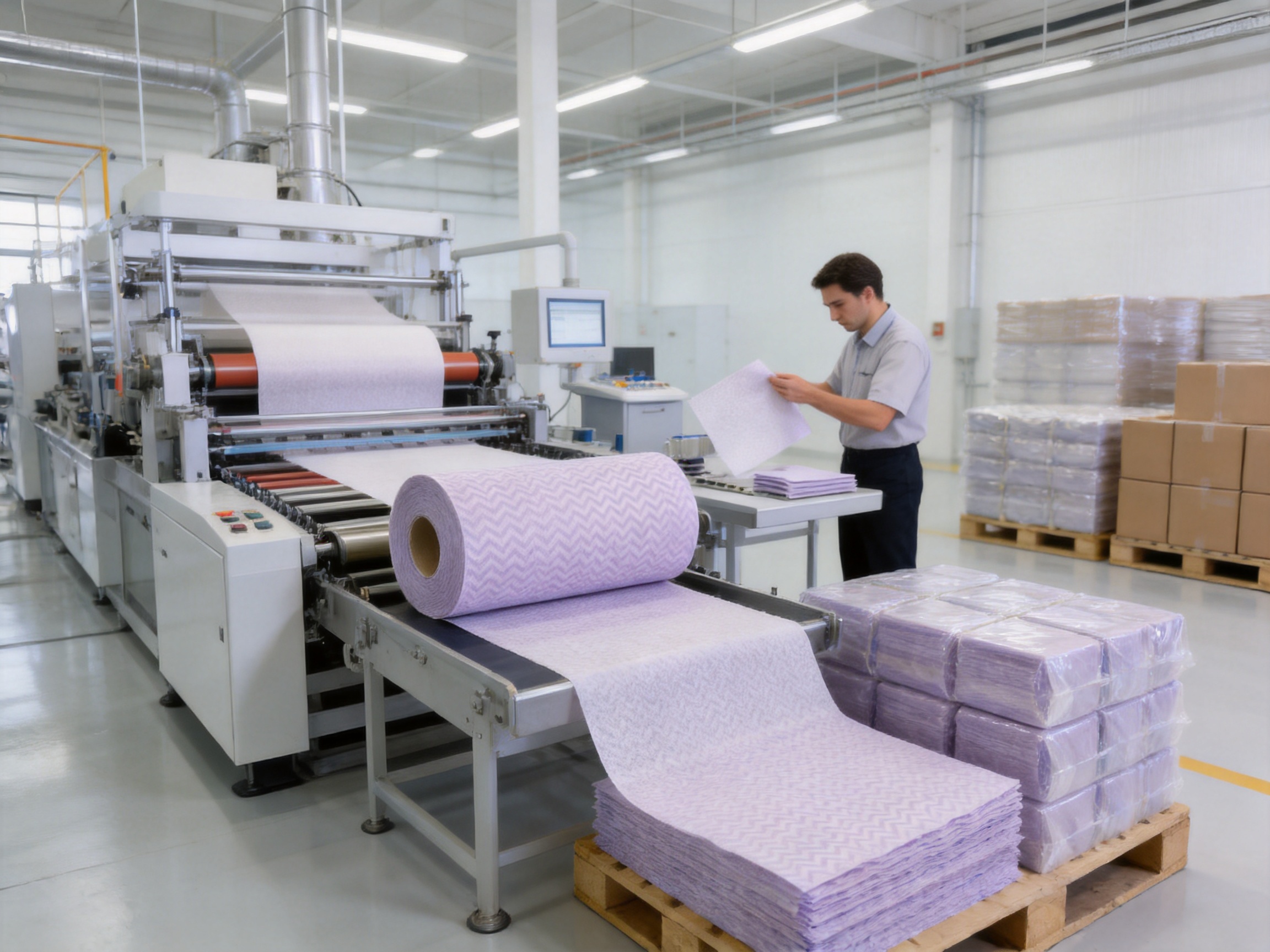
Industrial cleaning environments demand more than an ordinary household wipe. Factories, workshops, maintenance facilities, warehouses, garages, laboratories, and service areas frequently deal with oil, grease, water, dust, metal particles, chemical residues, and other contaminants. In these conditions, a cleaning cloth must absorb quickly, resist tearing, release minimal lint, and remain practical during repeated use. The Industrial Cleansing Nonwoven Cloth is designed to meet these demanding requirements through a combination of thickened nonwoven construction, strong liquid absorption, durable handling, and efficient packaging.
Unlike many lightweight disposable wipes that are intended mainly for simple dusting or occasional household tasks, this product is developed for professional and industrial applications. Its material structure provides a useful balance between softness, strength, absorbency, and surface durability. It can be used for wiping machinery, removing oil from tools, cleaning workbenches, maintaining production equipment, and preparing surfaces before inspection, repair, or assembly.
As industrial operators increasingly seek efficient, consistent, and cost-conscious cleaning solutions, the quality of the wiping material has become an important part of workplace productivity. A poor-quality cloth may tear during use, leave fibers behind, require several sheets to complete one task, or spread oil across a surface instead of removing it. A well-engineered nonwoven cloth reduces these problems and supports a cleaner, more organized, and more efficient working environment.
What Is Industrial Cleansing Nonwoven Cloth?
Industrial cleansing nonwoven cloth is a disposable or semi-disposable wiping material manufactured from engineered nonwoven fibers rather than traditional woven yarn structures. The fibers are bonded and processed into a uniform sheet that can be converted into wipes, rolls, folded packs, or other formats suitable for professional cleaning.
The product described here uses thickened, durable nonwoven fabric. This construction is especially valuable in industrial environments because it provides a stronger body than thin tissue-like materials while maintaining enough flexibility to follow curved surfaces, edges, tools, and equipment components. The cloth can be folded for detailed cleaning or opened fully for larger surface areas.
The material is designed to offer strong oil and water absorption. This means it can support both wet and dry cleaning tasks, including the removal of oil films, water droplets, light grease, dust, and general workplace residues. Its lint-free and pill-resistant properties are also important. When a cloth breaks down and releases fibers, the fibers may remain on machinery, finished products, optical components, or painted surfaces. By minimizing lint and pilling, the nonwoven cloth helps improve the cleanliness and appearance of the cleaned area.
The product is particularly suitable for areas where cleaning performance must be combined with convenience. Simple and practical packaging makes it easy to store, distribute, and use at workstations. Employees can take only the quantity they need, helping reduce unnecessary material consumption and keeping unused cloth protected from dust and contamination.
Why Industrial Cleaning Requires Specialized Wiping Materials
Industrial contamination is often more complex than ordinary household dirt. A single surface may contain a mixture of lubricating oil, metal dust, coolant, moisture, fingerprints, adhesive residues, and fine particles. These substances may be difficult to remove with a standard paper towel or low-strength wipe.
Paper towels can absorb liquids quickly, but they may tear when exposed to heavy rubbing or rough surfaces. They may also leave paper fragments behind. Conventional woven rags can be durable, but they may have inconsistent thickness, uneven absorbency, loose threads, or uncertain cleanliness depending on their source. Low-grade disposable wipes may be economical at first, but their limited strength can increase the number of sheets required for each task.
Professional users therefore need a wiping material with several properties at the same time. It should absorb oil and water without becoming unusable immediately. It should withstand friction against metal, plastic, rubber, glass, and painted surfaces. It should retain its shape while being folded, squeezed, or pulled across a work area. It should create minimal lint and should not form small pills that can interfere with finishing or inspection work.
Industrial Cleansing Nonwoven Cloth is designed around these practical requirements. Its thickened construction provides a more substantial wiping surface, while the nonwoven production method supports uniformity across the sheet. The result is a cloth that can help operators complete cleaning work with fewer interruptions and more predictable results.
Core Product Advantages
Thickened Construction for Demanding Work
A thickened cloth offers more material volume between the user’s hand and the surface being cleaned. This is useful when removing grease, wiping machinery edges, or working over rough metal components. A thicker structure is less likely to collapse immediately when it encounters resistance, allowing the user to apply practical pressure during cleaning.
The thickness also contributes to handling comfort. A thin sheet may become saturated or folded into a small ball after only a few passes. A thicker nonwoven cloth can remain easier to control, making it suitable for both broad wiping and detailed maintenance work. Operators can fold it into multiple layers when additional absorbency or protection is needed.
Strong Oil Absorption
Oil and grease are among the most common contaminants in workshops, mechanical production areas, automotive service facilities, and equipment rooms. Effective oil absorption helps prevent the spreading of contamination across a larger surface. Instead of pushing oil from one location to another, the cloth can collect it within its fiber structure.
Strong oil absorption is also valuable for maintenance procedures. Before a technician examines a component, applies a lubricant, installs a replacement part, or performs a repair, the surface may need to be cleaned. Removing excess oil and residue improves visibility and supports more accurate inspection. It can also help reduce the risk of slippery tools, contaminated parts, and untidy workstations.
Strong Water Absorption
Water absorption provides flexibility for facilities that encounter both liquid spills and oil-based contamination. The cloth can be used for wiping condensation, cleaning water-based residues, drying tools, and removing moisture from work surfaces. In mixed-contamination situations, its ability to handle water and oil helps reduce the need to switch immediately between different wiping materials.
Water absorption is also important during routine equipment care. After washing or using a water-based cleaning solution, the cloth can help remove remaining moisture. Drying the surface promptly may support a cleaner finish and help reduce the chance of water marks or unwanted moisture accumulation.
Lint-Free Performance
Lint can create serious inconvenience in professional cleaning. Loose fibers may attach to polished metal, painted panels, glass, electronic housings, tools, and finished products. In certain production environments, lint may even become a source of visual defects or contamination.
The lint-free characteristic of this nonwoven cloth helps reduce the release of loose fibers during normal wiping. This makes it more suitable for applications where surface appearance and cleanliness matter. It is especially beneficial for maintenance personnel who need to clean before inspection, packaging, assembly, coating, or quality control.
Pill Resistance
Pilling occurs when fibers gather into small balls on the surface of a textile or wiping material. These pills can detach during use, leaving unwanted particles behind. They can also make a cloth feel rough or reduce the consistency of its cleaning surface.
A pill-resistant structure supports a more stable wiping experience. The cloth is less likely to deteriorate quickly as it moves across a surface, which is important when cleaning repeated areas or working on components with edges and textured finishes. Pill resistance also complements the low-lint design by helping maintain a cleaner work area after wiping.
Durability During Repeated Wiping
Industrial cleaning often involves friction, pressure, folding, and contact with uneven surfaces. The cloth must therefore provide sufficient tensile strength and tear resistance for practical use. Durability allows an operator to complete a task without changing the wipe after every short movement.
Although the exact service life depends on the contamination level and application, a durable nonwoven cloth can help improve material utilization. Users may be able to clean a larger area with one sheet than they could with a thin or weak alternative. This can support more efficient consumption and reduce interruptions during maintenance operations.
Practical Packaging
Packaging affects how easily a cleaning product can be used in a real workplace. Simple packaging enables convenient storage, quick access, and easy distribution to different departments. It can be placed near workstations, maintenance carts, equipment rooms, production lines, or cleaning cabinets.
Practical packaging can also contribute to inventory management. Standardized packs make it easier for supervisors to estimate usage, organize replenishment, and keep cleaning supplies available where they are needed. When the cloth is protected inside suitable packaging, unused material is less exposed to dust, moisture, or accidental contamination.
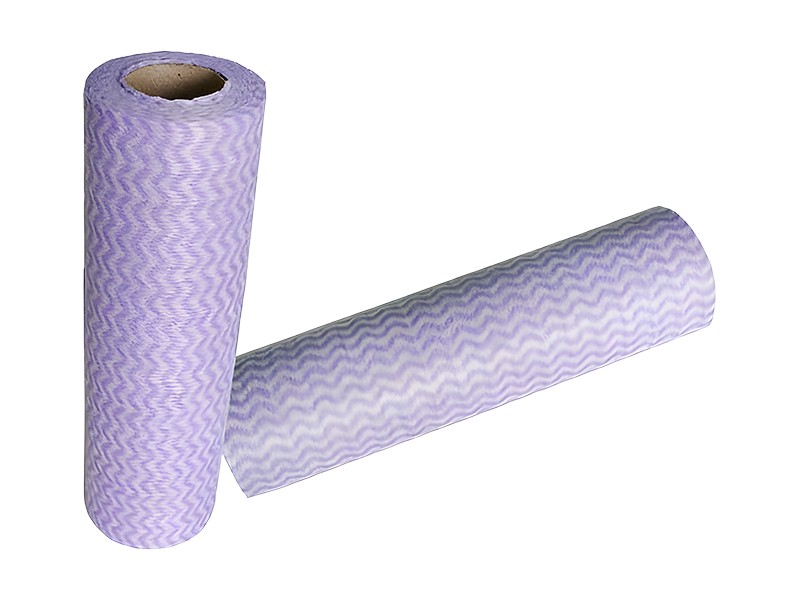
Industrial Cleansing Nonwoven Cloth
Comparison with Common Industrial Cleaning Alternatives
Industrial users often compare nonwoven cloth with paper towels, cotton rags, microfiber products, and low-cost disposable wipes. Each option may have a suitable application, but the performance priorities are different. The following comparison explains why a thickened industrial nonwoven cloth is a competitive choice for general-purpose factory and workshop cleaning.
| Cleaning Material | Typical Strength | Common Limitation | Position of Industrial Nonwoven Cloth |
|---|---|---|---|
| Paper towel | Fast initial liquid absorption and convenient disposal | May tear, shed paper fibers, or lose strength when saturated | Offers a more durable wiping structure for heavier cleaning tasks |
| Reusable cotton rag | Can be strong and familiar to maintenance workers | May vary in cleanliness, thickness, color, and fiber release | Provides more consistent material quality and practical disposable handling |
| Low-grade disposable wipe | Low purchase price and broad availability | May have limited absorbency, weak tear resistance, or higher lint | Combines absorbency, durability, lint control, and pill resistance |
| Microfiber cloth | Fine surface cleaning and dust capture | May require laundering and careful contamination control | Provides a convenient alternative where disposable or simple-use cleaning is preferred |
| Industrial nonwoven cloth | Balanced absorption, strength, low lint, and easy handling | Selection must match the contamination and disposal requirements | Suitable for broad industrial maintenance and routine cleaning applications |
The principal advantage of Industrial Cleansing Nonwoven Cloth is balance. Some products perform strongly in one area but compromise another. A paper towel may absorb water quickly but fail under friction. A reusable rag may be durable but inconsistent. A fine microfiber cloth may clean delicate surfaces effectively but require a laundering system. The nonwoven cloth provides a practical middle ground for users who need dependable absorption and strength without complicated handling.
For many factories and workshops, consistency is as important as peak performance. Every sheet should provide a predictable experience so that operators do not need to inspect each cloth before use. Uniform nonwoven production helps support this consistency by controlling the material structure across the product.
Advanced Manufacturing Strengths
Expertise in Nonwoven Materials
Zhejiang Uniquality Nursing Products Technology Co., Ltd., operating together with the Kingsafe and Uniquality manufacturing organization, has specialized in medical and hygienic nonwoven materials, nursing products, and high-end clothing interlining for more than three decades. Founded in 1987, the company has developed extensive experience in material development, production management, product conversion, and customer-oriented customization.
This background is directly relevant to industrial cleansing cloth production. Nonwoven materials are used across medical, personal care, household, industrial, and technical applications. Each field requires careful attention to fiber selection, web formation, bonding, softness, strength, absorbency, cleanliness, and converting performance. Experience across multiple categories helps the manufacturer understand how different material properties affect end-use performance.
International Production Equipment and Technology
The company has introduced advanced production equipment and technology from Germany, France, and Italy. Access to international equipment and process expertise supports the development of stable, high-quality nonwoven materials. Modern production systems can help control web uniformity, basis weight, thickness, bonding, winding, cutting, folding, and packaging.
For an industrial wiping product, these controls are significant. An uneven sheet may have weak areas that tear unexpectedly. Inconsistent thickness may affect absorbency and handling. Poor cutting may create rough edges or irregular dimensions. Controlled production helps ensure that the cloth performs more consistently from pack to pack.
Advanced equipment is also important for scalable manufacturing. Industrial customers may require regular supply, multiple specifications, private-label packaging, or customized formats. A manufacturer with established production resources is better positioned to support volume orders while maintaining an organized quality system.
Multiple Production Bases
The company has established eight production bases in China, including facilities in Changxing, Foshan, Nantong, and Wuhan. A multi-base manufacturing structure can provide broader production capacity and operational flexibility. It may also support different product categories, regional coordination, and improved resource allocation.
For customers purchasing industrial cleaning materials, supply reliability is a practical consideration. A supplier must be able to manage production schedules, raw material planning, quality control, packing requirements, and delivery coordination. A larger manufacturing network provides a foundation for handling these responsibilities in a more systematic manner.
Cross-Category Product Development
The company’s product portfolio includes spunlace nonwoven fabrics, spunmelt nonwoven fabrics, hot-air-through nonwoven fabrics, flushable and degradable nonwoven fabrics, wet wipes, dry wipes, baby diapers, pull-ups, wet toilet paper, and cleansing wipes. This broad product experience supports technical learning across different nonwoven structures and converting processes.
Industrial Cleansing Nonwoven Cloth benefits from this broader perspective because wiping performance depends on more than one characteristic. Absorption, softness, strength, lint control, surface texture, folding, and packaging all interact. Knowledge gained from medical, personal care, and household products can contribute to better process control and more refined product development for industrial cleaning.
Research, Development, and Customization
Industrial customers do not always need a single standard specification. One facility may require a heavy-duty cloth for oil removal, while another may prefer a softer wipe for painted surfaces or a larger format for equipment maintenance. Some customers may need private-label packaging, specific folding arrangements, or a particular quantity per pack.
The manufacturer’s research and development capability supports differentiated and customized product solutions. Customization may involve material weight, thickness, sheet size, folding style, packaging, labeling, and application positioning. The appropriate specification should be determined according to the customer’s cleaning process, contamination type, equipment, disposal system, and target cost.
How the Manufacturing Process Supports Product Performance
Fiber and Material Selection
The first stage of a high-quality nonwoven product is the selection of suitable fibers and raw materials. The fiber composition influences absorbency, softness, tensile strength, thermal behavior, surface feel, and resistance to linting. For industrial cleansing applications, the material must be selected with both liquid handling and mechanical durability in mind.
A well-designed material structure avoids relying on a single property. Excessive softness without strength may result in tearing. Excessive stiffness may make the cloth uncomfortable or difficult to fold. The objective is a balanced structure that can absorb contaminants while retaining enough integrity for wiping.
Web Formation
Nonwoven manufacturing begins by forming a web of fibers. The distribution of fibers across the web affects thickness, density, strength, and absorbency. Uniform web formation helps create a cloth with predictable performance throughout the sheet.
For industrial wipes, uniformity is particularly useful because operators often use the entire surface of a sheet. If one area is dense and another is weak, absorbency and tear resistance may vary during the same task. Controlled web formation helps reduce this inconsistency.
Bonding and Strength Development
The fibers must be bonded into a stable material. Depending on the nonwoven technology, bonding may involve mechanical, thermal, chemical, or combined methods. The bonding approach influences the cloth’s tensile strength, flexibility, surface stability, and resistance to pilling.
For a thickened industrial cloth, the bonding system must provide sufficient strength without making the material excessively rigid. The finished product should remain flexible enough to wrap around tools and equipment parts while resisting breakdown during rubbing and pulling.
Thickness and Basis Weight Control
Thickness contributes to absorbency, cushioning, handling, and perceived quality. Basis weight provides another important measure of material quantity per area. During production, controlling these characteristics helps ensure that the cloth meets its intended performance profile.
A thickened design can offer greater liquid-holding capacity and improved hand protection compared with a very light sheet. However, the thickness must remain practical for folding, packaging, transport, and storage. Effective manufacturing balances product performance with operational convenience.
Converting, Cutting, and Folding
After the nonwoven material is produced, it is converted into a usable cloth format. Cutting equipment determines sheet dimensions and edge quality. Folding systems influence how easily the user can remove a sheet and how much surface area is available at the start of a task.
Accurate converting helps the product fit its packaging and supports consistent usage. Clean edges and regular dimensions are also important for professional presentation, especially when the product is supplied under a private label or used in a quality-sensitive industrial setting.
Packaging and Final Inspection
Packaging is the final stage that protects the product and makes it ready for distribution. It should preserve cleanliness, support convenient storage, and allow users to access the cloth efficiently. Final inspection may include visual checks, dimensional checks, packaging verification, and evaluation of overall production consistency.
Although specific quality-control procedures depend on the product specification and customer requirements, a systematic inspection approach helps identify defects before shipment. This supports more reliable use at the customer’s facility and helps maintain confidence in long-term supply.
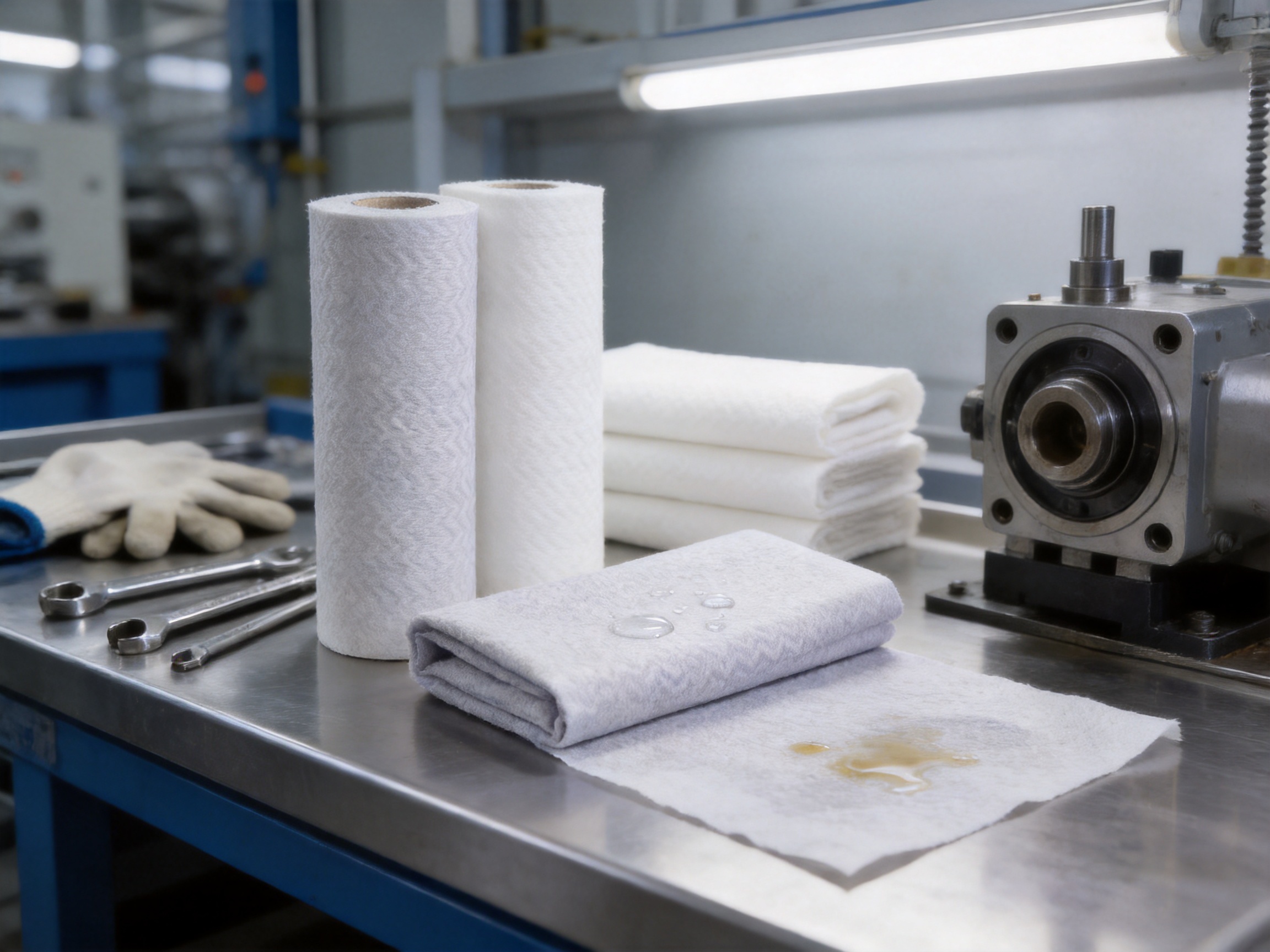
Applications in Factories and Workshops
Machinery and Equipment Maintenance
Industrial Cleansing Nonwoven Cloth can be used to wipe machine housings, control panels, guards, handles, rollers, tool surfaces, and maintenance components. Regular wiping removes oil films, dust, and general residue that accumulate during production.
Keeping equipment surfaces clean can make leaks easier to identify and help maintenance personnel observe abnormal buildup. A clean surface may also improve the appearance of machinery and contribute to a more orderly workplace.
Automotive and Mechanical Service
Automotive workshops and mechanical service centers regularly handle engine oil, transmission fluid, grease, coolant, and dirt. A strong, absorbent cloth is useful for cleaning tools, wiping components, drying hands, and managing small spills around work areas.
The cloth can also be used during parts inspection. Removing excess lubricant or dirt helps technicians examine surfaces, threads, seals, and contact points more clearly. Its low-lint and pill-resistant characteristics are useful when loose fibers could interfere with assembly or finishing.
Metal Fabrication and Engineering Workshops
Metalworking environments may generate cutting fluid, fine dust, polishing residue, and oily fingerprints. The cloth can help clean worktables, measuring tools, fixtures, and fabricated parts. Its durability makes it suitable for contact with many metal surfaces, including areas with mild texture or sharp transitions.
When wiping around sharp edges, users should apply appropriate caution and select a wiping method that protects both the operator and the material. Product performance is always influenced by the shape of the surface and the severity of the application.
Production Lines and Assembly Areas
Assembly operators may need to remove dust, fingerprints, oil spots, or handling residues before a component moves to the next stage. A low-lint wiping cloth supports this work by helping maintain cleaner surfaces without introducing unnecessary fibers.
The cloth may be placed at workstations, inspection points, tool stations, or material preparation areas. Simple packaging makes it practical to distribute the product throughout a production facility rather than keeping all cleaning materials in a central storeroom.
Warehouses and Logistics Facilities
Warehouses encounter dust, packaging debris, moisture, and occasional oil or grease from forklifts and handling equipment. Industrial cleansing cloth can be used for cleaning carts, shelving surfaces, equipment handles, worktables, and spill areas.
Its compact packaging and easy storage make it suitable for maintenance cabinets, cleaning stations, and mobile service carts. A consistent supply of wipes can help warehouse staff respond quickly to minor contamination before it spreads.
Facility and Building Maintenance
Building maintenance teams often work with pumps, generators, air-conditioning equipment, electrical cabinets, plumbing components, and hand tools. These tasks may involve water, lubricants, dust, sealants, and general dirt. The cloth’s combination of absorption and durability makes it useful for routine cleaning and service preparation.
Operational Benefits for Professional Users
Improved Cleaning Efficiency
A cloth that absorbs effectively and remains intact during use can reduce the time required for routine wiping. Operators spend less time searching for replacement materials and may complete more tasks with fewer sheets. This is particularly valuable in facilities where cleaning occurs repeatedly throughout each shift.
Improved efficiency does not mean that one cloth should be used indefinitely. The material should be replaced when it becomes saturated, heavily contaminated, damaged, or unsuitable for the next task. The advantage is that each sheet can perform more effectively within its appropriate service period.
Reduced Lint-Related Rework
Loose fibers can create additional cleaning steps. If lint remains on a component, the operator may need to wipe the same area again with another material. Low-lint performance helps reduce this possibility and supports cleaner preparation before inspection or assembly.
In environments where appearance and surface cleanliness are closely monitored, reducing lint can also help support product presentation and lower the risk of avoidable surface defects.
More Consistent Workplace Standards
Standardizing the wiping material across departments can help establish clearer cleaning procedures. Employees can be instructed on which cloth to use for equipment, tools, surfaces, and spill response. Consistent materials make training simpler and help supervisors evaluate whether the available product matches the task.
Standardization may also improve purchasing and inventory management. Instead of managing many inconsistent cloth types, a facility may use one dependable industrial cloth for a wide range of general-purpose applications while reserving specialized products for exceptional requirements.
Convenient Storage and Distribution
Practical packaging supports point-of-use availability. When wipes are located close to the equipment or workstation, employees are more likely to address contamination promptly. This reduces the risk that oil, dust, or moisture will remain on a surface for an extended period.
Packaging should be selected according to the facility’s workflow. High-use areas may require larger packs, while smaller workstations may benefit from compact packs that occupy less space. Private-label packaging can also help customers align the product with internal procurement systems or brand standards.
Private Label and OEM/ODM Potential
The company’s experience in OEM and ODM production provides opportunities for distributors, importers, industrial supply companies, and established brands seeking customized cleaning products. Private-label development can include product naming, packaging artwork, pack count, folding format, sheet dimensions, and market positioning.
Customers may choose to market the cloth for automotive service, machinery maintenance, factory cleaning, general workshop use, or professional janitorial supply. The same core product can be presented for different application segments when the packaging, instructions, and commercial positioning are adapted appropriately.
A successful private-label program requires more than a printed package. The product specification, material consistency, packaging protection, order quantity, production schedule, and quality expectations should be agreed upon before production. Clear communication allows the manufacturer to recommend a suitable construction and avoid a mismatch between marketing claims and actual use.
OEM and ODM cooperation may also support product differentiation. Customers can request changes to thickness, absorbency, dimensions, folding, or packaging, subject to technical feasibility and order requirements. A manufacturer with nonwoven research capability is better positioned to evaluate these requests and develop a practical solution.
Quality and Selection Considerations
Match the Cloth to the Contaminant
Before selecting a wiping cloth, users should identify the main contaminant. Oil-heavy applications may require maximum oil absorption and strong surface durability. Water-based cleaning may place greater emphasis on rapid liquid pickup and drying performance. Dust-sensitive work may prioritize low lint and pill resistance.
When a surface contains chemicals, solvents, aggressive cleaners, or high-temperature residues, compatibility should be evaluated separately. The Industrial Cleansing Nonwoven Cloth is designed for general industrial cleaning, but every chemical and process condition should be assessed according to the manufacturer’s instructions and the facility’s safety procedures.
Consider Surface Sensitivity
Most factory and workshop surfaces can tolerate a durable wiping cloth, but delicate coatings, optical components, precision instruments, and sensitive electronic parts may require a specialized material. Users should confirm that the cloth is suitable for the surface and cleaning agent before applying it broadly.
A small-area test can help evaluate surface interaction, lint behavior, absorbency, and visual results. This is a practical step when introducing a new wiping material into a quality-controlled process.
Determine the Required Format
Sheet size, fold type, thickness, and pack quantity influence the way the cloth is used. Large sheets are practical for broad surfaces and heavy contamination. Smaller sheets may be more convenient for tools, handles, and parts. Folded formats can improve dispensing and allow users to expose a clean section during a task.
The best format depends on the workflow, the average cleaning area, the number of operators, and the available storage space. Customized formats can be discussed for large-volume or private-label programs.
Review Disposal Procedures
Used cloths may contain oil, grease, chemicals, metal particles, or other residues. Disposal must follow the facility’s environmental, fire-safety, and occupational-safety procedures. A cloth that has absorbed flammable or hazardous substances should be handled according to the relevant local requirements.
Users should not assume that a nonwoven cloth is suitable for flushing or uncontrolled disposal merely because it is disposable. The material should be discarded through the appropriate waste stream after use.
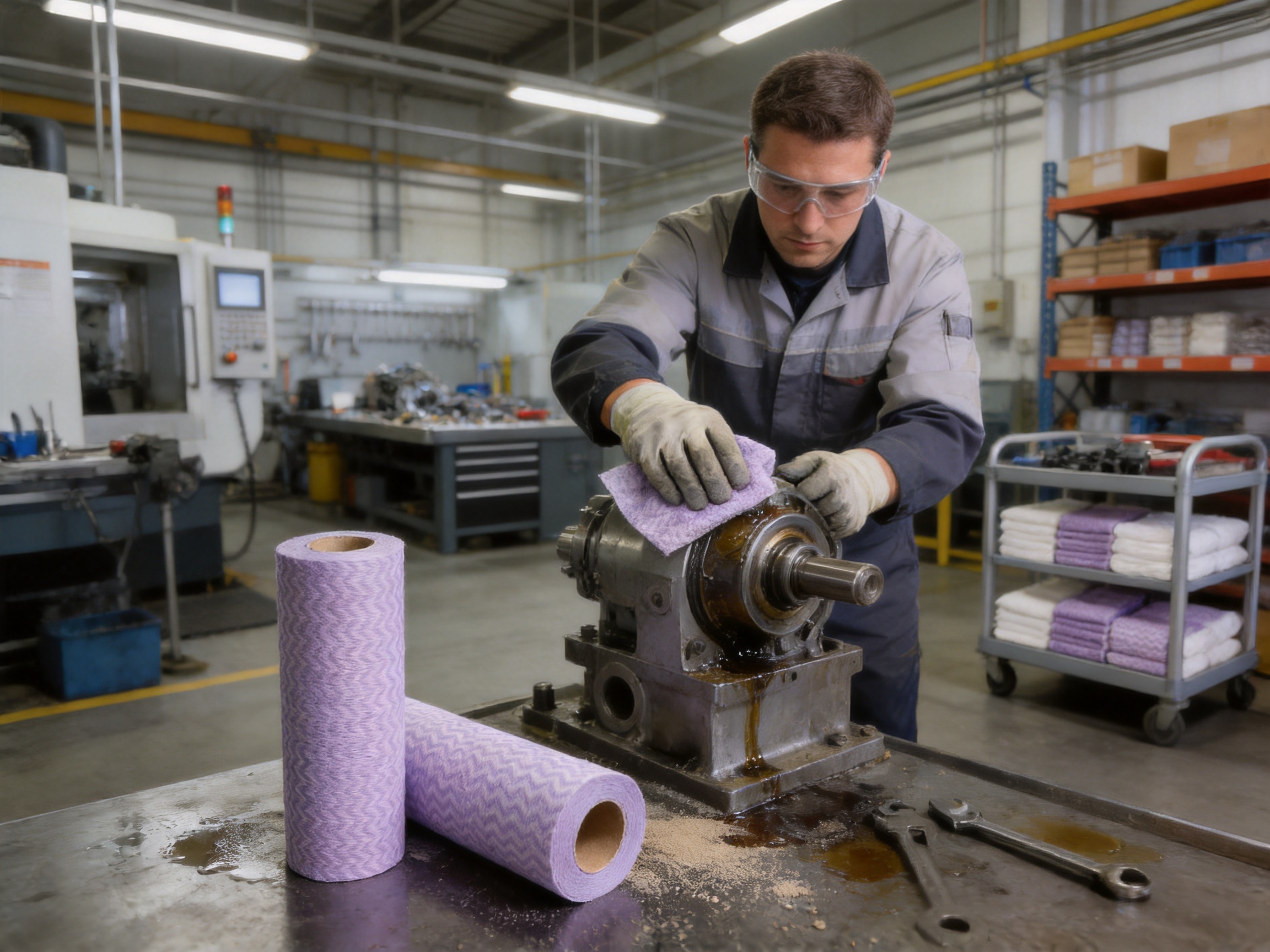
Best Practices for Industrial Use
Store unused cloths in a clean, dry area away from excessive heat, moisture, direct contamination, and incompatible chemicals. Keeping the packaging closed until the product is needed helps maintain cleanliness and protects the remaining sheets.
Use a fresh or clean section of the cloth when moving from a heavily contaminated area to a cleaner surface. Folding the cloth can create several usable faces and help prevent the operator from spreading oil or dirt.
Apply suitable pressure rather than excessive force. The cloth is durable, but sharp edges, burrs, and aggressive mechanical abrasion can damage any wiping material. When cleaning machinery, follow lockout, shutdown, and safety procedures before reaching near moving or energized components.
Replace the cloth when it is saturated, torn, heavily soiled, or no longer absorbing effectively. Continuing to use an overloaded wipe can spread contamination instead of removing it.
For organized facilities, establish clear locations for unused and used materials. Separate clean supplies from waste containers, and train employees to follow the site’s handling and disposal procedures.
Environmental and Resource Considerations
Responsible material use begins with choosing a cloth that matches the task. An excessively small or weak wipe may require multiple sheets, while a suitable durable cloth may complete the work more efficiently. Correct sizing, controlled dispensing, and timely replacement can help avoid unnecessary consumption.
The company’s wider nonwoven portfolio includes flushable and degradable nonwoven materials, but the disposal characteristics of each product depend on its specific construction and intended use. Industrial cleansing cloth should be handled according to its actual product specification and the contamination it has collected.
Facilities can also improve resource management by tracking consumption by department. If one workstation uses significantly more material than others, the cause may be excessive contamination, inefficient wiping technique, unsuitable sheet size, or poor access to disposal containers. Usage data can help identify opportunities for improvement.
Environmental responsibility must be considered together with safety and cleaning effectiveness. A lower-cost material is not necessarily the most sustainable option if it tears quickly, requires several sheets, creates rework, or causes excessive waste. A balanced evaluation should consider performance, consumption, packaging, transport, disposal, and the full cleaning process.
Why Choose an Experienced Manufacturer?
Choosing a manufacturer with long-term nonwoven expertise offers advantages beyond the individual product. An experienced supplier understands how raw materials, equipment settings, bonding methods, converting conditions, and packaging decisions affect final performance.
Long-term manufacturing experience also supports more dependable communication. Customers can discuss application problems, desired improvements, private-label requirements, and order planning with a supplier familiar with nonwoven product development. This is particularly valuable for companies that want to launch a new industrial cleaning line rather than simply purchase an unbranded commodity.
Zhejiang Uniquality Nursing Products Technology Co., Ltd. combines decades of industry experience with broad production capabilities and international equipment resources. Its association with Kingsafe and Uniquality provides access to a wide range of nonwoven products serving medical, maternal and baby, beauty, household, industrial cleaning, clothing, and other sectors.
The company’s position as a high-tech enterprise and its history of serving well-known domestic and international brands demonstrate a foundation for organized research, production, and cooperation. For industrial customers, this can translate into better support for product consistency, customized development, supply coordination, and long-term purchasing relationships.
Q&A: Industrial Cleansing Nonwoven Cloth
What is the main purpose of this cloth?
The main purpose is to provide efficient wiping for factories, workshops, maintenance sites, warehouses, mechanical service areas, and other professional environments. It is intended to absorb oil and water, remove general dirt and residue, and support routine equipment and surface cleaning.
Is it suitable for oil and grease?
Yes. The cloth is designed with strong oil absorption and a durable nonwoven structure, making it suitable for many oil-handling and grease-removal tasks. The exact result depends on the quantity and type of contamination, the surface condition, and the wiping method.
Can it absorb water as well as oil?
Yes. Strong water absorption makes the cloth suitable for drying surfaces, removing water-based residue, wiping condensation, and managing small liquid spills in addition to oil-based cleaning.
Does the cloth leave lint behind?
It is designed to be lint-free and pill-resistant, helping minimize loose fibers and surface pills during normal use. As with any wiping material, extremely rough surfaces, sharp edges, or aggressive abrasion may affect the material.
Is it stronger than a regular paper towel?
Its thickened nonwoven construction is designed to provide greater durability during practical industrial wiping than many ordinary paper towels. It is better suited to rubbing, folding, and handling oily or wet surfaces where a paper towel may tear or lose strength quickly.
Can it replace reusable cotton rags?
It can serve as a convenient alternative for many general-purpose cleaning tasks. Compared with mixed cotton rags, it offers more consistent material structure, predictable packaging, and simpler single-use handling. However, each facility should compare disposal requirements, cleaning procedures, and cost according to its own operation.
Where can it be used?
Typical applications include machinery maintenance, automotive repair, metal fabrication, production-line cleaning, tool wiping, warehouse maintenance, equipment rooms, factory workstations, and general workshop cleaning.
Can the product be customized?
OEM and ODM options may support customization of product specifications, dimensions, folding, pack quantity, packaging, and private-label presentation. Requirements should be discussed with the manufacturer so that the proposed design matches the intended application and production conditions.
How should unused cloths be stored?
Unused cloths should be stored in a clean, dry location and kept in their packaging until needed. They should be protected from dust, moisture, direct contamination, excessive heat, and incompatible chemicals.
How should used cloths be disposed of?
Disposal depends on the substances absorbed by the cloth and the local requirements of the facility. Cloths containing oil, solvents, chemicals, or other hazardous residues should be handled through the appropriate waste-management process. Users should follow workplace safety and environmental procedures.
Can it be used on delicate surfaces?
It may be suitable for some coated, painted, plastic, glass, or finished surfaces, but sensitive applications should be tested first. Users should evaluate the cloth together with any cleaning chemical and confirm that it does not affect the surface finish.
What makes it different from a low-cost disposable wipe?
The product is developed to combine thickened construction, strong oil and water absorption, durability, low-lint performance, and pill resistance. These balanced properties can provide more reliable industrial performance than a wipe selected only for its low purchase price.
Conclusion
Industrial Cleansing Nonwoven Cloth is a practical solution for professional cleaning environments that require more than basic dust removal. Its thickened and durable nonwoven structure supports demanding wiping tasks, while strong oil and water absorption helps manage common industrial contaminants. Lint-free and pill-resistant performance contributes to cleaner surfaces, and practical packaging supports convenient storage and point-of-use access.
The product is suitable for factories, workshops, maintenance departments, automotive service centers, production lines, warehouses, and equipment rooms. Compared with ordinary paper towels, inconsistent rags, and low-grade wipes, it offers a balanced combination of strength, absorbency, cleanliness, and handling convenience.
Behind the product is a manufacturing organization with a history dating back to 1987, extensive nonwoven expertise, international production equipment, multiple production bases, and experience across medical, hygienic, household, personal care, and industrial applications. These capabilities support product consistency, technical development, OEM/ODM cooperation, and private-label opportunities.
For businesses seeking an efficient and dependable wiping material, the most important evaluation is not simply the price per pack. It is the total value created through effective cleaning, reduced interruptions, controlled lint, consistent quality, convenient distribution, and dependable supply. When selected and used correctly, Industrial Cleansing Nonwoven Cloth can become an important part of a professional maintenance and workplace cleaning system.
References
1. Internal product information for Industrial Cleansing Nonwoven Cloth, including material characteristics, application positioning, and packaging concept.
2. Company information concerning the history, production bases, product portfolio, research capabilities, and nonwoven manufacturing experience of Zhejiang Uniquality Nursing Products Technology Co., Ltd.
3. General principles of nonwoven fabric production, including fiber web formation, bonding, thickness control, converting, and packaging.
4. General industrial maintenance practices for oil removal, water absorption, lint control, surface preparation, and workplace cleaning.
5. General occupational safety principles for handling used wiping materials contaminated with oils, chemicals, and industrial residues.