中文简体
 English
 日本語
 русский
 Español
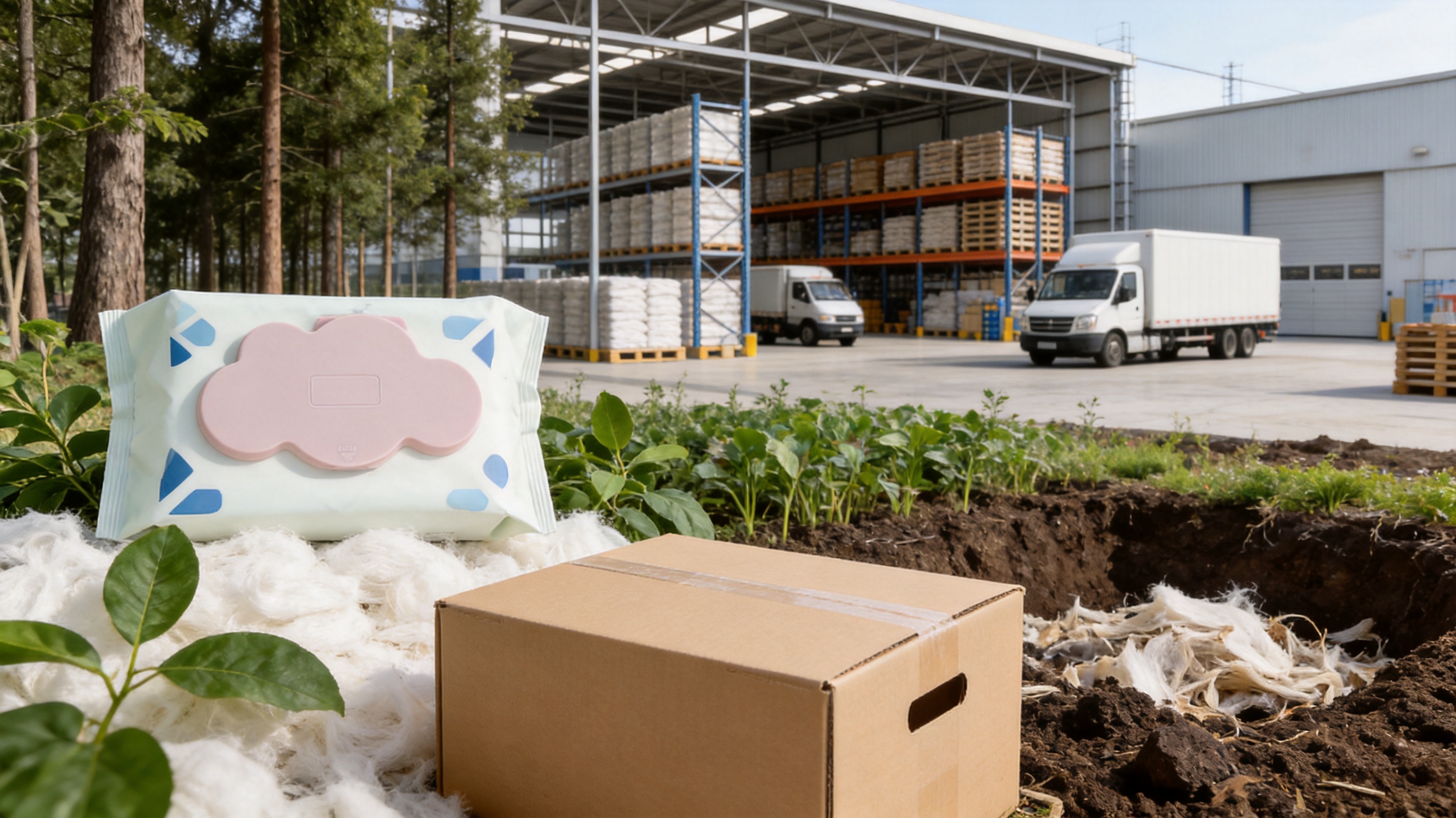
Baby wipes are among the most frequently used disposable hygiene products in homes, hospitals, childcare facilities, travel kits, and retail environments. Because they are used in large quantities, the choice of substrate, lotion formulation, packaging format, and manufacturing process has consequences far beyond individual cleaning performance. Buyers increasingly expect baby wipes to be gentle on delicate skin, reliable during use, convenient to dispense, and compatible with environmental objectives. At the same time, importers, retailers, private-label owners, and institutional procurement teams require stable quality, flexible customization, and dependable production capacity.
Alcohol-free compostable baby wipes made with 100% viscose address these requirements through a combination of plant-derived fiber technology, skin-conscious formulation, and industrial-scale nonwoven manufacturing. The product is designed for cleaning babies’ skin while reducing dependence on conventional petroleum-based synthetic fibers. Its soft structure, moisture-handling capacity, customizable surface patterns, and alcohol-free formulation make it suitable for daily maternal and infant care applications.
This article examines the technical advantages, manufacturing characteristics, customization options, quality considerations, and supply-chain value of alcohol-free compostable baby wipes. It also explains how an experienced manufacturer with a long history in nonwoven materials and nursing products can support private-label customers, distributors, retailers, and professional buyers.
1. Why Baby Wipe Substrate Selection Matters
A baby wipe is more than a piece of wet fabric. It is a carefully engineered hygiene article consisting of a nonwoven substrate, a liquid formulation, a folding and dispensing format, and packaging designed to preserve moisture and cleanliness. Each component affects the final user experience.
The substrate determines softness, tensile strength, absorbency, surface friction, lint behavior, and resistance to tearing. The formulation influences skin comfort, cleaning efficiency, odor, preservation, and compatibility with sensitive skin. Packaging protects the product from contamination and moisture loss. Manufacturing controls ensure that the finished wipes remain consistent from one production batch to the next.
Traditional wipes frequently use polyester, polypropylene, or blended synthetic fibers because these materials can provide strength, durability, and cost efficiency. However, petrochemical-based fibers do not readily biodegrade in ordinary disposal environments. Their persistence has contributed to broader concerns about landfill accumulation and the release of microplastic particles into natural ecosystems.
Viscose offers a different material pathway. It is manufactured from regenerated cellulose, usually originating from plant-based sources. In a properly specified and certified product system, viscose can provide the softness and absorbency expected from a baby wipe while offering improved end-of-life biodegradability compared with conventional synthetic substrates.
The use of 100% viscose is especially relevant for buyers seeking a simpler fiber composition. A single-fiber or predominantly cellulosic construction can make material communication clearer, support sustainability positioning, and reduce dependence on synthetic components. Nevertheless, responsible product claims must always be matched with appropriate testing, certification, packaging review, and disposal guidance.
2. Product Overview
The alcohol-free compostable baby wipes described in this product range use a soft, plant-derived viscose nonwoven substrate. They are intended for gentle cleaning of babies’ hands, face, and body, particularly during diaper changes and everyday care routines. The wipes are designed without ethanol or other harsh alcohol-based solvents in the formulation.
The product can be supplied in a range of piece counts, dimensions, basis weights, surface patterns, and fragrance options. This flexibility allows customers to develop products for different retail channels and usage scenarios. A premium newborn wipe may prioritize extra softness, a travel pack may require a compact format, and a value-oriented family pack may emphasize a higher piece count and efficient packaging.
| Product Feature | Available Specification or Characteristic | Procurement Value |
|---|---|---|
| Primary substrate | 100% viscose compostable nonwoven | Plant-derived fiber composition with soft hand feel and biodegradability potential |
| Optional material range | Polyester, viscose, bamboo, lyocell, cotton, or specified blends | Supports customized performance, cost, and sustainability targets |
| Piece count | 1–200 pieces per pack | Suitable for trial packs, travel packs, retail packs, and family-size formats |
| Basis weight | 30–100 gsm | Allows adjustment of softness, strength, thickness, and liquid retention |
| Manufacturing technology | Parallel and semi-cross lapping | Helps balance machine-direction and cross-direction strength |
| Available surface patterns | Plain, mesh, dot embossed, flower, and star patterns | Offers different tactile properties and cleaning friction |
| Size range | Width 12–22 cm; length 12–30 cm | Supports multiple folding, packaging, and application formats |
| Fragrance options | Unscented, fresh, lavender, lemon, lotus, fruit, coconut, cucumber, and others | Enables market segmentation and private-label product differentiation |
| Formulation direction | Alcohol-free and suitable for sensitive-skin positioning | Supports gentle daily-care communication when validated by testing |
The standard product concept centers on 100% viscose. However, the broader manufacturing platform can accommodate additional fibers and constructions when a customer requires a different balance of strength, cost, absorbency, or tactile performance. This distinction is important for professional procurement: buyers can select a clearly defined 100% viscose specification for compostable positioning or request an alternative material configuration for a particular market requirement.
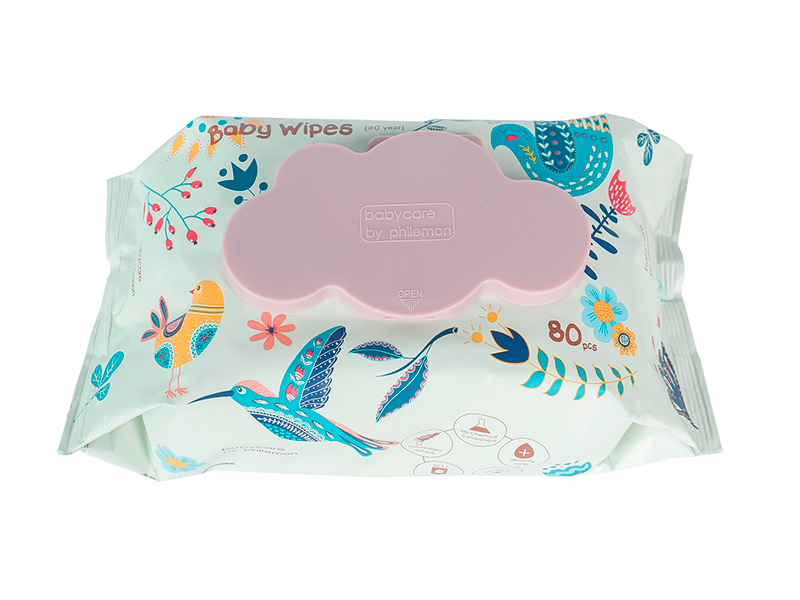
Alcohol free baby wipes compostable
3. The Advantages of 100% Viscose
3.1 Plant-Derived Cellulose Content
Viscose is a regenerated cellulose fiber. Unlike polyester and polypropylene, which are produced from petrochemical feedstocks, viscose originates from cellulose that is dissolved and regenerated into fiber form. This gives the material a plant-based origin and allows it to be used in products designed around renewable-resource objectives.
For baby wipes, the use of viscose provides a combination of softness, absorbency, and flexibility. These attributes are important because infant skin requires gentle contact, while caregivers need a wipe that can pick up moisture and soil without disintegrating during normal use.
Plant-derived content can also simplify the sustainability story of a private-label product. Instead of relying only on packaging reduction or marketing language, a customer can evaluate the fiber composition itself. A product specification based on 100% viscose makes the material choice visible and measurable. Buyers can further request documentation relating to fiber origin, responsible sourcing, biodegradability, compostability, and applicable environmental standards.
3.2 Reduced Dependence on Synthetic Fibers
Synthetic fibers provide useful mechanical properties, but their persistence after disposal is a growing concern. When synthetic fibers enter wastewater systems, landfill environments, or natural areas, they may remain for long periods and can contribute to microplastic pollution. A viscose-based alternative can reduce the synthetic content of a high-consumption hygiene category.
This does not mean that every viscose wipe will automatically compost in every environment. Compostability depends on the entire product system, including the substrate, lotion ingredients, dyes, printing, packaging, processing aids, and disposal conditions. Buyers should therefore distinguish between biodegradability claims, industrial compostability claims, home compostability claims, and general environmental positioning.
For professional customers, the most credible approach is to define the intended claim before product launch. If the product is intended for industrial composting, the manufacturer and customer should identify the relevant standard and arrange testing for the finished wipe rather than relying only on raw-material data.
3.3 Moisture Management and Absorption
Viscose fibers are naturally hydrophilic. They attract and retain water-based liquids, which is a valuable property in wet wipes. The product information identifies a moisture regain of approximately 13%, indicating a fiber structure capable of interacting effectively with moisture under normal atmospheric conditions.
In practical use, good moisture management supports efficient cleaning. A wipe should release enough lotion to soften and lift residue while retaining sufficient liquid to remain useful throughout the cleaning process. Excessive liquid release can make a wipe messy or difficult to handle, whereas insufficient liquid can increase friction and require multiple wipes.
The final absorption profile depends on several variables, including basis weight, fiber arrangement, hydroentanglement conditions, lotion viscosity, embossing, folding, and packaging. A technical manufacturer can adjust these factors to create a product for light facial cleaning, routine diaper changes, or more demanding body-care applications.
3.4 Softness for Delicate Skin
Infant skin is sensitive to friction, pressure, moisture imbalance, and exposure to irritating substances. A soft viscose substrate can provide a comfortable tactile experience when properly processed. The fiber’s flexibility and hydrophilic character help create a surface that feels less harsh than a coarse or heavily synthetic material.
Softness should not be evaluated only by touching a dry sample. The wet wipe must also be assessed because lotion absorption can alter the surface feel. Product developers should review softness after saturation, during wiping, and after storage. Sensory evaluation panels, instrumental softness measurements, and dermatological compatibility testing can all contribute to a more complete assessment.
3.5 Lower Static Tendency
Plant-derived cellulosic fibers generally generate less static electricity than many dry synthetic fibers. This can improve handling during converting, packaging, and dispensing. For end users, reduced static can make the wipe feel more natural and less likely to cling to packaging or clothing.
Antistatic behavior is particularly useful in automated production environments. Lower static can help reduce material adhesion, folding inconsistencies, and dispensing problems. Actual performance depends on humidity, fiber construction, equipment settings, and packaging materials, so production trials remain important.
4. Alcohol-Free Formulation and Sensitive-Skin Use
The alcohol-free formulation is a central feature of this baby wipe concept. Ethanol and other alcohol-based solvents can contribute to a sensation of dryness or stinging, particularly when skin is already irritated. Excluding alcohol from the formulation helps support a gentler product profile for daily infant care.
An alcohol-free wipe is not necessarily free from all potential irritants. Preservatives, fragrances, botanical extracts, surfactants, pH adjusters, and other ingredients must also be evaluated. For newborn and sensitive-skin products, formulation development should be conservative and evidence-based.
A pH-balanced lotion can help maintain compatibility with the skin’s natural protective barrier. The appropriate pH range should be confirmed through product testing and aligned with the intended market requirements. The final formulation should also be assessed for microbiological stability, preservative effectiveness, packaging compatibility, odor, color, and long-term storage performance.
4.1 Compatibility with Hypoallergenic Lotions
The nonwoven substrate is compatible with a wide range of water-based lotion systems. Customers may choose an unscented lotion for newborn care, a lightly fragranced lotion for general retail, or a specialized formulation containing skin-conditioning ingredients. The substrate must be tested with the selected lotion because differences in viscosity, surfactant content, oils, and preservatives can affect absorbency and tensile strength.
When a customer requests hypoallergenic positioning, the claim should be supported by an appropriate formulation review and relevant testing. “Hypoallergenic” does not have one universal meaning in every market. A responsible product specification should identify the test method, intended population, allergen policy, and labeling requirements.
4.2 Fragrance Selection
Several fragrance directions are available, including unscented, fresh, lavender, lemon, lotus, fruit, coconut, and cucumber profiles. Unscented products are often preferred for newborns, healthcare environments, and consumers who seek a minimal-ingredient experience. Lightly fragranced products may appeal to mainstream retail customers who associate a clean scent with freshness.
Fragrance selection should take account of regional regulations, allergen declaration requirements, consumer preferences, and the target age group. For a premium sensitive-skin line, an unscented formulation may provide the clearest and most conservative positioning. For general baby-care products, a mild fragrance can be evaluated if it meets applicable safety and labeling standards.
4.3 Microbiological Safety
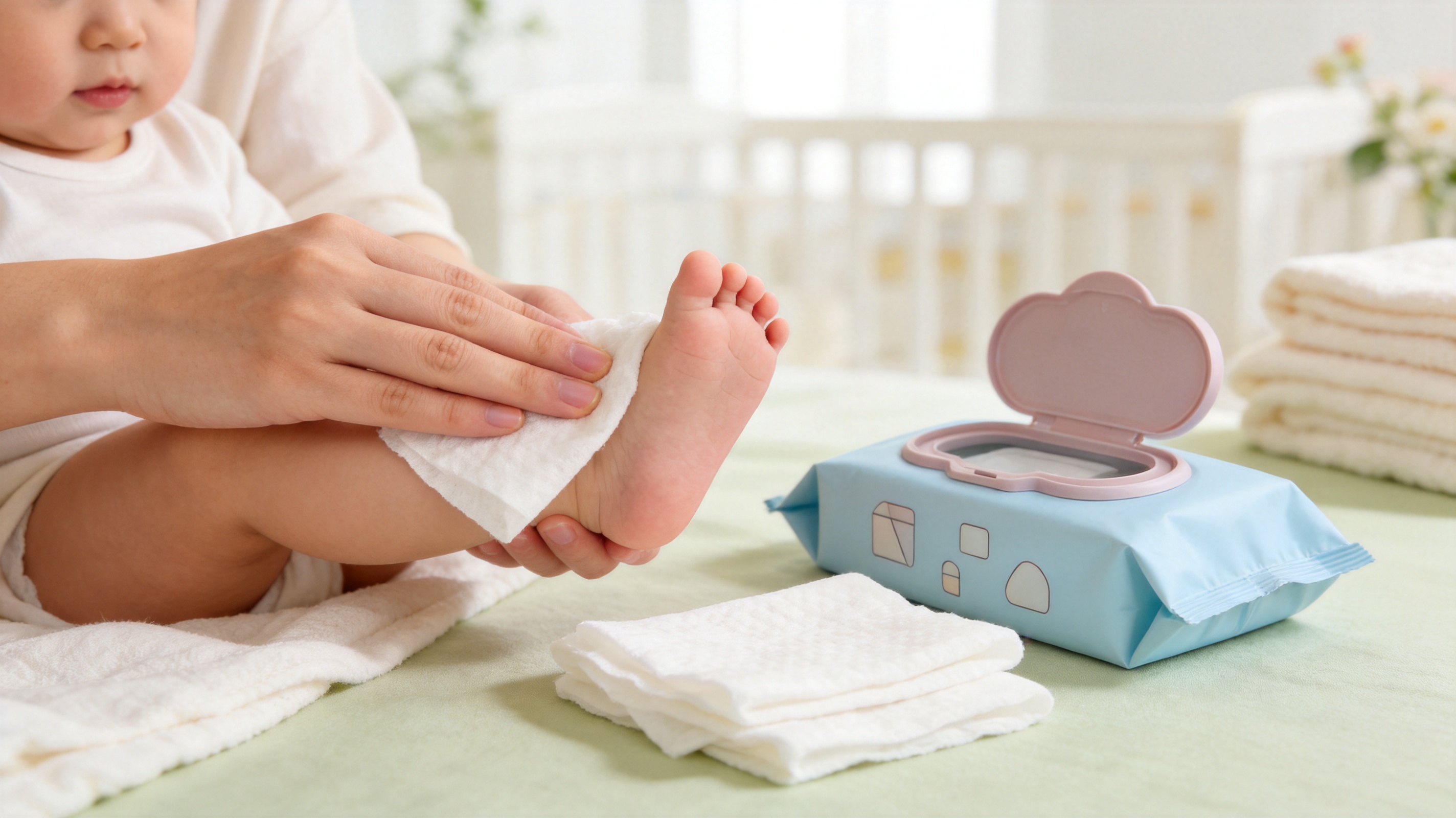
Because wet wipes contain water, microbiological control is essential. The product must be manufactured, filled, sealed, and stored under conditions that minimize contamination risk. The lotion system requires an appropriate preservation strategy, and finished products should undergo microbiological testing according to the customer’s target market and quality plan.
Clean manufacturing conditions, controlled water quality, hygienic equipment design, personnel procedures, environmental monitoring, and batch traceability all contribute to product safety. The company’s stated use of ISO-compliant cleanroom conditions demonstrates an emphasis on controlled production environments. Buyers should request the specific certifications, scope, audit records, and quality documentation applicable to the production site.
5. Nonwoven Manufacturing Technology
The physical performance of a baby wipe depends strongly on the arrangement of fibers within the nonwoven web. The product range uses Parallel and Semi-cross lapping technologies. These processes arrange layers of fibers in controlled orientations before bonding and finishing.
5.1 Parallel Lapping
Parallel lapping places a substantial proportion of fibers in the machine direction. This can support efficient high-speed production and provide consistent web formation. It may be appropriate when a customer requires a particular balance of lengthwise strength, softness, and production stability.
However, a web with excessive directional orientation may have different strength levels in the machine and cross directions. Product development therefore requires careful adjustment of web weight, fiber distribution, bonding intensity, and cutting dimensions.
5.2 Semi-Cross Lapping
Semi-cross lapping introduces additional fiber orientation across the web. This can help balance tensile performance and reduce the risk of tearing or deformation during use. A more balanced structure is valuable for wipes because caregivers may pull, stretch, fold, or twist the product during cleaning.
When a wipe maintains its dimensions under moderate stress, it is easier to control and less likely to leave fragments behind. Improved dimensional stability can also support automated folding, stack formation, and packaging efficiency.
5.3 Strength Without Excessive Harshness
Baby wipes require strength, but strength should not be achieved at the expense of softness. A stiff or overly dense wipe may feel uncomfortable on delicate skin, while a weak wipe may tear during use. The objective is to create a controlled relationship between tensile strength, wet strength, elongation, absorbency, and tactile softness.
Fiber type, fiber length, basis weight, web formation, hydroentanglement energy, and finishing conditions all influence this balance. A mature manufacturer can use production experience to select process parameters appropriate to the requested product grade rather than applying a single fixed recipe to every customer.
6. Surface Patterns and Functional Customization
The product can be manufactured with plain, mesh, dot-embossed, flower, or star surface patterns. Pattern selection is not merely decorative. It can influence friction, liquid distribution, tactile perception, and brand differentiation.
6.1 Plain Surface
A plain surface offers a clean and simple appearance. It is often suitable for sensitive-skin products, healthcare applications, and private-label lines that prioritize a minimal visual identity. The absence of pronounced embossing can also create a smooth wiping sensation.
6.2 Mesh Surface
A mesh surface can increase the perception of texture and may support the pickup of light residue. It can be useful for customers seeking a more functional or premium appearance. Mesh designs should be evaluated for softness because an overly open or pronounced structure may feel rough on delicate skin.
6.3 Dot Embossing
Dot embossing creates a controlled pattern that can improve tactile distinction and help distribute lotion across the wipe. It may offer a useful compromise between a smooth surface and a more textured cleaning face.
6.4 Flower and Star Patterns
Flower and star patterns are suitable for visually distinctive baby-care products. They can support private-label differentiation without requiring a completely different substrate. Pattern scale, depth, repeat distance, and embossing pressure can be adjusted to preserve softness and prevent excessive lotion drainage.
Customers should assess each pattern in both dry and wet conditions. The selected pattern should also be compatible with folding equipment, packaging machinery, printing requirements, and the intended pack presentation.
7. Size, Basis Weight, and Pack Configuration
The available size range includes widths of approximately 12–22 centimeters and lengths of approximately 12–30 centimeters. This provides flexibility for different use cases. Smaller wipes may be suitable for face and hand cleaning or compact travel packs. Larger formats can provide broader coverage during diaper changes and body cleaning.
Basis weights from approximately 30 to 100 gsm allow customers to balance cost, strength, absorbency, thickness, and softness. A lower-basis-weight wipe may be efficient for everyday cleaning, while a higher-basis-weight wipe may provide a more substantial premium feel. The best specification depends on the lotion loading, folding style, piece count, packaging format, and consumer expectations.
Piece counts can range from one to 200 pieces per pack. Single or low-count packs may serve sampling, travel, hospitality, or promotional purposes. Medium-count packs are common in retail and childcare settings. High-count packs may appeal to families seeking convenience and lower cost per wipe.
Pack configuration should be evaluated together with opening and resealing performance. A package must retain moisture, protect the wipes from contamination, and allow consistent one-handed or two-handed dispensing. The interaction between wipe dimensions, fold pattern, stack height, and opening size is important for user satisfaction.
8. Sustainability Benefits and Responsible Environmental Positioning
Environmental performance is increasingly important in the baby-care market. Parents, retailers, and institutional buyers are examining fiber composition, packaging, manufacturing energy, transportation, disposal, and corporate transparency.
A 100% viscose substrate can help reduce reliance on petroleum-based nonwovens. Its cellulose origin and biodegradability potential provide a foundation for a lower-persistence product concept. The use of compostable or biodegradable materials may also support retailers’ sustainability programs and private-label environmental objectives.
However, sustainability must be evaluated across the complete product life cycle. The product should be considered in relation to:
• Fiber sourcing and forestry practices.
• Chemical processing used to produce regenerated cellulose.
• Energy and water consumption during nonwoven manufacturing.
• Lotion ingredients and preservative systems.
• Packaging material and recyclability.
• Transportation distances and logistics efficiency.
• Disposal conditions available to the end user.
• Independent testing and certification for biodegradability or compostability.
Professional customers should avoid vague environmental language that cannot be documented. Claims such as “compostable,” “biodegradable,” “plastic-free,” or “eco-friendly” may have specific regulatory expectations depending on the destination market. The safest commercial approach is to define the claim, test the finished product, and provide clear disposal instructions.
8.1 Compostability Versus Flushability
Compostability and flushability are different product characteristics. A compostable wipe is designed to break down under specified composting conditions. A flushable wipe must meet separate requirements relating to dispersibility, sewer infrastructure, and wastewater behavior. A compostable baby wipe should not be marketed or disposed of through toilets unless it has been independently developed and tested for flushability.
Clear consumer instructions are therefore essential. Packaging should state the appropriate disposal method and discourage flushing where applicable. This protects plumbing systems, wastewater infrastructure, and the credibility of environmental claims.
8.2 Packaging Considerations
The environmental value of a biodegradable substrate can be weakened if the pack uses excessive material or lacks a responsible end-of-life plan. Customers may therefore evaluate lightweight films, recyclable structures, refill formats, resealable lids, and optimized carton sizes.
Packaging must still protect the product adequately. Moisture loss can reduce functionality and lead to product waste, which may offset some environmental benefits. The best solution balances material reduction with shelf-life stability, seal integrity, transport durability, and consumer convenience.
9. Quality Control and Manufacturing Strengths
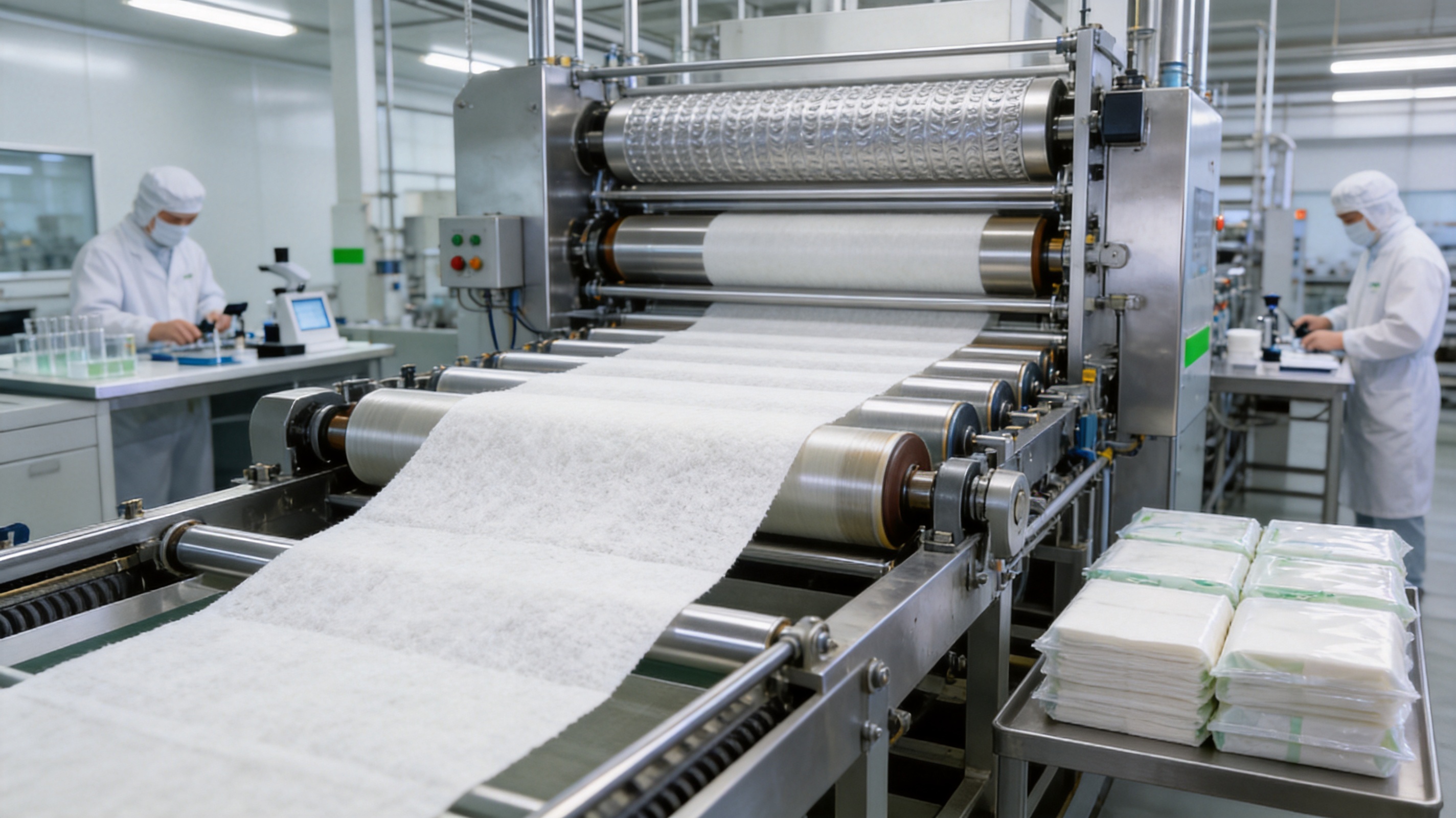
A successful baby-wipe supplier must provide more than a suitable raw material. The manufacturer must control the entire process from fiber preparation through finished-goods inspection. This is particularly important for private-label customers, who depend on consistent quality across repeated production orders.
9.1 Experience in Nonwoven Materials
The manufacturer described in the product information was founded in 1987 and has developed expertise in medical and hygienic nonwoven materials, nursing products, and clothing interlinings. More than three decades of industrial experience can support process knowledge in fiber selection, web formation, bonding, converting, lotion application, and packaging.
This background is valuable because wet wipes must satisfy several requirements simultaneously. A manufacturer familiar with nonwoven engineering can adjust fiber ratios, web structures, basis weights, and surface designs according to the customer’s application rather than treating all wipes as interchangeable.
9.2 Multi-Category Production Capability
The company’s product portfolio includes spunlace nonwovens, spunmelt nonwovens, hot-air nonwovens, flushable and degradable nonwovens, wet wipes, dry wipes, baby diapers, pull-up pants, wet toilet paper, cleansing wipes, and related hygiene products.
This broad capability can create advantages for customers seeking coordinated product development. A brand may require baby wipes, dry wipes, diapers, training pants, and packaging-compatible accessories from one supply partner. Working with a manufacturer that understands multiple hygiene categories can simplify technical communication, sampling, quality management, and production planning.
9.3 International Equipment and Process Development
The company has introduced advanced production equipment and technology from Germany, France, and Italy. International equipment can contribute to stable web formation, automated control, precise converting, and higher production consistency. Equipment alone does not guarantee quality, however. The practical benefit depends on operating discipline, preventive maintenance, process monitoring, and experienced technical personnel.
Modern production lines can improve the control of basis weight, moisture addition, cutting accuracy, folding, sealing, and pack counting. Automated systems can also reduce variation and help manufacturers record production data for traceability.
9.4 Production Base Network
The company has established multiple production bases in major Chinese industrial regions, including facilities in Zhejiang, Guangdong, Jiangsu, and Hubei. A multi-site manufacturing network can provide advantages in capacity planning, regional logistics, sourcing flexibility, and business continuity.
For international buyers, production-site selection should be based on the actual product, available certifications, quality systems, capacity, lead time, and export experience. Customers should confirm which facility will manufacture the specified baby wipes and ensure that approvals and audit documentation correspond to that site.
9.5 Quality and Traceability
Quality systems for baby wipes should cover incoming materials, water quality, lotion preparation, nonwoven formation, converting, packaging, storage, and shipment. Typical controls may include:
• Fiber identification and composition verification.
• Basis-weight measurement.
• Dimensional inspection.
• Tensile and elongation testing in machine and cross directions.
• Wet-strength assessment.
• Absorption and liquid-retention testing.
• pH measurement.
• Lotion weight or moisture-content verification.
• Microbiological testing.
• Seal-integrity and package-leak testing.
• Fragrance and appearance inspection.
• Batch coding and traceability review.
• Shelf-life and accelerated-stability evaluation.
The exact test plan should be agreed upon before mass production. A detailed product specification reduces misunderstandings between the manufacturer and the customer, particularly when multiple versions use similar packaging or different lotion formulas.
10. Private-Label and OEM/ODM Advantages
Private-label customers require flexibility because each market has different consumer expectations, regulations, pack sizes, language requirements, and price points. An OEM/ODM partner should be able to support product planning from the initial concept through sampling, production, packaging, and shipment.
The available material, size, pattern, fragrance, and piece-count choices provide a foundation for private-label development. A customer can select a 100% viscose substrate, define a target basis weight, choose plain or embossed surfaces, specify an unscented or fragranced lotion, and select a suitable pack count.
ODM support may include assistance with product architecture, lotion selection, pattern development, packaging structure, testing arrangements, and market-oriented positioning. OEM production may follow a customer’s existing formulation, artwork, technical specification, and quality agreement.
A capable supplier should also support sample approval procedures. A complete approval sample should represent the intended raw materials, substrate weight, lotion formula, folding method, packaging format, and label information. Approval based only on a laboratory swatch or an unfilled dry wipe may create problems during mass production.
10.1 Flexible Product Segmentation
One manufacturing platform can support several product tiers:
• A newborn line using unscented lotion, soft 100% viscose, and a moderate basis weight.
• A premium line using a higher basis weight, embossed surface, larger dimensions, and enhanced packaging.
• A family-value line using a practical size, efficient basis weight, and high piece count.
• A travel line using compact packs and smaller piece counts.
• An institutional line using simple packaging, plain surfaces, and controlled cost.
This segmentation helps customers serve different channels without changing suppliers for every variation.
11. Advantages Over Conventional Synthetic Wipes
The main competitive advantage of 100% viscose baby wipes is the integration of environmental positioning with the performance expected from a modern wet wipe. Conventional synthetic wipes may offer strength and low cost, but they can create concerns about long-term persistence and microplastic pollution. A viscose product provides an alternative based on regenerated cellulose.
Compared with low-quality wipes made from weak or irregular substrates, the parallel and semi-cross lapping technologies can improve structural integrity. Better strength balance helps prevent tearing, deformation, and inefficient use during cleaning.
Compared with heavily fragranced or alcohol-containing wipes, an alcohol-free, pH-conscious formulation can provide a gentler option for sensitive-skin positioning. Compared with generic untextured wipes, customized surface patterns can create a differentiated tactile experience and support specific cleaning preferences.
Compared with suppliers focused on a single finished product, a manufacturer experienced in nonwovens, wipes, diapers, and related nursing products can offer broader technical coordination. This is especially valuable to private-label owners seeking a complete maternal and infant care portfolio.
These advantages should be communicated accurately. The product should not be described as universally superior in every category because performance depends on the selected specification. A high-strength synthetic blend may outperform a low-basis-weight cellulosic wipe in a particular mechanical test, while a premium viscose wipe may offer better softness and sustainability positioning. The correct comparison is always between products with equivalent basis weight, lotion loading, dimensions, packaging, and test conditions.
12. Product Development Recommendations for Buyers
Before placing a large order, buyers should establish a product-development checklist. The first step is to define the target user and use case. Newborn care, general baby care, travel, healthcare, hospitality, and institutional cleaning may require different specifications.
The second step is to select the substrate. If sustainability is the primary objective, a 100% viscose construction should be evaluated. If the product requires exceptional mechanical strength or a specific price target, a blend may be considered. The fiber composition should be stated clearly in the technical file and confirmed through supplier documentation or testing.
The third step is to select dimensions and basis weight. Larger and heavier wipes may feel more premium but can increase material consumption, packaging volume, and transportation cost. A smaller or lighter wipe may be adequate for routine cleaning but should still meet wet-strength and absorbency requirements.
The fourth step is to define the lotion. Customers should determine whether the product will be unscented or fragranced and identify any restrictions on alcohol, parabens, essential oils, allergens, dyes, or other ingredients. Stability, preservation, skin compatibility, and package compatibility should be evaluated together.
The fifth step is to select the surface pattern and folding format. Plain, mesh, and embossed surfaces should be tested for softness, cleaning performance, lotion release, and consumer acceptance. The fold should provide reliable dispensing without excessive pull-through or multiple-wipe extraction.
The final step is to approve packaging and claims. Artwork should be reviewed for ingredient declarations, disposal instructions, environmental statements, fragrance information, age-related wording, and required regulatory marks.
13. Storage, Transportation, and Shelf-Life Considerations
Wet wipes should be stored in a clean, dry environment away from direct sunlight, excessive heat, freezing conditions, and strong odors. Temperature fluctuations can influence lotion viscosity, package pressure, fragrance stability, and seal performance.
During transportation, cartons should be protected from crushing and water exposure. Pallet configuration should avoid excessive compression of flexible packs. A damaged seal may cause moisture loss or allow contamination, even when the wipe substrate and lotion are properly formulated.
Shelf-life testing should include both normal and accelerated conditions. The evaluation should monitor appearance, odor, pH, moisture content, tensile properties, microbial status, package integrity, and dispensing performance. The recommended shelf life should be based on evidence rather than a generic industry assumption.
For compostable products, storage stability is also important. The material must remain stable throughout the declared shelf life while still retaining its intended biodegradability or compostability characteristics after disposal. Product developers should ensure that packaging, adhesives, printing inks, and lotion components do not undermine the environmental claim.
14. Frequently Asked Questions
What makes these baby wipes alcohol-free?
The formulation is designed without ethanol and harsh alcohol-based solvents. This supports a gentler product profile for routine infant care. The complete ingredient list should be reviewed to confirm the absence of specific substances required by the customer or destination market.
Are the wipes made from 100% viscose?
The featured product specification is based on 100% viscose. The broader manufacturing platform can also support polyester, bamboo, lyocell, cotton, and blended materials when a customer requests a different performance or cost profile. The selected composition should be confirmed in the final product specification.
Are 100% viscose wipes compostable?
Viscose is a regenerated cellulose fiber with biodegradability potential, but compostability depends on the complete finished product and the relevant disposal environment. Customers should request finished-product testing and certification before making specific industrial-compostability or home-compostability claims.
Can the wipes be flushed down the toilet?
They should not be flushed unless the finished product has been specifically developed and tested for flushability. Compostability and flushability are separate properties. Appropriate disposal instructions should appear on the packaging.
Are the wipes suitable for newborns?
The alcohol-free, soft-substrate design is intended to support sensitive-skin and baby-care applications. Newborn suitability depends on the final lotion, fragrance, preservative system, pH, microbiological quality, and applicable safety testing. An unscented formulation is often preferred for newborn-focused products.
What sizes are available?
The listed range is approximately 12–22 centimeters in width and 12–30 centimeters in length. Exact dimensions can be customized according to the intended application, folding pattern, pack format, and equipment requirements.
What basis weights are available?
The stated range is approximately 30–100 gsm. Lower basis weights may support cost efficiency, while higher basis weights can provide a more substantial feel and increased liquid-holding capacity. Final performance should be confirmed through product testing.
Can the wipes be scented?
Yes. Available fragrance directions include unscented, fresh, lavender, lemon, lotus, fruit, coconut, cucumber, and other options. Fragrance selection must comply with the requirements of the target market and should be assessed for sensitive-skin positioning.
Which surface patterns can be selected?
Available patterns include plain, mesh, dot embossed, flower, and star designs. The selected pattern can influence tactile feel, friction, liquid distribution, and visual differentiation.
How many wipes can be packed per package?
The listed range is from one to 200 pieces per pack. The appropriate count depends on the sales channel, package dimensions, consumer usage, transportation requirements, and desired price point.
What manufacturing technologies are used?
The product information identifies Parallel and Semi-cross lapping technologies. These processes help control fiber orientation and support tensile strength and dimensional stability in both machine and cross directions.
Can the product be customized for private-label brands?
Yes. Customers can discuss substrate composition, basis weight, dimensions, surface pattern, lotion, fragrance, piece count, folding style, packaging, labeling, and testing requirements. OEM and ODM support can be arranged according to the customer’s technical brief.
What should buyers request before mass production?
Buyers should request a complete technical specification, raw-material information, sample approval, test reports, packaging details, quality standards, production-site information, estimated lead time, minimum order quantity, and documentation supporting any environmental or skin-safety claims.
15. Why an Experienced Manufacturing Partner Matters
The quality of a baby wipe is influenced by dozens of interconnected variables. A supplier may offer an attractive material claim, but the product will only succeed if the substrate, lotion, packaging, process control, and logistics function as one system.
An experienced manufacturer with long-term specialization in medical and hygienic nonwovens can provide a stronger technical foundation than a general trading company. Expertise in fiber processing, spunlace production, wet wipes, dry wipes, diapers, and related nursing products can help customers solve problems across product categories.
Manufacturing scale is also important. Multiple production bases, international equipment, established process knowledge, and experience with domestic and international customers can support continuity and capacity planning. For large retailers and distributors, a stable supply partner reduces the risk of inconsistent quality, delayed shipments, or repeated development cycles.
At the same time, buyers should conduct appropriate due diligence. Factory audits, sample testing, document verification, regulatory reviews, and clear quality agreements remain essential. A strong supplier relationship is built through transparent specifications and measurable performance, not through marketing language alone.
16. Conclusion
Alcohol-free compostable baby wipes made with 100% viscose offer a practical response to two major demands in modern hygiene: gentle performance for sensitive skin and reduced dependence on persistent synthetic materials. Their plant-derived cellulose substrate provides softness, hydrophilicity, moisture management, and a strong foundation for biodegradability-oriented product development.
The use of Parallel and Semi-cross lapping technologies supports the mechanical integrity needed for daily cleaning. Adjustable basis weights, sizes, piece counts, fragrances, and surface patterns allow the product to be adapted for newborn care, mainstream retail, travel, healthcare, institutional, and private-label applications.
The manufacturer’s long-standing experience in nonwoven materials, wet wipes, diapers, and nursing products adds value through process knowledge, production scale, equipment capability, and customization support. Its broader manufacturing network can help customers coordinate several hygiene categories while maintaining consistent technical communication.
For the most credible result, buyers should evaluate the finished product as a complete system. Fiber composition, lotion, packaging, preservation, microbiological safety, shelf life, environmental claims, and disposal instructions should all be documented and tested. When these elements are properly aligned, alcohol-free compostable baby wipes can deliver dependable everyday performance while helping brands respond to evolving consumer and supply-chain expectations.
References
1. International Organization for Standardization. Standards and guidance relating to quality management systems, environmental management, and textile testing.
2. International Organization for Standardization. Guidance concerning packaging, biodegradability, compostability, and environmental claims.
3. Association of the Nonwoven Fabrics Industry. Technical publications on nonwoven materials, spunlace processing, and hygiene-product performance.
4. European Committee for Standardization. Standards relating to the assessment of biodegradability and compostability of materials and products.
5. United States Pharmacopeia. General guidance concerning microbiological quality and preservation of aqueous personal-care products.
6. World Health Organization. Publications concerning hand hygiene, environmental health, and safe sanitation practices.
7. Textile Exchange. Reports and guidance on preferred fibers, responsible cellulose sourcing, and material sustainability.
8. Product technical information supplied for the alcohol-free compostable baby wipes specification, including material options, dimensions, basis weights, manufacturing technologies, and customization parameters.