中文简体
中文简体 English
 日本語
日本語 русский
 Español
Industrial cleaning wipes have become an essential part of modern maintenance, production, repair, and facility-management operations. In factories, workshops, automotive service centers, warehouses, laboratories, printing facilities, and equipment rooms, workers need a convenient way to remove grease, oil, ink, adhesives, dust, paint, lubricants, tar, asphalt, and other difficult contaminants. Traditional cloth rags may be inconsistent, difficult to store, and prone to cross-contamination. Industrial cleaning wipes provide a more controlled, hygienic, and efficient alternative.
The product discussed in this article is a heavy-duty, multi-purpose industrial cleaning wipe designed for both hand cleaning and the cleaning of hard, non-porous surfaces. Made with advanced nonwoven materials and supplied in portable packaging, the wipe combines durability, absorbency, cleaning efficiency, and convenience. Its applications extend from hand cleaning after mechanical work to wiping tools, machine parts, workbenches, vehicle bodies, and other industrial surfaces.
For distributors, importers, industrial suppliers, MRO businesses, private-label brands, and institutional purchasers, product performance is only one part of the purchasing decision. Consistent quality, flexible specifications, reliable production, compliance support, packaging options, and supply capacity are equally important. A capable manufacturer must therefore provide more than a standard wipe. It must offer a complete product-development and supply solution.
Zhejiang Uniquality Nursing Products Technology Co., Ltd., operating together with the Kingsafe and Uniquality manufacturing network, provides industrial wipes and other nonwoven hygiene products for wholesale, OEM, and ODM projects. Its capabilities include nonwoven material development, wipe conversion, solution formulation, packaging customization, quality testing, documentation support, and large-scale manufacturing.
This article explains the construction, functions, applications, advantages, customization options, manufacturing processes, quality considerations, and purchasing value of heavy-duty industrial cleaning wipes.
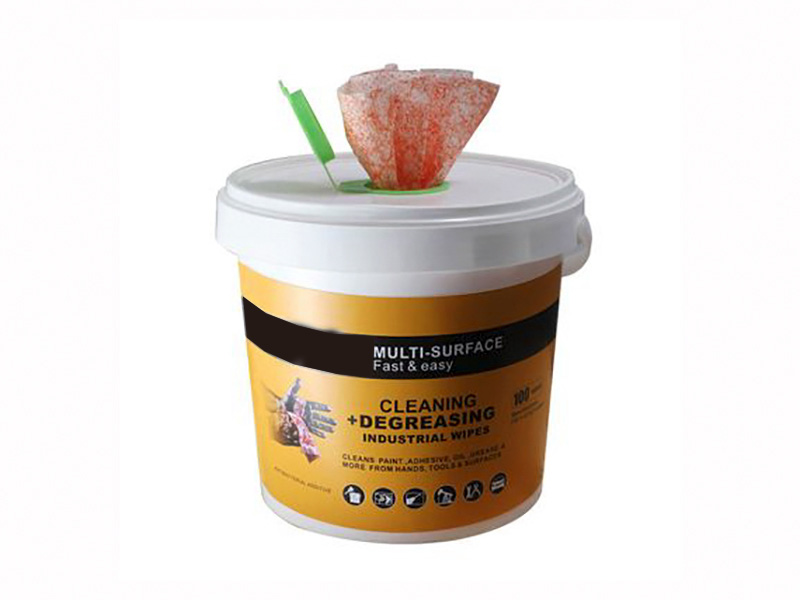
Industrial cleaning wipes
1. What Are Heavy-Duty Industrial Cleaning Wipes?
Heavy-duty industrial cleaning wipes are pre-moistened disposable wipes formulated to remove ordinary dirt as well as difficult industrial contaminants. They are generally made from strong nonwoven substrates selected for tear resistance, absorbency, surface cleaning, and controlled release of cleaning solution.
Unlike ordinary household wet wipes, industrial wipes are designed for more demanding conditions. They may be used around oils, grease, metal particles, adhesives, printing inks, paint, lubricants, and machine residues. Their structure must withstand firm wiping pressure without falling apart, while their lotion or cleaning solution must loosen and lift contamination efficiently.
The wipes described here are suitable for hands and many hard, non-porous surfaces. Typical examples include metal tools, machine housings, vehicle bodies, workbenches, equipment panels, maintenance components, and industrial fixtures. Users can clean without immediately accessing water, which makes the product especially useful in workshops, field-service environments, construction areas, and production locations.
A heavy-duty wipe normally combines several functional characteristics:
- Strong nonwoven construction for demanding wiping tasks.
- High oil-dissolving or degreasing performance, depending on the selected formula.
- Textured or embossed surfaces that help loosen ingrained contamination.
- A smoother reverse side that helps collect and retain removed dirt.
- Pre-moistened convenience for fast, waterless cleaning.
- Packaging designed for portability, controlled dispensing, and workplace storage.
- Options for fragrance-free, lightly scented, or customized formulations.
The final performance depends on the relationship between the wipe substrate, basis weight, embossing pattern, lotion chemistry, folding method, package format, and intended application. An experienced manufacturer evaluates these elements as a complete system rather than treating the wipe material and liquid formula as separate components.
2. Product Construction and Available Specifications
2.1 Nonwoven Material Options
The product platform supports a range of nonwoven materials, including polyester, viscose, bamboo, lyocell, cotton, melt-blown substrates, spunlace, wood-pulp composites, and microfiber. Each material offers a different balance of strength, absorbency, softness, lint control, cost, and environmental positioning.
Polyester is valued for strength, abrasion resistance, and dimensional stability. It is suitable for wiping tasks that require repeated pressure or contact with rougher surfaces. Viscose provides good liquid absorption and a soft hand feel. Bamboo and lyocell can support product concepts that emphasize renewable or plant-derived fibers, subject to the selected construction and applicable claims requirements.
Cotton provides a familiar natural-fiber profile and can be selected when softness and absorbency are priorities. Melt-blown materials are useful when a fine-fiber structure, liquid-holding capacity, or specialized filtration-related characteristics are required. Spunlace materials can combine softness, strength, and versatility, while wood-pulp composite substrates can provide absorbency and cost efficiency for selected industrial applications.
The correct substrate depends on the cleaning task. A wipe for removing grease from automotive components may require a different structure from a wipe intended for electronics-area maintenance, where low lint and controlled residue are especially important. Product development should therefore begin with the actual contamination, surface, wiping motion, and disposal conditions.
2.2 Basis Weight and Thickness
Available basis weights range from approximately 30 to 100 grams per square meter. Lower-basis-weight wipes may be suitable for lighter cleaning work, compact packaging, and cost-sensitive projects. Higher-basis-weight wipes generally provide greater substance, liquid capacity, durability, and user perception of quality.
A thick, reinforced wipe is particularly valuable when users must remove heavy grease, dried dirt, adhesive residues, ink, fresh paint, or sludge. Greater thickness allows the wipe to retain more contamination and reduces the likelihood that the user will need several thin wipes for one task. It can also improve hand protection by creating more distance between the user’s skin and the contamination.
However, maximum thickness is not always the best solution. Excessive material may increase packaging volume, shipping costs, and consumption expense. A professional manufacturer can recommend an appropriate basis weight by considering cleaning intensity, pack size, target price, dispensing method, and customer expectations.
2.3 Size, Folding, and Surface Pattern
Standard size options include widths of approximately 12 to 22 centimeters and lengths of approximately 12 to 30 centimeters. These dimensions can be adjusted according to application and packaging requirements. Larger wipes are convenient for hand and equipment cleaning, while smaller wipes may be preferred for tools, components, and controlled-use environments.
Available patterns include plain, mesh, dot embossed, flower, and star designs. Pattern selection is not merely decorative. Embossing can improve mechanical contact with contamination, create additional surface area, and support the loosening of embedded dirt. A textured side can provide scrubbing action, while a smoother side can help pick up and retain released contamination.
Folding options include Z-fold, quarter-fold, pop-up dispensing, and roll formats. Z-fold and pop-up configurations can support one-at-a-time dispensing and reduce unnecessary contact with the remaining wipes. Quarter-fold formats are familiar to many professional users. Roll formats can be useful in high-consumption maintenance areas where wipes are pulled continuously from a central or wall-mounted dispenser.
2.4 Fragrance and Solution Choices
The product can be supplied unscented or with fragrance options such as fresh, lavender, lemon, lotus, fruit, coconut, cucumber, and other profiles. Fragrance-free products are often preferred in sensitive workplaces, food-equipment maintenance, healthcare-adjacent environments, and applications where scent transfer must be minimized.
Cleaning solution options may include water-based, alcohol-based, degreasing, solvent-free, low-residue, or customized formulations. The formula should be selected according to the contamination, surface compatibility, worker-use conditions, local regulations, and desired drying behavior.
A water-based neutral formula can be appropriate for general cleaning and hand use when strong solvent action is unnecessary. A degreasing formula may be developed for oil, grease, and lubricant removal. An alcohol-based formula may be considered for specific fast-drying applications, subject to flammability, transportation, labeling, and regulatory requirements.
Formula customization should always be validated through technical review and application testing. A solution that removes grease effectively may not be suitable for every plastic, painted surface, coating, seal, or sensitive component. Industrial cleaning wipes should be tested against representative contaminants and surfaces before full-scale adoption.
| Product Element | Available or Typical Options | Primary Performance Considerations | Common Application Purpose |
|---|---|---|---|
| Substrate | Polyester, viscose, bamboo, lyocell, cotton, melt-blown, spunlace, microfiber, wood-pulp composite | Strength, absorbency, lint, softness, durability | Hand cleaning, equipment wiping, maintenance, degreasing |
| Basis weight | Approximately 30–100 gsm | Thickness, liquid capacity, tear resistance, cost | Light-duty through heavy-duty cleaning |
| Surface pattern | Plain, mesh, dot embossed, flower, stars | Scrubbing action, contact area, dirt retention | General wiping and ingrained contamination removal |
| Size | Approximately 12–22 cm wide and 12–30 cm long | Coverage, handling, packaging efficiency | Hands, tools, machinery, vehicle surfaces |
| Folding format | Z-fold, quarter-fold, pop-up, roll type | Dispensing control, storage, user convenience | Workstations, workshops, production lines |
| Packaging | Bucket, canister, soft pack, refill bag, flow pack | Portability, moisture retention, dispensing, logistics | Mobile service, fixed stations, bulk supply |
| Formula | Water-based, alcohol-based, degreasing, solvent-free, customized | Cleaning power, drying, residue, surface compatibility | Oil, grease, ink, dirt, adhesives, general maintenance |
3. Cleaning Performance in Industrial Environments
3.1 Removing Grease, Oil, and Lubricants
Grease and oil are among the most common industrial contaminants. They adhere strongly to hands, tools, machine housings, bearings, vehicle components, and work surfaces. Water alone may spread oily contamination rather than remove it. A properly designed industrial wipe uses a suitable combination of substrate structure and cleaning solution to loosen, absorb, and retain oily residues.
The product’s high oil-dissolving capability is intended to support the removal of grease, grime, lubricants, and related contamination. The wipe should be folded or turned during use so that a relatively clean surface remains in contact with the work area. This helps prevent the redistribution of oil and improves the total cleaning area obtained from each wipe.
For very heavy deposits, users may first remove excess material with a scraper or disposable absorbent material before completing the cleaning process with the wet wipe. This approach can improve efficiency and reduce unnecessary wipe consumption.
3.2 Removing Ink, Paint, Adhesives, and Persistent Stains
Printing facilities, workshops, assembly operations, and maintenance departments frequently encounter ink, fresh paint, adhesive, wax, tar, asphalt, and other persistent residues. The best formula depends on whether the contamination is water-soluble, oil-based, partially cured, or fully dried.
Textured nonwoven surfaces can help break the bond between contamination and the surface. At the same time, the wipe must remain cohesive under pressure. A weak or loosely bonded material may tear, shed fibers, or leave fragments behind. A stronger reinforced substrate allows users to apply firm wiping action with greater confidence.
Industrial wipes are most effective when used promptly. Fresh paint, ink, and adhesive are generally easier to remove before they cure completely. For cured residues, a specialized solvent or mechanical treatment may be necessary, and the compatibility of the cleaning solution with the surface must be confirmed in advance.
3.3 Waterless Hand Cleaning
Many industrial workers need to clean their hands away from a sink. Field technicians, mechanics, installers, warehouse personnel, and construction workers may work in locations where water is unavailable or inconvenient. Dermatologically tested industrial hand wipes can help remove paint, dirt, grease, and other difficult substances without immediate access to water.
The textured side of the wipe helps lift ingrained contamination, while the smoother side can collect loosened material and reduce re-soiling. After wiping, hands can feel cleaner and drier than after using an overly wet or poorly balanced wipe.
Hand-use suitability does not mean that the wipe should be used on every skin condition or as a substitute for handwashing in situations requiring hygienic hand disinfection. Users should follow the product label, safety documentation, and workplace procedures. Where regulations or occupational requirements specify handwashing, the industrial wipe should be treated as a convenient preliminary or interim cleaning method.
3.4 Cleaning Tools, Machine Parts, and Workbenches
Tools and machine parts often contain a combination of dust, oil, metal particles, and lubricant residue. A disposable industrial wipe can be used during inspection, adjustment, repair, and routine maintenance. Because the wipe is pre-moistened, the user does not need to prepare a separate bucket of cleaning liquid or manage reusable cloths.
On workbenches and equipment panels, a controlled wipe can remove contamination without leaving large amounts of liquid behind. A low-residue formula may be selected when the surface must be returned to service quickly. For larger surfaces, a roll or bucket format can provide convenient access during repeated maintenance tasks.
Before use on painted, coated, plastic, rubber, or sensitive surfaces, operators should perform a small compatibility test. This is particularly important when using stronger degreasers or alcohol-containing formulas.
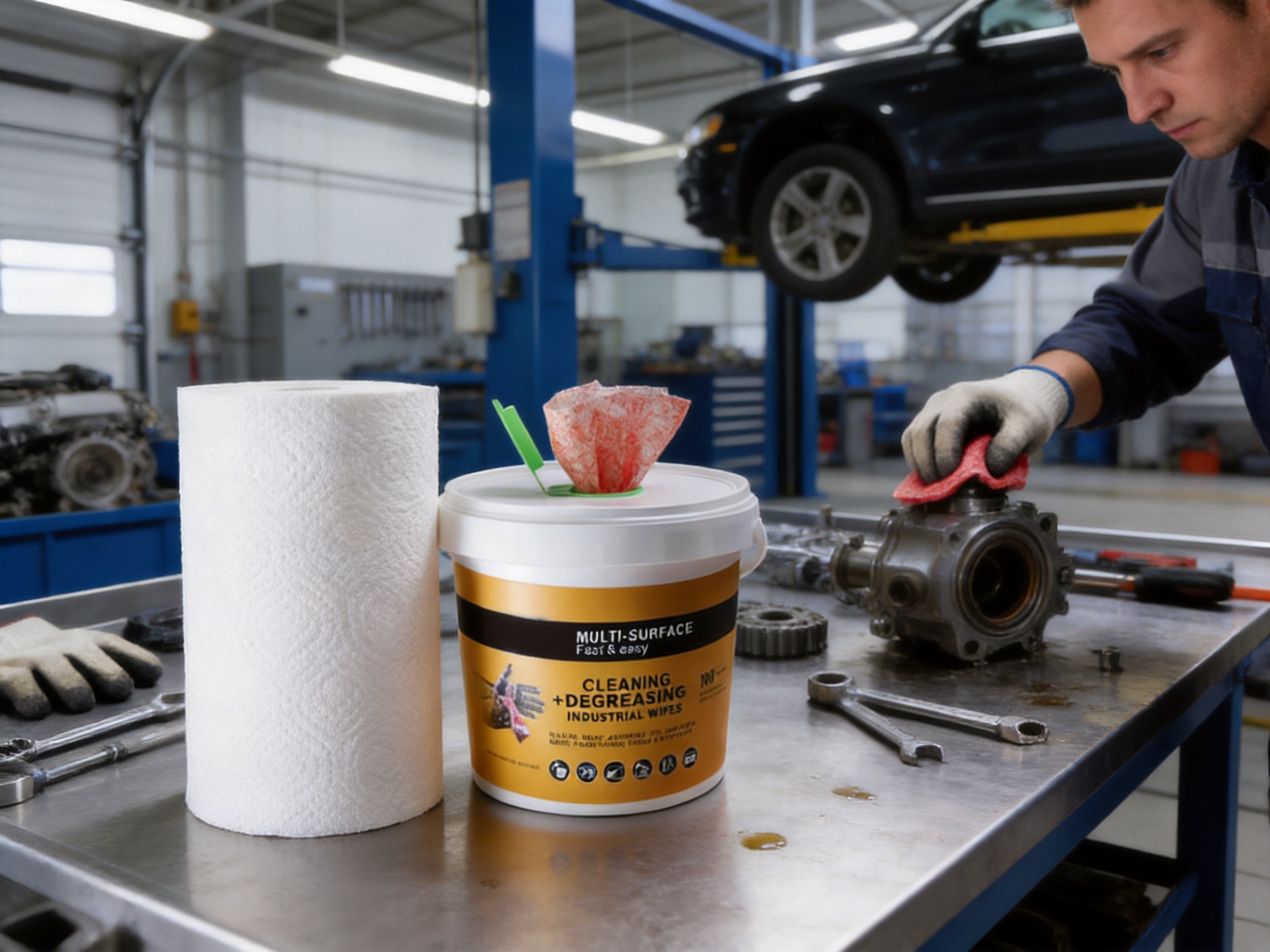
4. Advantages Compared with Ordinary Cloth Rags and General-Purpose Wipes
4.1 Consistent Construction
Traditional cloth rags can vary significantly in fiber type, thickness, absorbency, cleanliness, and size. They may contain buttons, seams, loose threads, or residues from previous use. Industrial nonwoven wipes are manufactured to defined specifications, allowing buyers to control product consistency from one shipment to the next.
Consistent basis weight, dimensions, lotion loading, folding, and packaging improve workplace predictability. Workers can select the appropriate wipe without sorting through mixed textile scraps. Distributors can also present a clearer product specification to their customers.
4.2 Reduced Cross-Contamination Risk
Reusable rags require collection, transport, sorting, washing, drying, and quality control. If these processes are not properly managed, a rag previously used with oil, solvent, pigment, or metal dust may transfer contamination to another job. Disposable wipes reduce this risk because each wipe is intended for a limited use cycle.
Disposable does not automatically mean environmentally superior in every situation. Buyers should evaluate the full product life cycle, packaging, disposal method, material selection, and consumption rate. Nevertheless, for operations where contamination control and convenience are priorities, a controlled disposable wipe can provide important practical benefits.
4.3 Better Portability and Availability
Portable buckets and other sealed formats allow wipes to be placed close to the point of use. A bucket can be carried to a repair location, stored in a service vehicle, or positioned beside a production line. The sealed package also helps protect the remaining wipes from drying and external contamination.
Compared with open containers of liquid and loose cloths, pre-moistened wipes reduce preparation time and simplify workplace organization. A worker can open the package, dispense a wipe, complete the task, and dispose of the used material according to site procedures.
4.4 Improved User Experience
Users typically value wipes that are thick enough to handle, wet enough to clean, but not so saturated that they drip excessively. A reinforced nonwoven substrate can feel more reliable than a thin consumer wipe. Embossed texture can provide useful mechanical cleaning action, while a smooth reverse side supports final pickup.
These details influence consumption, worker acceptance, and perceived product value. A wipe that performs efficiently may reduce the number of pieces needed for each maintenance task, even if its unit price is higher than that of a lightweight general-purpose wipe.
4.5 Flexible Product Positioning
Industrial wipes can be developed for broad multi-purpose use or targeted to a particular industry. A distributor may require an economical general-maintenance wipe, while an automotive supplier may need a stronger degreasing wipe with a mechanic-oriented package. A private-label brand may request a specific fragrance, color, folding pattern, label, and carton design.
This flexibility allows buyers to create differentiated product lines rather than competing only on price. Substrate, formula, size, pack count, packaging, and branding can be combined to serve different customer segments.
5. Manufacturing Process and Quality Control
5.1 Integrated Nonwoven Material Development
A major strength of an integrated manufacturer is the ability to control more stages of the supply chain. Zhejiang Uniquality Nursing Products Technology Co., Ltd. has a long history in medical and hygienic nonwoven materials, nursing products, and high-end clothing interlining. Its manufacturing network includes multiple domestic production bases and a broad product portfolio covering nonwoven fabrics, wet wipes, dry wipes, diapers, cleansing wipes, and other hygiene products.
Material integration can support better coordination between substrate development and finished-wipe production. Rather than selecting a generic material without considering the final formula and application, engineers can evaluate how fiber composition, bonding method, basis weight, embossing, liquid absorption, and converting behavior work together.
This approach is valuable for industrial products because cleaning performance often depends on small structural differences. A material may look similar to a competing wipe but behave differently during wiping, folding, saturation, liquid release, or contamination retention.
5.2 Selection and Preparation of Raw Materials
Production begins with the approval and preparation of fibers, nonwoven rolls, packaging materials, and solution ingredients. Incoming materials should be checked against defined specifications, including appearance, width, basis weight, moisture, strength, and other relevant properties.
For solution components, the manufacturer must manage identity, concentration, storage conditions, batch traceability, and compatibility. Fragrance, preservatives, surfactants, emollients, alcohols, solvents, and other ingredients should be selected in accordance with the target market and intended application.
Raw-material traceability is important for commercial buyers. If a quality issue occurs, batch records help identify the relevant materials and production conditions. A mature quality system also supports more consistent repeat orders, which is especially important for private-label and long-term distribution programs.
5.3 Nonwoven Conversion
Nonwoven rolls are converted into the required wipe width and length through controlled slitting, cutting, folding, or roll-forming processes. Depending on the design, the material may be embossed or patterned to create the desired surface structure.
Conversion equipment must maintain accurate dimensions and stable tension. Inconsistent cutting can cause dispensing problems, uneven package appearance, or reduced user satisfaction. Folding equipment must also be adjusted to match the package format, especially for pop-up and Z-fold products where the relationship between adjacent wipes affects dispensing performance.
For heavy-duty products, conversion settings must preserve substrate strength. Excessive mechanical stress, poor edge control, or unsuitable folding pressure can weaken the wipe before it reaches the customer. Production technicians therefore monitor both appearance and functional integrity.
5.4 Lotion Preparation and Application
The cleaning solution is prepared according to the approved formula and applied to the nonwoven substrate at a controlled loading level. The target loading must provide sufficient moisture and cleaning action while avoiding excessive dripping, poor package stability, or inadequate shelf-life performance.
Uniform distribution is essential. If some wipes are too dry and others are too wet, the user experience will be inconsistent. Uneven application can also affect cleaning efficiency, fragrance intensity, and preservative performance. Production controls may include weighing, sampling, visual inspection, and laboratory testing.
Formula development should consider the intended surface and user. A hand-cleaning wipe may require a milder feel than a specialized equipment degreaser. A low-residue formula may be more appropriate for precision maintenance. A solvent-free option may support customers seeking a particular safety or regulatory profile, although the final formula must be validated for actual cleaning performance.
5.5 Filling and Packaging
After lotion application and folding, the wipes are inserted into the selected packaging format. Portable buckets are especially suitable for industrial use because they offer large capacity, mobility, stackability, and convenient access. Canisters, refill bags, soft packs, and flow packs can be selected for different channels and consumption patterns.
Packaging serves several technical functions. It helps retain moisture, protects the wipes from dirt, communicates product information, supports transportation, and controls dispensing. A package designed for a busy workshop should be easy to open with gloved hands and stable when placed on a bench or vehicle.
For OEM products, packaging may include private-label artwork, custom color schemes, printed labels, product instructions, warning information, carton markings, barcode requirements, and pallet specifications. The packaging development process should confirm the target market’s labeling and documentation requirements before mass production.
5.6 Inspection, Testing, and Release
Finished products may be evaluated for dimensions, piece count, basis weight, moisture or lotion loading, appearance, odor, package sealing, dispensing behavior, and microbial or chemical requirements relevant to the product category. Additional testing may be carried out for tensile strength, tear resistance, absorbency, lint, pH, residue, or surface compatibility.
The manufacturer operates a full-function testing center and uses controlled production environments, including 100,000-class GMP clean workshops for applicable hygiene-product manufacturing. These capabilities help support process discipline, controlled handling, and documentation across different product lines.
Industrial wipes are not all subject to the same regulatory requirements. The required testing and documentation may vary according to formula, claims, destination market, hand-use positioning, packaging, and customer specification. Available support may include ISO-related documentation, material or product test reports, MSDS or SDS, COA, FDA registration where applicable, REACH information, RoHS documentation, and other compliance materials as required.
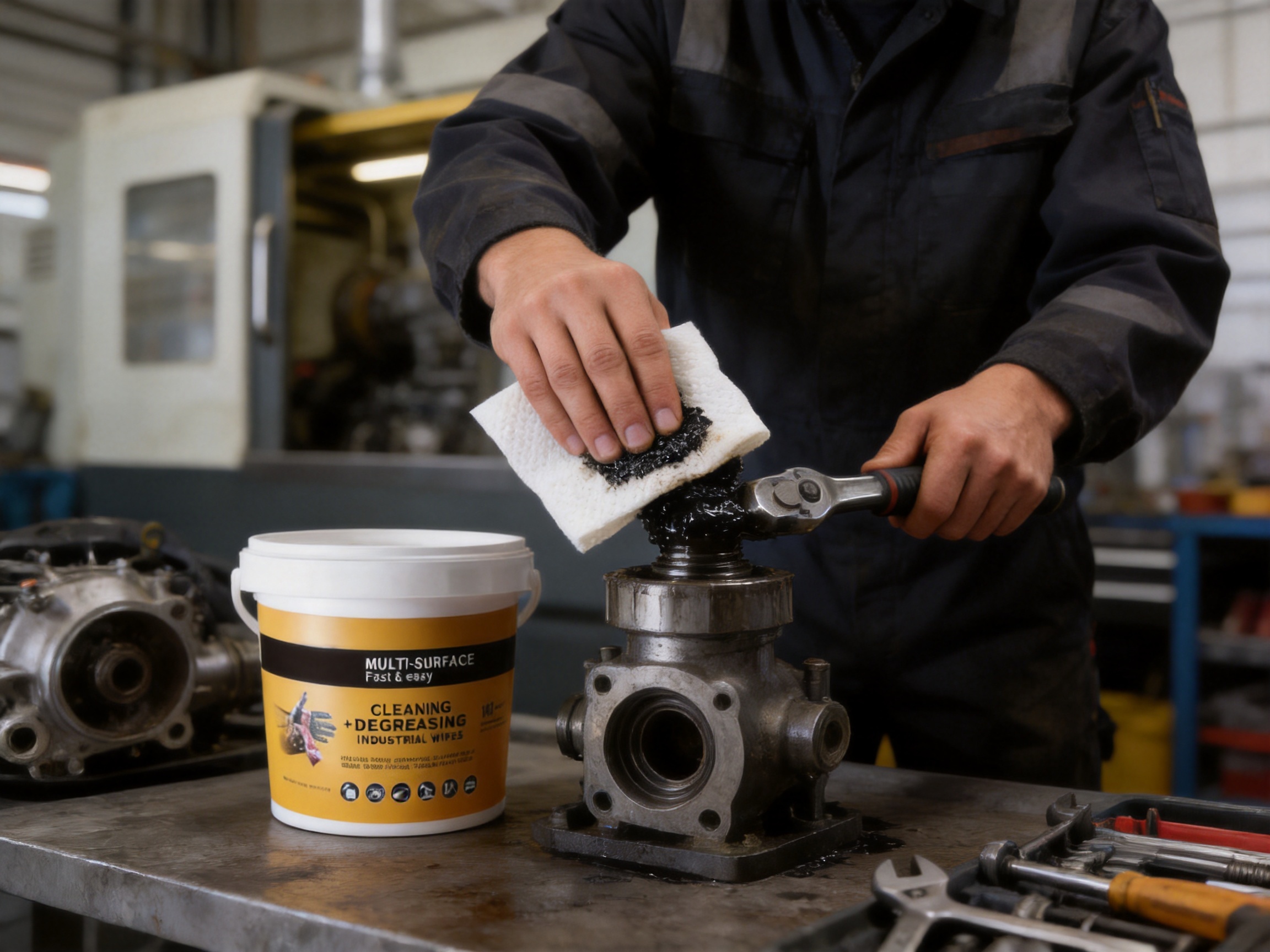
6. Manufacturing Strengths Supporting Global B2B Supply
Industrial wipe buyers often require more than a product sample. They need confidence that the manufacturer can support repeat orders, manage changing specifications, maintain quality across batches, and deliver documentation on time. A large, integrated production organization can provide several advantages in these areas.
6.1 Long-Term Industry Experience
Founded in 1987, the Kingsafe and Uniquality organization has more than three decades of experience in nonwoven materials, nursing products, hygiene products, and related manufacturing. This history provides a foundation for process knowledge, supplier management, product development, and international cooperation.
Experience is particularly valuable when industrial wipes require customization. A new project may involve balancing cleaning strength with hand feel, selecting a substrate for low lint, adapting a formula to local regulations, or designing packaging for high-volume dispensing. An experienced technical team can identify potential problems earlier in the development process.
6.2 Multiple Production Bases
The company has established eight production bases in China, with facilities associated with regions including Zhejiang, Guangdong, Jiangsu, and Hubei. This multi-site structure supports broad manufacturing capacity and provides a platform for different product categories and production requirements.
For large wholesale and container-level projects, production scale can help improve material planning and supply continuity. Buyers should still confirm the specific factory, production line, minimum order quantity, lead time, and quality-control arrangement for each project. However, an established production network offers a stronger foundation than a trading-only supply model.
6.3 Full Industrial Chain Capability
The organization’s capabilities extend from self-developed or internally managed nonwoven substrates to finished hygiene products. This full-chain orientation can simplify communication between material engineers, formula developers, converting teams, packaging specialists, and quality personnel.
For industrial wipe customers, this may reduce the number of separate suppliers involved in a project. One coordinated manufacturing partner can help manage material selection, solution development, sample preparation, packaging design, compliance documentation, and mass production.
6.4 Research, Development, and Patents
The company reports a full-function testing center and support from a substantial patent portfolio. Research and development resources can help the manufacturer create differentiated materials, optimize product structures, and adapt products to specific customer requirements.
Innovation in industrial wipes is not limited to creating a stronger liquid. It may involve improved fiber blending, better embossing, more efficient lotion distribution, lower-lint structures, redesigned dispensing systems, reduced packaging material, or product configurations that improve workplace productivity.
6.5 Export and Compliance Support
International buyers need documentation that corresponds with the product and destination market. A professional manufacturer can help prepare technical files, safety documents, ingredient information, product specifications, test reports, packaging details, and other materials required by the importer or regulatory authority.
Compliance is a shared responsibility between manufacturer, importer, distributor, and end user. Requirements can change according to claims and market. For example, a wipe marketed for general cleaning may have different requirements from one marketed for disinfection, medical use, or specialized skin cleaning. Clear communication about intended claims is therefore essential at the beginning of a project.
7. OEM and ODM Customization Options
Industrial cleaning wipes are well suited to OEM and ODM development because professional buyers often need product differentiation. Customization can begin with a minor adjustment, such as a logo or pack count, or extend to a complete product platform with a new substrate, formula, package, and brand identity.
7.1 Wipe Material Customization
Customers may select spunlace, wood pulp plus polypropylene, polyester, microfiber, or another customized nonwoven. The choice should be connected to the application. For example, a highly absorbent substrate may be preferred for liquid pickup, while a stronger polyester blend may be selected for mechanical wiping and durability.
Material customization can also address texture, color, thickness, lint behavior, wet strength, and environmental objectives. If a customer wants to make sustainability-related claims, those claims must be supported by appropriate evidence and evaluated according to the destination market’s rules.
7.2 Cleaning Formula Customization
Formula options may include water-based, alcohol-based, degreasing, solvent-free, low-residue, fragrance-free, or customer-specific formulations. The manufacturer can work with the customer to define the target contaminant and surface before proposing a solution.
A formula-development brief should identify whether the wipe is intended primarily for hands, tools, painted metal, stainless steel, plastics, glass, vehicle surfaces, machinery, or multiple surface types. It should also identify the expected cleaning speed, drying time, odor preference, residue tolerance, worker exposure conditions, storage temperature, and transport requirements.
7.3 Folding and Dispensing Customization
Z-fold, quarter-fold, pop-up, and roll formats allow customers to match the product to their operating environment. Pop-up dispensing may reduce unnecessary contact with the next wipe. Roll formats may support large maintenance teams. Folded wipes in buckets can provide a balance between capacity and portability.
Dispensing tests should be part of product approval. The wipe should pull out without excessive tearing, multiple-sheet release, or package collapse. For products used with gloves, the lid and opening should be evaluated for ease of use.
7.4 Packaging and Brand Customization
Packaging choices include soft packs, canisters, buckets, refill bags, and flow packs. Customers can request private-label packaging, custom artwork, logo printing, product instructions, carton design, and color systems that align with their brand.
Industrial customers may also require packaging information such as batch number, manufacturing date, expiration or recommended-use information, piece count, safety precautions, storage guidance, and disposal instructions. Export cartons may require specific marks, pallet configurations, or barcode formats.
7.5 Development Support
OEM and ODM support can include product consultation, sample production, formula adjustment, packaging design, compliance documentation, pilot production, and mass manufacturing. A structured development process helps reduce misunderstandings and provides clear approval points before large-scale production.
For distributors, the ability to create several grades under one product family can be commercially useful. A basic general-purpose wipe, a premium heavy-duty wipe, a fragrance-free technical wipe, and a specialized degreasing wipe can serve different market segments while sharing a common manufacturing platform.
8. Applications Across Different Industries
8.1 Automotive Maintenance and Repair
Automotive technicians work with engine oil, grease, brake dust, lubricants, adhesives, sealants, paint, and road contamination. Industrial wipes can be used for hand cleaning, tool wiping, component preparation, and workbench maintenance.
Portable buckets are convenient for mobile service teams and repair bays. A strong, textured wipe can help remove heavy contamination without disintegrating during use. Customers may request automotive-focused labeling, larger pack sizes, or a formula optimized for grease and oil.
8.2 Manufacturing Plants
Manufacturing environments require routine wiping of equipment, machine guards, production fixtures, tools, and work surfaces. The correct wipe can support preventive maintenance, changeover cleaning, spill response, and general workplace organization.
Factories may purchase wipes through MRO suppliers or directly under an institutional procurement program. They may require consistent specifications, lot traceability, safety documentation, and delivery schedules aligned with production planning.
8.3 Printing and Packaging Operations
Printing operations encounter ink, coatings, adhesives, solvents, paper dust, and oil. Wipes can be used around presses, tools, rollers, workbenches, and maintenance areas. Formula selection should take into account the type of ink and the compatibility of the wipe with coated or painted equipment.
8.4 Metal Processing
Metalworking produces cutting fluids, lubricants, metal dust, polishing compounds, and other residues. Industrial wipes can support equipment maintenance, hand cleaning, part inspection, and preparation before assembly or coating.
Low-lint options may be preferred when loose fibers could affect downstream processing. Strong substrates are useful when operators need to wipe edges, tools, and components with firm pressure.
8.5 Electronics and Technical Assembly
Electronics and technical assembly environments may require controlled residue, low lint, and careful surface compatibility. The strongest degreasing formula is not always appropriate for sensitive components. Buyers should specify the types of surfaces and contamination involved and request application testing before adoption.
8.6 Equipment Maintenance and Field Service
Field-service technicians often work in locations without convenient cleaning facilities. Buckets, canisters, and compact packs allow wipes to travel with service vehicles, tool cases, and maintenance teams.
In this setting, durability, resealability, storage stability, and dispensing convenience may be just as important as cleaning strength. Custom packaging can help distributors create products specifically for field maintenance, utilities, construction, or facility service customers.
8.7 Institutional and Government Procurement
Government agencies, public workshops, transport organizations, and institutional maintenance departments may purchase industrial wipes through formal procurement programs. These buyers often require standardized documentation, defined specifications, reliable delivery, and transparent quality procedures.
A manufacturer with experience in export and large-scale production can help prepare the technical materials needed for tenders, qualification reviews, and recurring supply contracts.
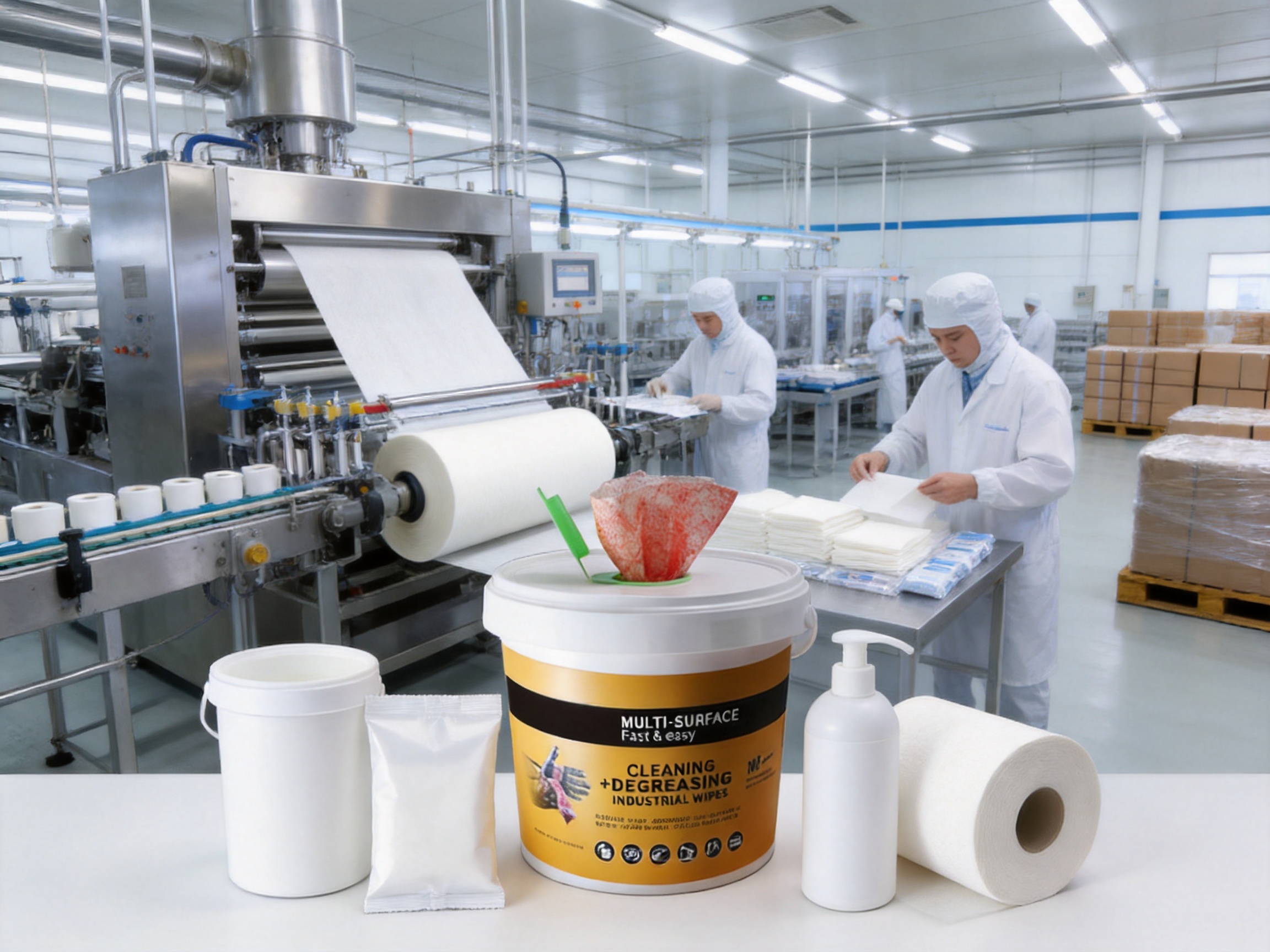
9. How to Select the Right Industrial Wipe
Choosing an industrial wipe should begin with the cleaning problem rather than the package appearance. Buyers should identify the type of contamination, the surfaces involved, the required cleaning speed, the expected frequency of use, and the workplace conditions.
9.1 Identify the Contaminant
Common contaminants include dust, soil, oil, grease, ink, paint, adhesive, wax, tar, asphalt, sludge, and lubricant. Some are water-soluble, some are oil-based, and some require a specialized solvent or mechanical action. The formula and substrate should be selected accordingly.
9.2 Identify the Surface
Hard, non-porous surfaces may include stainless steel, painted metal, glass, plastic, rubber, coated panels, and vehicle bodies. Surface sensitivity varies. A wipe suitable for unfinished metal may not be suitable for a delicate coating or plastic component.
Surface compatibility should be assessed through practical testing. The test should examine discoloration, dulling, swelling, cracking, sticky residue, coating damage, and any change in surface appearance after wiping and drying.
9.3 Define the Required Durability
Heavy contamination and rough surfaces require a wipe with adequate wet strength and tear resistance. For light dusting or final polishing, a softer and smoother material may be sufficient. Selecting the right durability can reduce both product waste and purchasing cost.
9.4 Consider Lint and Residue
Low-lint performance is important in many technical environments. Residue may also be a concern where the cleaned surface will be painted, bonded, coated, assembled, or inspected. Buyers should communicate these requirements clearly and request suitable test data or samples.
9.5 Select the Package for the Workflow
A portable bucket is useful for large teams and mobile maintenance. A canister can be convenient at a fixed workstation. A refill bag may reduce packaging cost for customers who already have durable dispensers. Soft packs and flow packs may support compact storage or retail-adjacent professional channels.
9.6 Confirm Commercial Requirements
Before ordering, buyers should confirm minimum order quantity, sample policy, production lead time, packaging artwork requirements, carton quantity, palletization, shipping terms, payment terms, shelf-life expectations, and documentation. These details affect the total project cost and launch schedule.
10. Commercial Value for Distributors and Private-Label Buyers
For a distributor, industrial wipe performance directly affects customer retention. If wipes tear, dry out, dispense poorly, or fail to remove common contaminants, end users may quickly switch suppliers. Consistency and technical support are therefore important parts of the product value proposition.
Private-label buyers can use customized industrial wipes to build a branded maintenance range. The product can be positioned by industry, cleaning intensity, substrate technology, package size, fragrance profile, or environmental objective. The ability to order multiple formats from one manufacturer may simplify supplier management.
Large production capacity can also support promotional planning and regional distribution. However, inventory should be planned carefully because wipes contain liquid and may have specific storage conditions. A demand forecast should account for seasonal maintenance activity, customer contracts, shipping schedules, and packaging lead times.
Industrial wipes are generally intended for wholesale, OEM, commercial, and institutional purchasing rather than small-quantity consumer orders. This business model is suitable for importers, industrial suppliers, MRO distributors, cleaning brands, e-commerce companies purchasing in bulk, and organizations with recurring maintenance needs.
When comparing suppliers, buyers should evaluate the complete cost of ownership rather than only the price per pack. Relevant factors include the number of wipes required per task, cleaning speed, durability, dispensing loss, product shelf stability, packaging damage, freight efficiency, documentation support, and the cost of handling used rags or alternative cleaning materials.
11. Sustainability and Responsible Product Development
Environmental performance is increasingly important in industrial procurement. Product developers may consider renewable fibers, efficient basis weight, reduced packaging, refill systems, optimized transportation, and responsible manufacturing practices.
Material selection should be based on actual application requirements. A longer-lasting wipe that uses fewer pieces may reduce consumption, while a lighter wipe may reduce material use per piece. The best solution depends on the cleaning task and the full product life cycle.
Claims such as biodegradable, compostable, flushable, recycled, or environmentally friendly should be used only when supported by appropriate testing and documentation. Industrial wipes containing strong cleaning solutions should also be disposed of according to the contamination involved and applicable local requirements.
The manufacturer reports an eco-friendly green production approach and product lines that include degradable and flushable nonwoven materials. These capabilities may support customers seeking more sustainable product concepts, but each industrial wipe project should be evaluated individually because heavy-duty formulas, contamination type, and disposal practices can affect environmental claims.
12. Frequently Asked Questions
Q1: What are industrial cleaning wipes mainly used for?
They are used to remove grease, oil, dust, ink, adhesives, lubricants, paint, tar, sludge, and other contaminants from hands, tools, machines, vehicle surfaces, workbenches, and hard, non-porous equipment surfaces.
Q2: Can these wipes be used on hands?
The product platform includes dermatologically tested industrial hand-cleaning wipes designed to help remove paint, dirt, grease, and other difficult substances without immediate access to water. Users should follow the specific product label and should not treat a general industrial wipe as a replacement for required handwashing or regulated hand disinfection.
Q3: What materials are available?
Available options include polyester, viscose, bamboo, lyocell, cotton, melt-blown, spunlace, wood-pulp composites, microfiber, and customized nonwoven materials. The best choice depends on absorbency, durability, lint, softness, residue requirements, and application.
Q4: Can the wipes be produced under our own brand?
Yes. OEM and private-label services can include wipe material, cleaning formula, fragrance, size, folding, package format, logo, label, printed artwork, carton design, and product documentation.
Q5: Can the cleaning formula be customized?
Yes. Possible options include water-based, alcohol-based, degreasing, solvent-free, low-residue, fragrance-free, and customer-specific formulas. Final development must consider surface compatibility, worker use, storage, shipping, and destination-market regulations.
Q6: Are portable buckets the only packaging option?
No. Other options include canisters, soft packs, refill bags, flow packs, and roll formats. Packaging should be selected according to consumption rate, portability, dispensing requirements, storage space, and distribution channel.
Q7: What sizes and basis weights are available?
Typical options include approximately 30–100 gsm, widths of about 12–22 centimeters, and lengths of about 12–30 centimeters. Exact specifications can be customized according to the product application and packaging design.
Q8: Which industries purchase industrial wipes?
Common customers include manufacturing plants, automotive repair suppliers, MRO distributors, equipment maintenance companies, printing operations, metal-processing facilities, electronics assembly businesses, industrial cleaning brands, importers, government departments, and institutional procurement organizations.
Q9: What documents may be available?
Depending on the product and destination market, documentation may include ISO-related certificates, SDS or MSDS, COA, FDA registration where applicable, REACH information, RoHS documentation, technical data, product specifications, and other compliance materials required by the buyer or local authority.
Q10: How long does OEM production take?
Lead time depends on order quantity, product complexity, formula development, packaging artwork, raw-material availability, testing, and production scheduling. A detailed timeline should be confirmed after the product specifications and packaging requirements are approved.
Q11: Are small consumer orders available?
The manufacturing program is designed primarily for wholesale, OEM, ODM, commercial, and institutional projects. Customers should discuss minimum order quantities and project scale with the supplier before requesting production.
Q12: How should buyers test a new wipe?
Buyers should test the wipe on representative contaminants and surfaces under actual working conditions. Evaluation may include cleaning speed, number of wipes used per task, tear resistance, lint, residue, drying time, fragrance, dispensing, package sealing, and user acceptance.
13. Recommended OEM Project Process
A clear project process helps customers move from an initial concept to stable mass production.
Step 1: Define the Application
Describe the target industry, contamination, surfaces, cleaning intensity, user group, and expected consumption. Photographs, sample contaminants, and existing competitor products can help the manufacturer understand the requirement.
Step 2: Select the Substrate and Formula
Choose the material, basis weight, texture, size, and solution type. The manufacturer can recommend alternatives based on cleaning performance, target cost, packaging volume, and market positioning.
Step 3: Produce and Evaluate Samples
Samples should be tested in realistic conditions. If the first version is too dry, too wet, too soft, too abrasive, too fragrant, or insufficiently strong, the specifications can be adjusted before approval.
Step 4: Confirm Packaging and Compliance
Finalize the bucket, canister, soft pack, refill, flow pack, or roll format. Confirm artwork, label content, warnings, batch coding, carton markings, SDS requirements, and destination-market documentation.
Step 5: Approve a Pilot or Preproduction Batch
A pilot or preproduction review can verify that the approved sample translates correctly to production equipment. This stage is useful for checking dispensing, moisture distribution, sealing, appearance, and carton configuration.
Step 6: Begin Mass Manufacturing
After approval, the manufacturer schedules raw materials, production, testing, packaging, and shipment. Batch records and inspection procedures help maintain consistency for repeat orders.
Step 7: Review Ongoing Performance
After market launch, customer feedback can be used to improve the wipe, adjust pack sizes, develop additional formulas, or create industry-specific versions. Long-term cooperation is especially valuable when demand grows across multiple markets.
Conclusion
Heavy-duty industrial cleaning wipes provide a practical solution for removing grease, oil, ink, paint, adhesives, dirt, lubricants, tar, sludge, and other difficult contaminants. Their combination of strong nonwoven construction, textured cleaning surfaces, moisture-balanced formulas, and portable packaging makes them suitable for hands, tools, machine parts, workbenches, automotive surfaces, and many other hard, non-porous applications.
Compared with inconsistent cloth rags and lightweight general-purpose wipes, a professionally manufactured industrial wipe can offer more predictable quality, improved durability, controlled dispensing, reduced cross-contamination risk, and greater convenience. The ability to customize the material, basis weight, size, pattern, formula, folding, fragrance, package, and branding allows distributors and private-label buyers to develop products for specific industries and market segments.
Zhejiang Uniquality Nursing Products Technology Co., Ltd., together with the Kingsafe and Uniquality manufacturing network, brings long-term nonwoven expertise, multiple production bases, integrated material and finished-product capabilities, research resources, testing support, OEM and ODM flexibility, and international documentation experience to industrial wipe projects.
For buyers seeking a reliable supplier, the most important evaluation should combine product performance with manufacturing strength. A suitable partner should be able to understand the application, develop the right wipe structure and formula, provide representative samples, support compliance requirements, manage customized packaging, and maintain stable quality during large-scale production. With these elements in place, industrial cleaning wipes can become a dependable component of professional maintenance programs and a commercially scalable product for global B2B distribution.
References
1. Manufacturer-provided product specifications for heavy-duty industrial cleaning wipes, including material, basis weight, dimensions, patterns, fragrances, packaging, and OEM options.
2. Manufacturer-provided company information concerning nonwoven material production, hygiene-product manufacturing, research and development, production bases, testing capabilities, and international supply services.
3. General principles of nonwoven fabric manufacturing, including fiber selection, bonding, embossing, converting, wet-strength management, and absorbency control.
4. General industrial maintenance practices for the removal of oils, grease, lubricants, inks, adhesives, paint, dust, and other workplace contaminants.
5. General product-development principles for cleaning wipes, including surface compatibility testing, formula evaluation, packaging validation, storage review, and user-performance assessment.
6. Applicable safety data sheet, chemical labeling, transportation, workplace-use, and destination-market compliance requirements for pre-moistened cleaning products.