中文简体
中文简体 English
 日本語
日本語 русский
 Español
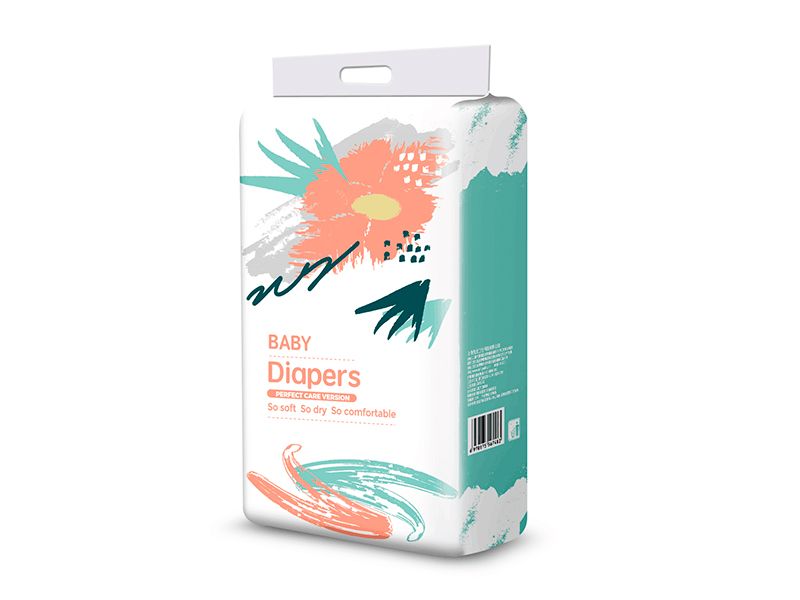
Choosing a baby diaper is an important decision for parents, caregivers, retailers, and healthcare-oriented product distributors. A diaper must do much more than absorb liquid. It must help keep the baby’s skin dry, reduce the risk of leakage, remain comfortable during movement, fit securely around the body, and provide convenient handling for caregivers. At the same time, buyers increasingly expect consistent quality, responsible manufacturing, flexible customization, and dependable supply capabilities.
Absorbent baby diapers are designed to address these expectations through a combination of fast liquid acquisition, water-locking performance, directional fluid management, three-dimensional leakage protection, soft elastic construction, and adjustable fastening. The product described in this article is positioned within the premium diaper category and is suitable for customers seeking reliable private-label or original equipment manufacturing solutions. Its design focuses on the practical needs of babies and parents while benefiting from the technical capabilities of an experienced manufacturer of nonwoven materials and hygiene products.
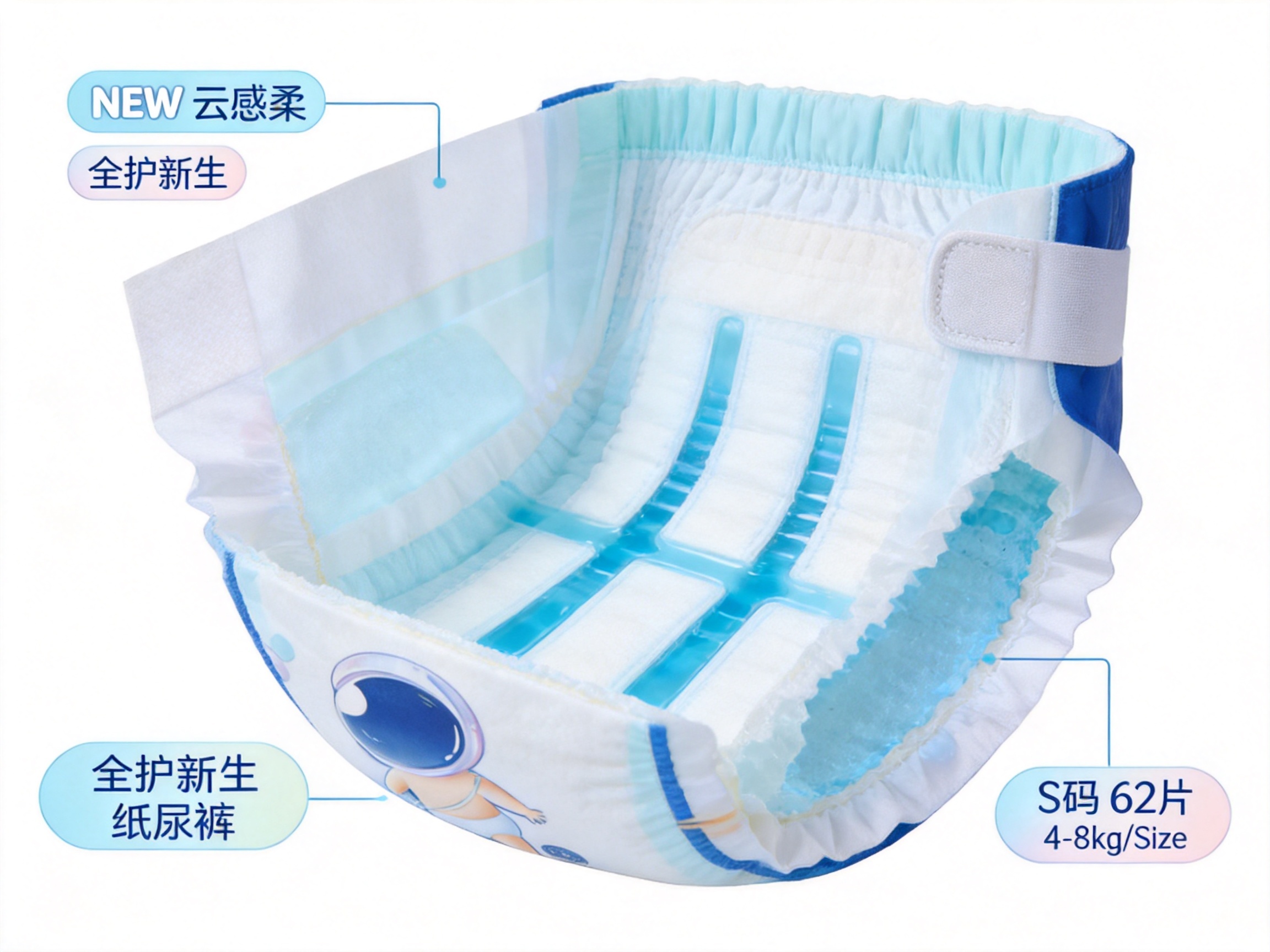
The diaper combines three layers that work together to quickly receive liquid and lock it within the absorbent structure. It also includes three full-length diversion grooves to help distribute fluid more efficiently, heightened double three-dimensional leak-proof partitions to create additional barriers, and a soft elastic back waist for a closer yet more comfortable fit. A widened and lengthened soft non-adhesive magic buckle further improves convenience and positioning.
These features are not isolated additions. They form an integrated system intended to support dryness, comfort, fit, and ease of use. The result is a diaper designed for daily routines, overnight wear, travel, childcare, and other situations in which dependable protection is essential.
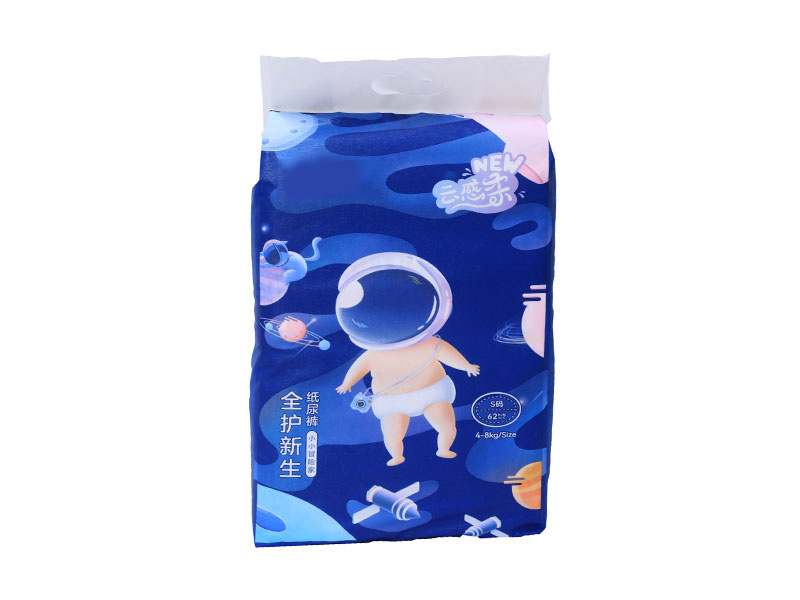
Absorbent baby diapers
Understanding the Main Performance Requirements of Baby Diapers
Baby diapers operate in a demanding environment. Infants may remain in one position for extended periods, move rapidly during play, sleep for several hours, or change position frequently. A diaper that performs well in one situation must still remain comfortable and protective in another. This requires coordinated performance from the topsheet, absorbent core, backsheet, leg barriers, waist area, and fastening system.
The first requirement is rapid intake. When liquid is released, it should move away from the skin as quickly as possible. A slow intake rate can leave moisture in contact with the baby and may also create a risk of surface wetness. The second requirement is retention. Once liquid enters the absorbent core, it must remain there instead of returning to the surface or escaping through the sides.
The third requirement is distribution. Liquid should not accumulate in only one small area. Uneven distribution can overload a local section of the absorbent core while other areas remain underused. Diversion channels help guide liquid toward a wider absorbent area, supporting more balanced use of the diaper’s internal capacity.
The fourth requirement is containment. Even a highly absorbent core cannot prevent leakage if liquid bypasses the core at the waist, legs, or sides. Leak-proof partitions and elastic components therefore play a vital role. Finally, a diaper must be easy to put on, adjust, remove, and dispose of. A technically capable product that is difficult to handle will not deliver a satisfactory user experience.
Fast Absorption and Moisture Management
The three-layer fast-suction and water-locking design is intended to separate the functions of receiving, transferring, and retaining liquid. A well-coordinated structure can help liquid pass quickly through the surface layer, spread through the internal absorbent zone, and remain locked away from the baby’s skin.
Fast absorption is particularly important for active babies and nighttime use. During a single fluid event, a diaper may need to receive liquid quickly without allowing it to flow backward or collect at the surface. The product’s layered structure is designed to support this process. By combining fast intake with internal retention, it aims to provide a drier feeling and reduce the likelihood of wetness reaching the outer surface.
Moisture management also affects comfort. A diaper that stays wet against the skin can feel heavy and uncomfortable. Continued exposure to moisture may contribute to irritation, especially when combined with friction, heat, or prolonged wear. While no diaper can replace regular changing and appropriate skin care, efficient liquid management can support a cleaner and more comfortable wearing environment.
Three Full-Length Diversion Grooves
The three full-length diversion grooves are designed to guide fluid along the diaper and help distribute it across the absorbent structure. Their length is important because short channels may provide limited directional control, while full-length grooves can support movement over a broader area.
Directional diversion is useful when a baby changes position. Liquid may otherwise collect in the central area, move toward the back, or travel toward the sides. By helping guide liquid through predetermined pathways, the grooves can reduce localized saturation and make better use of the available absorbent material.
The grooves also contribute to the visual and functional structure of the diaper. They can help define the central absorbent zone and cooperate with the surrounding barriers. Their effectiveness depends on the interaction between channel design, absorbent materials, compression, bonding, and the overall shape of the finished product. For this reason, manufacturing accuracy is important.
Water-Locking Absorbent Performance
Absorbency should not be measured only by how much liquid a diaper can hold under ideal laboratory conditions. Practical performance also includes how quickly the diaper receives liquid, how well it distributes moisture, how firmly it retains fluid under pressure, and how stable it remains when the baby moves.
The water-locking concept addresses retention after absorption. A diaper may be compressed when a baby sits, crawls, rolls, or sleeps on one side. If the internal structure releases liquid under pressure, the surface may become damp and leakage may occur. The product is designed to help lock liquid within its absorbent layers so that the diaper remains more reliable during everyday activity.
For distributors and private-label customers, water-locking performance is also a key part of product positioning. It provides a clear and meaningful benefit that can be communicated to parents without relying solely on decorative packaging or vague claims.
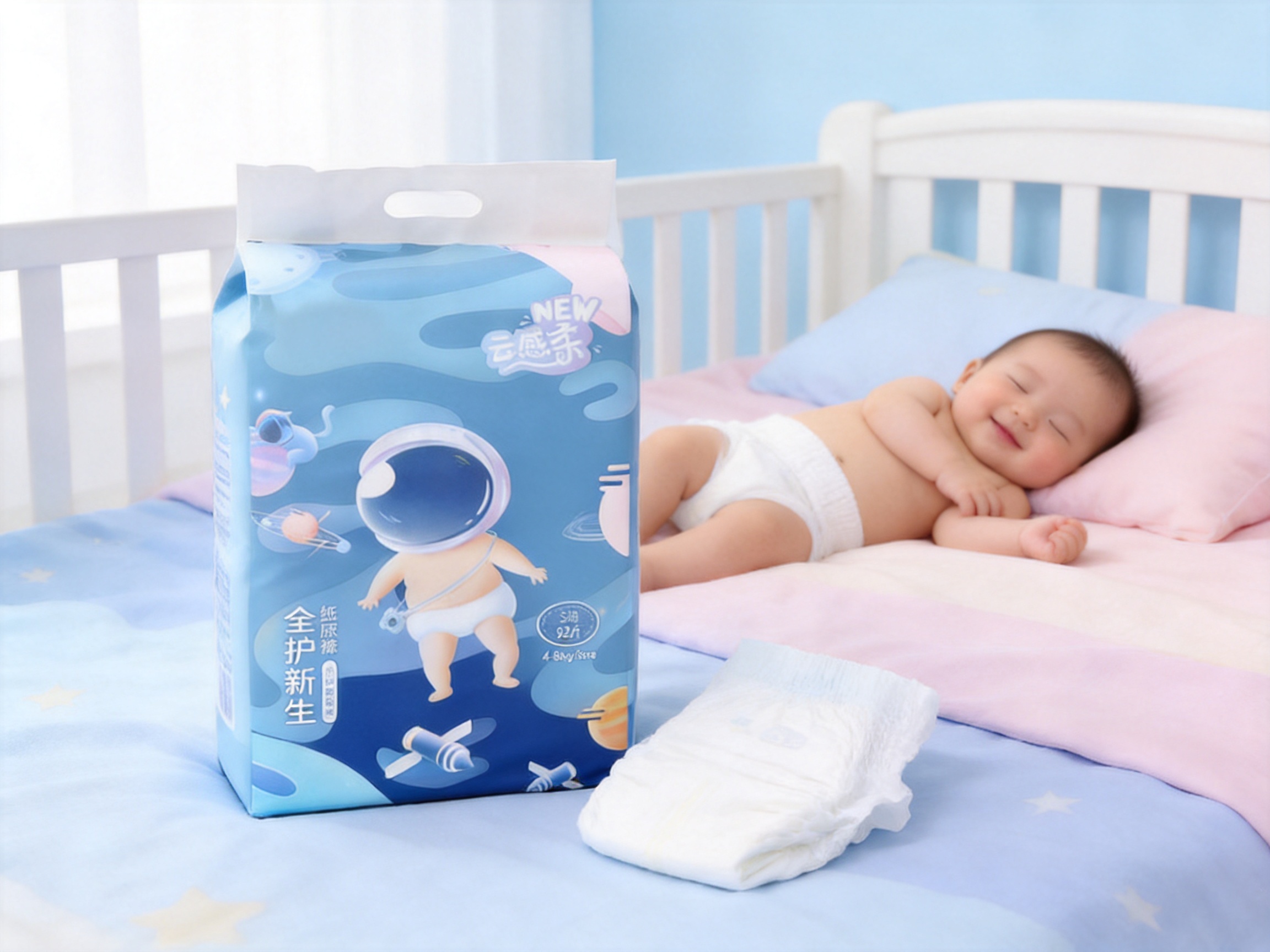
Leakage Protection Through a Multi-Barrier Construction
Leakage is one of the most common causes of dissatisfaction with baby diapers. It can occur when the absorbent core is overloaded, when liquid is not distributed properly, when the diaper shifts, or when fluid escapes through the leg or waist areas. The product addresses these risks through the cooperation of diversion grooves, heightened double three-dimensional leak-proof partitions, elastic components, and adjustable fastening.
Heightened Double Three-Dimensional Leak-Proof Partitions
The heightened double three-dimensional partitions are positioned to create elevated protective barriers along the sides of the diaper. Their three-dimensional form is intended to help channel fluid toward the absorbent core rather than allowing it to move directly toward the leg openings.
Using two raised barrier structures provides an additional level of protection compared with a single flat edge. The inner and outer barriers can work together to help contain fluid, especially when the baby is moving or lying in different positions. The partitions also help define the fit around the legs and support a more secure contact zone without requiring a rigid construction.
Barrier height, elasticity, bonding quality, and symmetry are all important. If a barrier is too low, it may not provide sufficient containment. If it is too rigid or poorly positioned, it can reduce comfort. A well-controlled manufacturing process must therefore maintain consistent placement and tension across the diaper width.
Leg Fit and Movement Protection
A baby diaper needs to protect against leakage without restricting normal movement. Babies kick, bend their knees, crawl, sit, and turn during sleep. The leg area must accommodate these movements while keeping the protective structure close enough to the body to reduce gaps.
The three-dimensional side partitions are intended to support this balance. Their raised construction helps create a flexible boundary, while the diaper’s soft materials reduce the risk of uncomfortable pressure. A stable leg fit can also help prevent the diaper from shifting when the baby is active.
Fit is influenced by more than the leg area alone. The back waist, fastening tabs, absorbent core shape, and overall dimensions must work together. A diaper with strong absorption but an unstable fit may still leak. Conversely, a secure fit with inadequate liquid management may become saturated. The product’s performance comes from combining both functions.
Back Waist Protection
The soft elastic back waist is designed to improve the diaper’s ability to follow the baby’s body. The back waist area is especially important during sleep and movement because it can help maintain contact and reduce the chance of gaps between the diaper and the back.
Elasticity allows the waist area to expand and contract as the baby moves. A soft elastic construction can also make the diaper more comfortable during extended wear. The intention is to provide a closer fit without creating a stiff or restrictive feeling.
For caregivers, a flexible back waist can make positioning easier. It helps the diaper sit naturally against the body and can support more consistent placement from one change to the next. Proper positioning remains essential, but a responsive waist can make that task simpler.
Softness, Comfort, and Skin-Friendly Design
Absorbency and leakage protection are essential, but comfort determines whether a diaper is pleasant to use throughout the day. A baby’s skin is delicate, and the diaper remains in close contact with the body for long periods. Softness should therefore be considered across the topsheet, leg barriers, waist area, and fastening components.
The product uses soft structural elements in areas that directly or indirectly affect the baby’s comfort. The soft elastic back waist is intended to reduce harsh contact around the body. The non-adhesive magic buckle is designed to provide secure fastening without relying on a rough adhesive surface against the skin.
A comfortable diaper should also support freedom of movement. Excess bulk, stiff materials, or poorly controlled edges can interfere with crawling, rolling, sitting, or walking. The diaper’s design seeks to balance the amount of absorbent material needed for performance with a structure that remains practical for normal baby activity.
Why Soft Materials Matter
Soft materials can reduce the sensation of friction when the baby moves. This is particularly relevant at the leg openings and waist, where repeated movement may cause rubbing. A well-finished nonwoven surface can offer a smooth hand feel while supporting the structural requirements of the diaper.
Nonwoven materials are widely used in hygiene products because they can be engineered for softness, fluid passage, strength, breathability, and process compatibility. Different nonwoven technologies can be selected for different layers. The manufacturer’s experience with spunlace, spunmelt, and hot-air-through nonwoven materials provides a broad technical foundation for developing hygiene products with differentiated functions.
Softness must be consistent, not limited to a small area. Manufacturing controls should help ensure that the topsheet, side panels, waist area, and barrier materials meet defined quality expectations. Consistency is especially important for private-label customers, because repeat purchasers expect the same feel and performance from every production batch.
Breathability and Wearing Comfort
A diaper’s outer materials influence how heat and humidity are managed during wear. Breathable components can contribute to a more comfortable microenvironment, although performance depends on the complete construction, fit, usage conditions, and changing frequency.
Comfort should be viewed as a complete experience that includes softness, dryness, fit, flexibility, and weight. The product’s fast-suction structure, water-locking layers, soft waist, and leak-proof partitions are intended to work together rather than compete with one another.
Convenient Fastening With a Widened Soft Magic Buckle
Fastening is one of the most visible differences between diaper designs. Caregivers need to secure the diaper quickly and accurately, often while the baby is moving. The product adopts a widened and lengthened soft non-adhesive magic buckle to support this process.
A wider fastening surface can provide more flexibility during positioning. It may allow caregivers to adjust the diaper more easily and accommodate differences in body shape. The added length can also provide a broader adjustment range as the caregiver seeks a comfortable fit.
The non-adhesive construction is designed to avoid the use of a sticky fastening surface. This can make the fastening experience more convenient and may reduce concerns about adhesive contact with skin, clothing, or other materials. The soft structure is intended to support comfortable handling while still maintaining a secure closure.
Benefits for Caregivers
Parents and caregivers often change diapers under time pressure. A fastening system that is easy to locate, grip, open, adjust, and refasten can reduce frustration. It can also make diaper changes more consistent, which supports correct positioning of the leak-proof partitions and absorbent core.
The buckle can be adjusted according to the baby’s size and movement. Caregivers should ensure that the diaper is secure but not excessively tight. The correct fit should allow comfortable movement while keeping the waist and leg barriers close to the body.
For childcare centers, hospitals, retailers, and distributors, simple fastening can also be a practical product advantage. Staff and caregivers may handle many changes each day, so a reliable closure can improve efficiency and reduce waste caused by incorrectly positioned diapers.
Product Advantages Compared With Basic Diaper Designs
Premium diapers generally distinguish themselves through the coordination of multiple performance features rather than through one isolated specification. Compared with a basic diaper design, this product offers several integrated advantages.
| Performance Area | Product Design | Practical Benefit |
|---|---|---|
| Liquid intake | Three-layer fast-suction structure | Helps receive liquid quickly and reduce surface wetness |
| Fluid distribution | Three full-length diversion grooves | Guides liquid through a wider absorbent area |
| Fluid retention | Water-locking absorbent layers | Helps retain liquid during movement and pressure |
| Side protection | Heightened double three-dimensional partitions | Creates additional barriers against side leakage |
| Waist fit | Soft elastic back waist | Supports a closer, flexible fit during sleep and activity |
| Fastening | Widened and lengthened soft non-adhesive magic buckle | Improves adjustment and caregiver convenience |
| Material expertise | Advanced nonwoven manufacturing capabilities | Supports consistency, customization, and functional development |
The comparison demonstrates that the product is designed as a complete protection system. Basic designs may offer absorption but lack directional channels, elevated dual barriers, or a flexible fastening system. Other products may include some of these elements but use narrower fastening components or less developed waist structures.
The most meaningful advantage is the relationship between the features. Fast intake helps liquid enter the diaper. Diversion grooves help move it. The absorbent layers help retain it. The side partitions and waist elastic help keep it contained. The buckle helps the caregiver position the diaper correctly. Together, these functions can provide a more dependable experience than a product relying on a single absorbent layer and simple side edges.
Manufacturing Expertise and Technical Foundations
The product is manufactured by Zhejiang Uniquality Nursing Products Technology Co., Ltd., operating within the Kingsafe and Uniquality group. Founded in 1987, the company has developed extensive experience in research, production, and sales related to medical and hygienic nonwoven materials, nursing products, and high-end clothing interlining.
The company is headquartered in Changxing, Huzhou, Zhejiang, an area with convenient land, sea, and air transportation connections within the Yangtze River Delta. It has also established eight production bases in China, including facilities in Foshan, Guangdong, Nantong, Jiangsu, and Wuhan, Hubei. This multi-base structure supports production capacity, regional coordination, and supply planning.
More than three decades of development have allowed the company to build a broad technical and operational foundation. According to the supplied company information, it has ranked among the leading enterprises in China’s industrial textile industry and has been recognized among major nonwoven manufacturers in China and internationally.
Advanced Nonwoven Production
Nonwoven materials are central to modern hygiene products. Unlike woven fabrics, nonwovens are formed through processes that bond or entangle fibers without conventional yarn interlacing. This provides manufacturers with flexibility in controlling basis weight, softness, strength, absorbency support, air permeability, surface texture, and functional performance.
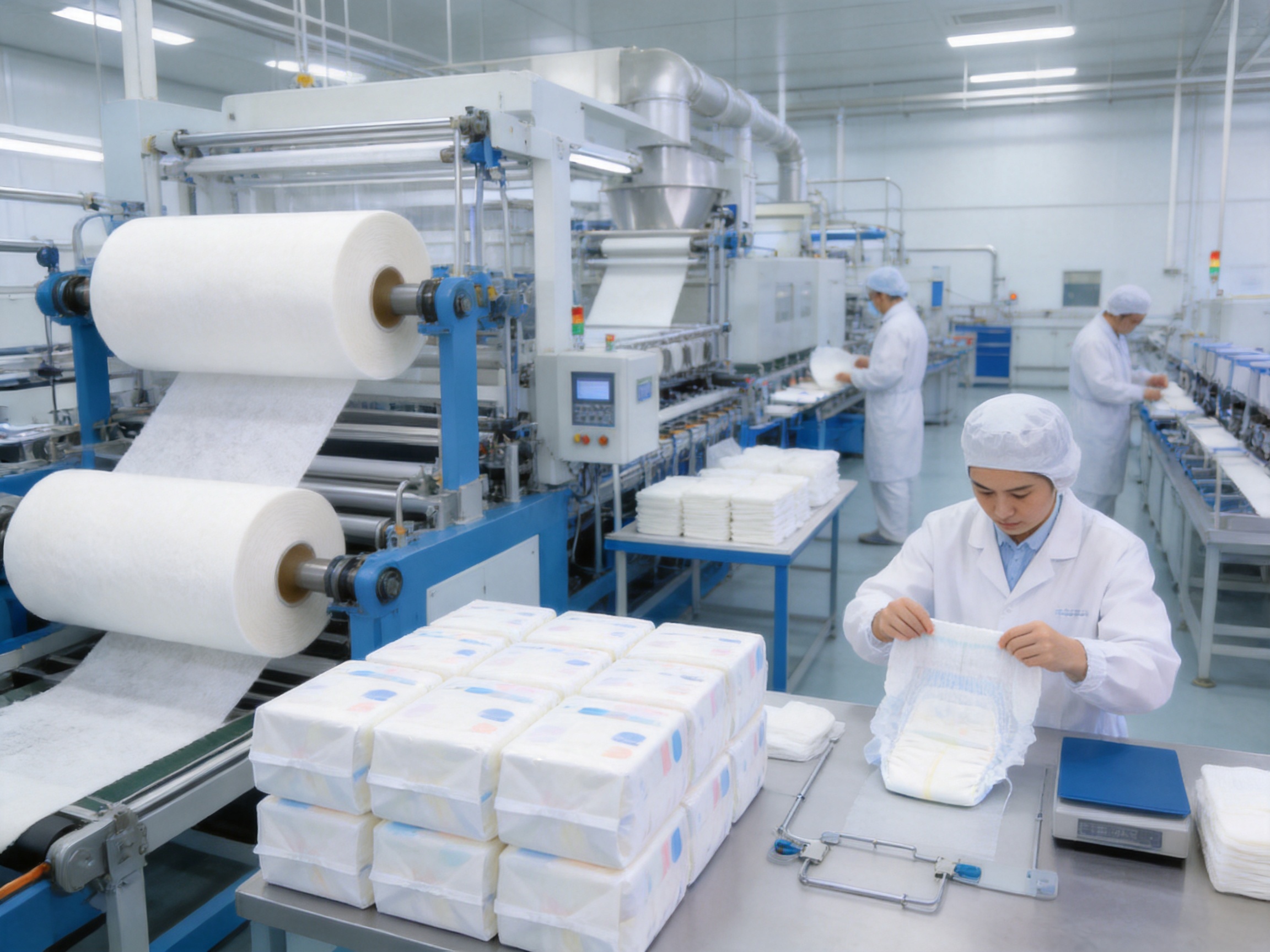
The company has introduced advanced production equipment and technology from Germany, France, and Italy. International equipment and process experience can support stable production, precise material formation, and improved quality control. These capabilities are relevant to baby diapers because every layer must meet specific requirements, and small variations can influence comfort, absorption, fit, and appearance.
The company’s stated material capabilities include spunlace nonwoven fabrics, spunmelt nonwoven fabrics, hot-air-through nonwoven fabrics, flushable and degradable nonwoven fabrics, wet wipes, and dry wipes. This range indicates experience with several nonwoven technologies and with products requiring different combinations of softness, strength, liquid handling, and surface performance.
From Material Development to Finished Product
A strong diaper manufacturing process begins before the finished diaper reaches the assembly line. It starts with material selection and formulation. The manufacturer must determine which materials are suitable for the topsheet, absorbent core support, backsheet, leg barriers, waist components, and fastening areas.
The next step is structural design. The three diversion grooves, absorbent zones, side partitions, elastic waist, and fastening system must be positioned accurately. The design must account for the intended size range, baby movement, packaging requirements, and production efficiency.
During assembly, individual materials are combined through controlled bonding, cutting, folding, elastic placement, and fastening attachment. The process must maintain alignment and tension. If the grooves are not correctly positioned, fluid distribution may be affected. If the elastic is uneven, the fit may vary. If the fastening components are misaligned, caregivers may have difficulty securing the diaper.
Quality control should continue throughout production. Incoming materials can be checked for appearance, dimensions, softness, strength, and other relevant properties. In-process inspections can verify alignment, bonding, elastic placement, cutting accuracy, and closure attachment. Finished products can be assessed for size, weight, appearance, packaging, and functional performance.
Production Consistency for Private-Label Customers
Private-label customers need more than a product concept. They need repeatable manufacturing, stable specifications, reliable communication, and the ability to support packaging or product differentiation. A supplier with experience in both materials and finished hygiene products is well placed to coordinate these requirements.
The company’s product portfolio covers medical, maternal and baby, beauty, home, industrial cleaning, and clothing applications. This broad experience can support cross-functional understanding of nonwoven materials and consumer product requirements. It also provides a foundation for customers seeking related products, such as wet wipes, dry wipes, training pants, pull-ups, or other nursing products.
Customization may involve product dimensions, absorbency targets, material combinations, printing, packaging, fastening design, or market-specific requirements. Any customization should be confirmed through technical evaluation and sample testing before mass production. The manufacturer’s stated ability to meet differentiated, functional, and customized customer needs is therefore relevant to brand owners and distributors seeking a long-term supply partner.
Quality, Safety, and Product Development Considerations
Baby diapers are products used close to a child’s skin, so quality and safety must be treated as fundamental requirements. A responsible development process should evaluate materials, construction, packaging, production hygiene, and product performance.
Material selection should consider softness, cleanliness, odor, strength, and suitability for intended contact. The finished diaper should have smooth edges, secure bonding, and properly controlled elastic tension. The fastening system should remain attached during normal use while allowing caregivers to open and adjust the diaper without excessive force.
Performance testing may include absorbency, acquisition speed, rewet, leakage resistance, tensile strength, fastening strength, elastic recovery, dimensional accuracy, and visual inspection. Tests should be selected according to the product specification, target market, applicable regulations, and customer requirements.
Quality should also be monitored after packaging. Compression during transportation and storage can affect product shape and fastening components. Proper packaging design helps protect the diapers from contamination, moisture, deformation, and handling damage. Batch identification and traceability support effective quality management and customer service.
Continuous Improvement
Diaper manufacturing is not a one-time engineering task. Consumer expectations change, new materials become available, and different markets require different features. Continuous improvement may focus on reducing leakage, improving softness, optimizing absorbent material usage, enhancing packaging efficiency, or developing more environmentally considerate materials.
The company’s research and development orientation is supported by its high-technology enterprise background and extensive experience in nonwoven materials. Its product range includes flushable and degradable nonwoven materials, indicating engagement with functional and environmental development areas. Any environmental claim for a finished diaper, however, should be supported by appropriate testing and regulatory review rather than assumed solely from the use of a particular material.
Applications Across Daily Baby Care
The product is suitable for a wide range of everyday uses. During daytime activities, the fast intake structure and flexible fit can support babies who are crawling, rolling, sitting, or beginning to walk. During naps and nighttime sleep, the water-locking core, diversion grooves, back waist, and side partitions provide a coordinated approach to extended protection.
Travel is another important use case. Parents may not have immediate access to changing facilities, so a diaper that is easy to fasten and designed for reliable containment can be especially useful. The product can also be included in hospital, nursery, childcare, and family-care supply programs where consistent performance is important.
For retailers, the product can be positioned as a premium diaper with practical, easy-to-understand benefits. Rather than focusing only on marketing language, retailers can explain the relationship between fast absorption, fluid distribution, water locking, leak-proof barriers, soft waist construction, and adjustable fastening.
Guidance for Correct Use
Caregivers should select the size appropriate for the baby’s weight, body shape, and stage of development. The diaper should be opened fully before placement. The back should be positioned evenly, the leg partitions should be pulled outward, and the front should be aligned with the waist.
The fastening buckle should be secured symmetrically and adjusted so that the diaper remains close to the body without being too tight. The three-dimensional side partitions should not be folded inward, because doing so may reduce their protective function. After fastening, caregivers should check the leg and waist areas for gaps and confirm that the baby can move comfortably.
Diapers should be changed regularly according to the baby’s needs. Even a high-performance diaper should not be considered a substitute for timely changing, gentle cleansing, or appropriate skin-care practices. If persistent irritation or discomfort occurs, caregivers should seek professional medical advice.
Why Manufacturing Scale Matters to Buyers
Product quality is important, but supply reliability is also critical for importers, wholesalers, retailers, and private-label companies. A supplier must be able to produce consistent goods, coordinate packaging, manage schedules, and support communication across the development and delivery cycle.
The company’s eight production bases and long operating history provide a foundation for supply planning. Multiple facilities may help support capacity allocation and operational resilience, although customers should confirm specific production arrangements, lead times, minimum order quantities, and export documentation for each project.
Experience across nonwoven materials and finished hygiene goods can also reduce coordination complexity. A customer developing a baby diaper and related wet wipes, dry wipes, or training pants may benefit from working with a supplier familiar with the material and packaging relationships among these product categories.
For international buyers, the company’s location in Zhejiang and its transportation connections in the Yangtze River Delta are relevant logistical advantages. Efficient access to domestic transportation and export channels can support planned delivery, subject to destination requirements and shipping conditions.
Private-Label and OEM/ODM Potential
Private-label diaper programs typically require cooperation in several areas: product specifications, size selection, absorbency expectations, material preferences, fastening options, packaging design, regulatory documents, sample approval, production scheduling, and shipment coordination.
The manufacturer’s stated OEM and ODM capabilities cover wet and dry wipes, diapers, and growing training pants. This makes the product suitable for businesses that want to build or expand a maternal and baby care range. A retailer may begin with a standard premium diaper specification and later develop market-specific variations based on consumer feedback.
OEM production generally focuses on manufacturing according to a customer’s established design or specification. ODM cooperation may involve more support in product structure, material selection, function development, and packaging concepts. The appropriate model depends on the buyer’s technical resources, market position, order volume, and desired level of customization.
Important Questions for Project Development
Before placing an order, buyers should clarify the available sizes, recommended weight ranges, absorbency requirements, packaging formats, carton dimensions, sample procedures, production lead time, and quality inspection standards. They should also discuss whether the product can be adjusted for different regional preferences or retail channels.
Buyers should request technical information and samples before approving a final specification. Samples allow the buyer to examine softness, fit, fastening, packaging appearance, and practical performance. Testing should include different baby positions and realistic use conditions, not only visual inspection.
Clear documentation helps avoid misunderstandings. The approved sample, product specification, artwork, packaging details, inspection method, and change-control procedure should be recorded. Any change to materials, equipment, dimensions, or suppliers should be evaluated before implementation.
Environmental and Resource Considerations
Modern hygiene product development increasingly considers material efficiency, packaging reduction, manufacturing energy use, and end-of-life communication. These topics require careful evaluation because baby diapers are complex products composed of multiple materials selected for hygiene and performance.
Reducing unnecessary material use can lower product weight and packaging volume, but changes must not compromise absorption, containment, softness, or safety. The most appropriate approach is usually a balanced design that uses materials efficiently while maintaining the performance expected from a premium diaper.
The company’s experience includes flushable and degradable nonwoven materials, providing a technical basis for exploring material innovation. However, flushability and biodegradability are specific claims that require defined testing, appropriate infrastructure, and compliance with applicable market requirements. Customers should review the evidence and intended disposal conditions before making environmental claims.
Packaging can also be optimized. Lightweight packaging, efficient carton loading, and clear disposal information may help improve logistics and reduce unnecessary resource use. Environmental messaging should remain accurate, transparent, and supported by product-specific documentation.
Positioning the Product in the Premium Diaper Market
A premium diaper should communicate meaningful value. The product’s strongest positioning is based on functional performance: fast absorption, water locking, directional fluid distribution, enhanced side protection, soft waist comfort, and convenient adjustment.
These advantages can appeal to parents who prioritize dryness and leakage protection, distributors who require differentiated product features, and private-label brands seeking a dependable foundation for their own market identity. The product is not presented merely as a basic disposable diaper. It is designed as a multi-feature hygiene solution supported by experienced nonwoven manufacturing.
Premium positioning should be supported by consistent production. If performance varies between batches, consumer confidence may decline. The manufacturer’s long history, technical equipment, multiple production bases, and broad product expertise are therefore important elements of the value proposition.
At the retail level, the product can be explained through clear benefit statements. For example, the three-layer structure supports fast intake and water locking; the three full-length grooves support fluid distribution; the double three-dimensional partitions support leak resistance; the soft elastic back waist supports comfort; and the widened magic buckle supports easy fitting.
Frequently Asked Questions
What makes this diaper different from a basic baby diaper?
The product combines several coordinated features: three-layer fast suction and water locking, three full-length diversion grooves, heightened double three-dimensional leak-proof partitions, a soft elastic back waist, and a widened and lengthened soft non-adhesive magic buckle. The combined structure is designed to improve absorption, containment, fit, and convenience.
How do the three diversion grooves help?
The grooves are designed to guide liquid along the absorbent area and support more even distribution. This can help reduce localized saturation and allow the absorbent structure to be used more effectively.
What is the purpose of the double three-dimensional partitions?
They create raised side barriers that help contain liquid and reduce the chance of leakage through the leg areas. Their three-dimensional structure is intended to work with the diaper’s fit and elastic components.
Is the fastening system adhesive?
The product uses a soft non-adhesive magic buckle. It is widened and lengthened to provide convenient adjustment and secure positioning without relying on a sticky adhesive surface.
How does the soft elastic back waist improve comfort?
The elastic back waist is designed to follow the baby’s body more flexibly. It can help reduce gaps during movement and support a closer fit while maintaining softness around the waist.
Can the product be customized for a private label?
The manufacturer provides OEM and ODM services for diapers and related hygiene products. Potential customization may include product specifications, materials, packaging, dimensions, and functional details, subject to technical review, minimum order requirements, and sample approval.
What types of products does the manufacturer produce?
The company’s stated portfolio includes spunlace nonwoven fabrics, spunmelt nonwoven fabrics, hot-air-through nonwoven fabrics, flushable and degradable nonwoven fabrics, wet wipes, dry wipes, baby diapers, pull-ups, wet toilet paper, cleansing wipes, and other products for medical, maternal and baby, beauty, home, industrial cleaning, and clothing applications.
How long has the company been operating?
The company was founded in 1987 and has more than 30 years of experience in research, production, and sales related to nonwoven materials and nursing products.
Where is the company located?
The company is headquartered at 68 Luhui Road, Taihu Street, Changxing County, Huzhou City, Zhejiang, China. Buyers should contact the company directly to confirm current production, sampling, logistics, and export arrangements.
What should caregivers check after putting on the diaper?
Caregivers should check that the diaper is centered, the leg partitions are pulled outward, the waist is secure but not too tight, and there are no significant gaps around the legs or back. The baby should be able to move comfortably.
Can a premium diaper eliminate the need for regular changing?
No. Absorbent performance can support dryness and protection, but diapers should still be changed regularly according to the baby’s needs. Proper cleansing and skin care remain important parts of baby care.
Conclusion
Absorbent baby diapers must combine liquid management, leakage protection, comfort, fit, and convenience in one dependable product. This premium diaper design addresses those requirements through a three-layer fast-suction and water-locking structure, three full-length diversion grooves, heightened double three-dimensional leak-proof partitions, a soft elastic back waist, and a widened and lengthened non-adhesive magic buckle.
Its advantages over simpler designs come from the way these features function together. Liquid is intended to be received quickly, distributed through the absorbent area, and retained away from the skin. The side partitions and waist structure support containment, while the fastening system helps caregivers achieve a secure fit. These benefits make the diaper suitable for daily use, nighttime protection, travel, childcare, and private-label product programs.
The manufacturing foundation adds further value. Zhejiang Uniquality Nursing Products Technology Co., Ltd., operating within the Kingsafe and Uniquality group, brings a history dating back to 1987, advanced nonwoven production capabilities, international equipment and technology experience, multiple production bases, and a broad portfolio of hygiene and nursing products.
For parents, the product offers a practical combination of dryness, protection, softness, and ease of use. For distributors and private-label customers, it offers a technically developed diaper platform that can be evaluated, customized, and integrated into a broader maternal and baby care range. Buyers should confirm the final specifications, testing requirements, packaging, order conditions, and regulatory documentation before production, but the product provides a strong foundation for reliable premium diaper development.
References
1. Product specification and descriptive materials supplied for the absorbent baby diaper product.
2. Company information supplied for Zhejiang Uniquality Nursing Products Technology Co., Ltd. and the Kingsafe and Uniquality group.
3. General technical principles of disposable diaper construction, including topsheets, absorbent cores, backsheet materials, elastic components, leakage barriers, and fastening systems.
4. General nonwoven textile manufacturing principles covering spunlace, spunmelt, and hot-air-through nonwoven materials.
5. General hygiene product quality considerations for absorbency, rewet, leakage resistance, softness, fastening strength, dimensional consistency, and packaging protection.