中文简体
中文简体 English
 日本語
日本語 русский
 Español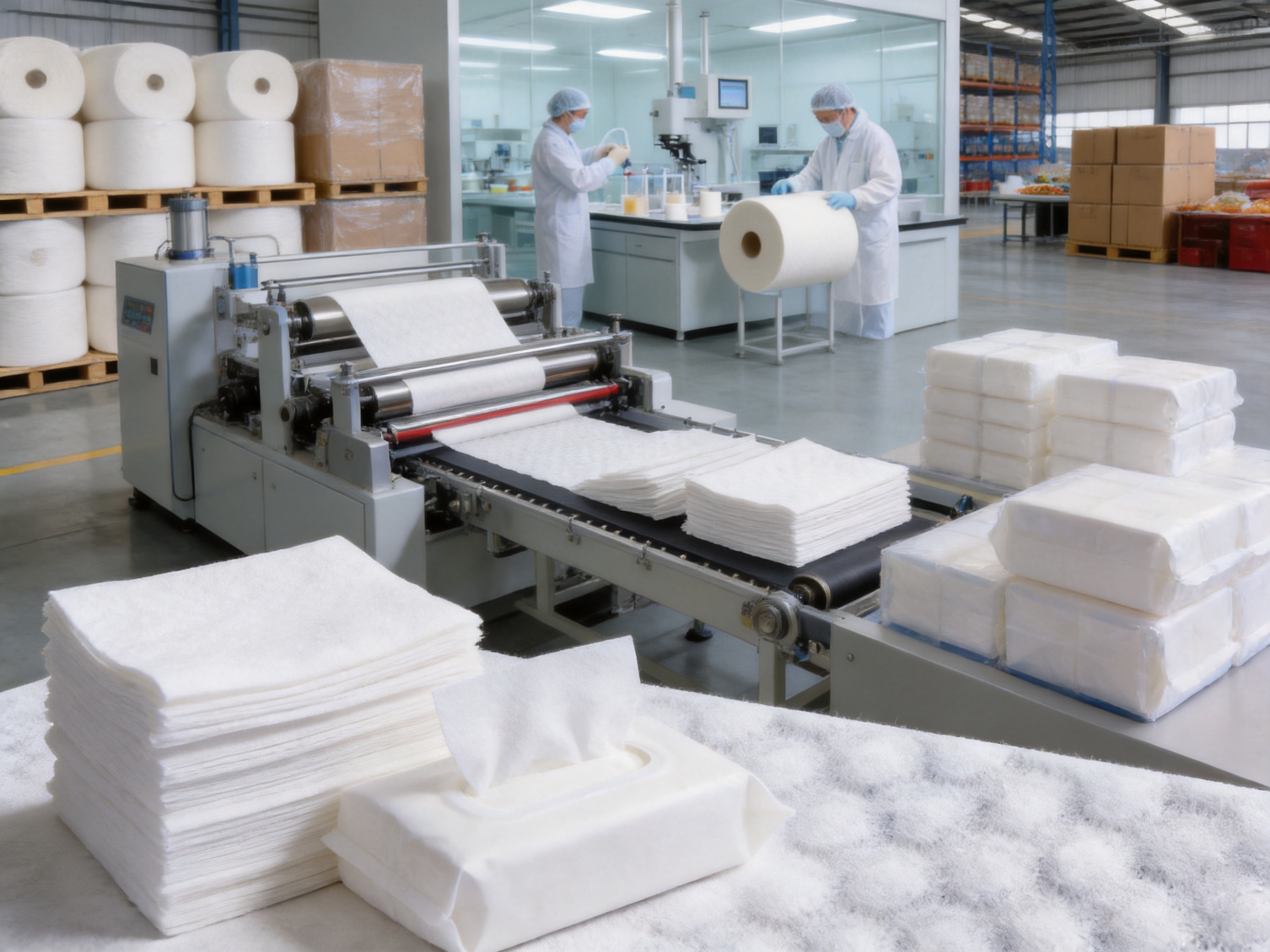
Restaurant kitchens, food service counters, catering facilities, hospitality operations, and commercial cleaning teams require wiping materials that can work quickly, absorb efficiently, resist tearing, and support consistent hygiene practices. A restaurant wipe is not simply a piece of fabric. It is a functional cleaning tool that must perform under demanding conditions involving water, cooking oil, sauces, food residue, grease, dust, and repeated wiping motions. It must also be practical for high-volume production, easy to convert, stable during storage, and suitable for different private-label product specifications.
The 5mm Big Dot Spunlace Nonwoven for Restaurant Wipes is designed to meet these requirements. With a basis weight of approximately 70 grams per square meter, a 50% viscose and 50% polyester composition, and a pronounced 5mm dot pattern, the material combines softness, absorbency, mechanical strength, and surface cleaning performance. It delivers some of the practical heaviness associated with traditional towels while retaining the convenience of a disposable or single-use wipe.
Manufactured through a double-carding, parallel-laid spunlace process, the fabric can be converted into wet wipes, dry wipes, kitchen cleaning cloths, and other commercial wiping products. Its composition and structure can also be customized for different processing lines, market requirements, packaging formats, and end-use applications. Available options include different basis weights, roll widths, fiber blends, finishing treatments, embossing patterns, and roll dimensions.
For manufacturers and brands, the material offers more than a basic nonwoven substrate. It provides a platform for developing restaurant wipes with improved wiping efficiency, controlled absorbency, flexible converting performance, and a strong value proposition for professional users.
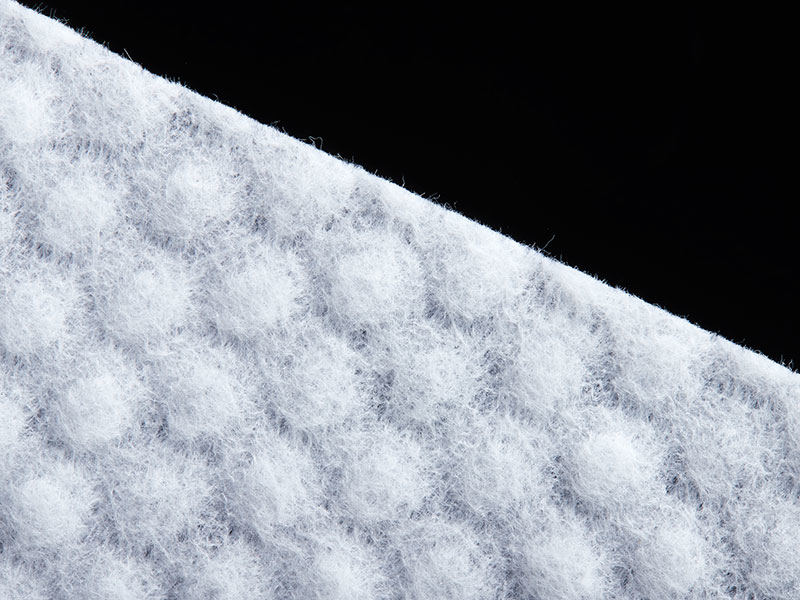
5mm Big Dot Spunlace Nonwoven For Restaurant Wipes
Why Restaurant Wipes Need a Specialized Nonwoven Structure
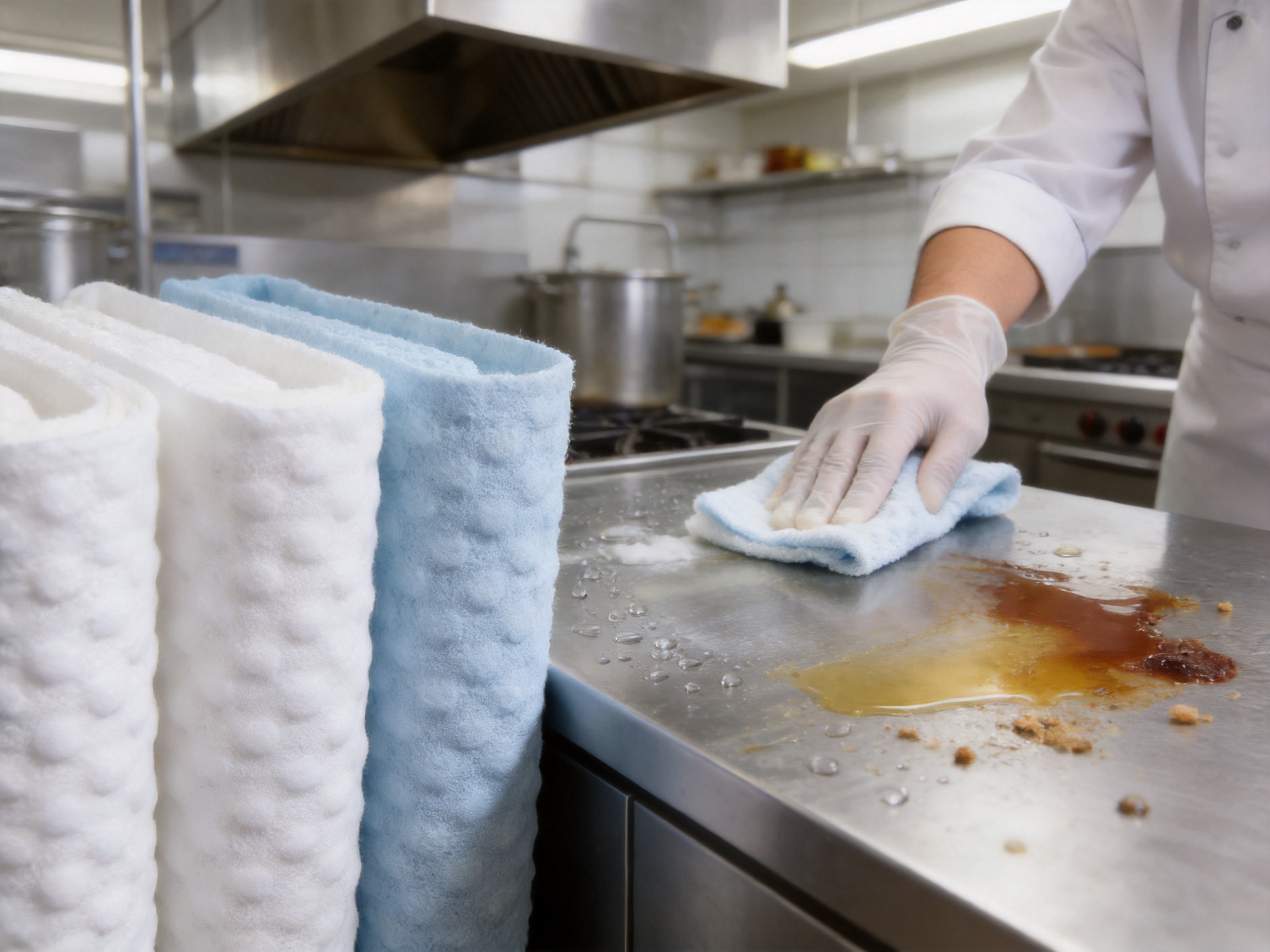
Restaurant cleaning is more demanding than many household wiping tasks. A commercial wipe may be used on tables, countertops, preparation surfaces, cooking equipment, refrigerator doors, service counters, shelves, utensils, and other areas exposed to moisture and food residues. In many cases, the user must remove a combination of loose particles, oil, liquid spills, sticky sauces, and fine dirt with one wiping motion.
A low-quality wipe can create several problems. It may absorb too slowly, spread grease instead of lifting it, leave lint on a clean surface, tear when wet, or lose its shape after repeated passes. These issues can increase labor time and material consumption. They may also affect the appearance of a restaurant or food service environment, where visible cleanliness is closely connected with customer confidence.
A specialized restaurant wipe substrate should therefore balance several performance factors:
- Rapid absorption of water and other compatible liquids.
- Effective pickup of oil, grease, crumbs, and food residue.
- Sufficient wet and dry strength for commercial use.
- Low-lint performance for cleaner wiping results.
- Resistance to tearing during handling and converting.
- Consistent thickness and surface texture across the roll.
- Compatibility with high-speed folding, slitting, and packaging equipment.
- Flexibility for wet-wipe and dry-wipe production.
- Options for customized basis weight, width, composition, and finishing.
The 5mm Big Dot structure addresses these requirements by combining a functional embossed surface with a strong spunlace base. The raised dots create additional surface relief, while the fiber network provides liquid handling capacity and mechanical integrity. This combination can give the final wipe a more substantial feel than a flat, lightweight sheet without requiring the complexity of a reusable textile towel.
Product Overview and Technical Profile
The standard product is a 70gsm spunlace nonwoven material made from an approximately equal blend of viscose and polyester. The viscose component contributes softness and liquid absorption, while polyester helps improve strength, dimensional stability, abrasion resistance, and shape retention. The blending ratio can be adjusted when customers need a different balance between absorbency, strength, softness, cost, or converting performance.
| Item | Standard or Available Specification | Functional Significance |
|---|---|---|
| Product type | 5mm Big Dot Spunlace Nonwoven | Suitable for restaurant, kitchen, wet-wipe, and dry-wipe applications |
| Standard basis weight | Approximately 70gsm | Provides a substantial hand feel while remaining suitable for disposable products |
| Basis weight range | Approximately 40gsm to 100gsm | Supports lightweight, standard, and heavy-duty product development |
| Composition | 50% viscose and 50% polyester | Balances absorbency, softness, strength, and shape retention |
| Composition customization | Available according to customer requirements | Allows performance and cost optimization |
| Manufacturing technology | Double-carding, parallel-laid spunlace | Supports uniform fiber distribution and stable material performance |
| Surface pattern | 5mm large raised dot pattern | Improves contact texture and assists dirt and grease pickup |
| Roll width | Approximately 10cm to 320cm | Suitable for different converting lines and product formats |
| Finishing options | Hydrophilic, coating, antistatic, and other treatments | Allows the material to be adapted to specific applications |
| Final products | Wet wipes, dry wipes, restaurant wipes, and cleaning cloths | Supports multiple commercial product categories |
The broad specification range is important for B2B customers because not every market requires the same wipe. A restaurant chain may require a thick, highly absorbent wipe for kitchen use, while a distributor may need a lighter material for economical table wipes. A private-label brand may request a specific roll width or folding format to match existing machinery. By offering customizable material parameters, the manufacturer can support different product concepts without forcing every customer into one fixed specification.
The Functional Advantage of the 5mm Big Dot Pattern
The surface pattern is one of the most visible and important features of this material. Instead of presenting a completely flat surface, the fabric incorporates large raised dots with an approximate diameter or pattern scale of 5mm. These raised areas create a textured contact surface that can interact more effectively with moisture, grease, dirt, and food residue.
During wiping, a flat material may glide across a smooth surface without making sufficient contact with irregular particles or sticky residues. The raised-dot structure can provide additional points of contact and a mild scrubbing effect without requiring an excessively abrasive material. This is especially useful when wiping tables, counters, stovetops, preparation equipment, display cases, and other food service surfaces.
The 5mm pattern can contribute to several practical advantages:
- Improved dirt pickup: The raised surface can help collect crumbs, particles, and residue instead of simply pushing them across the surface.
- More effective grease removal: The textured structure provides additional friction and contact points for lifting oily contamination.
- Enhanced liquid handling: Surface relief creates additional space for liquid distribution and uptake.
- Better wiping feedback: The user can feel the material engaging with the surface, which may improve perceived cleaning performance.
- More substantial product appearance: The large dot design gives the finished wipe a professional, purpose-built appearance.
- Reduced dependence on excessive pressure: A functional texture may help users achieve cleaning results with fewer aggressive passes.
The pattern should not be viewed as a substitute for a suitable cleaning chemical, sanitation procedure, or food safety program. Rather, it is a structural feature that supports the physical removal of contamination. The best cleaning result depends on the wipe, the cleaning solution, contact time, wiping technique, and the nature of the surface being cleaned.
Compared with a plain, low-texture nonwoven, the 5mm Big Dot material offers a more distinctive surface designed specifically for active wiping. Compared with highly abrasive scouring materials, it is better suited to routine wiping where the operator needs a balance of cleaning power, surface friendliness, softness, and disposability.
Balanced Fiber Composition: Viscose and Polyester
The standard composition uses 50% viscose and 50% polyester. This blend is important because restaurant wipes must manage competing performance requirements. Highly absorbent fibers may not always provide sufficient strength, while very strong synthetic fibers may not deliver the desired softness or liquid uptake. A balanced blend can provide a more practical combination for commercial wiping applications.
Contribution of Viscose
Viscose is a regenerated cellulose fiber known for its softness and ability to absorb water-based liquids. In a wiping substrate, viscose can help the fabric take up moisture quickly and provide a comfortable hand feel. It can also support the formation of a more textile-like surface, which is useful when the finished wipe is intended to feel substantial and pleasant during use.
For restaurant applications, absorbency is particularly important. A wipe may need to collect spilled water, diluted cleaning solution, beverage residue, or other water-based liquids. Viscose can help the wipe manage these liquids efficiently, reducing the need for repeated wiping or immediate replacement.
Contribution of Polyester
Polyester contributes strength, durability, abrasion resistance, and dimensional stability. It helps the material retain its shape when handled, folded, converted, or used in a wet condition. This is valuable in high-speed manufacturing as well as in the final application.
When a wipe becomes saturated, weak fibers can stretch, deform, or tear. The polyester component helps support the overall fiber network and can improve resistance to mechanical stress. It also contributes to a stable surface that can withstand contact with countertops, equipment, and other commercial surfaces.
Why the Blend Is Suitable for Commercial Wipes
The 50/50 blend offers a practical middle ground between absorbency and strength. It is suitable for customers who need a wipe that feels soft enough for routine surface cleaning but remains durable enough for demanding kitchen work. The material can be adjusted when customers prefer a higher viscose content for greater absorbency or a higher polyester content for additional strength and resilience.
Customized blends can also be considered for specific target markets. For example, a premium hospitality wipe may prioritize softness and appearance, while an industrial kitchen wipe may prioritize wet strength and abrasion resistance. The ability to adjust fiber composition allows manufacturers to develop different grades using the same general product platform.
Spunlace Manufacturing and Double-Carding Technology
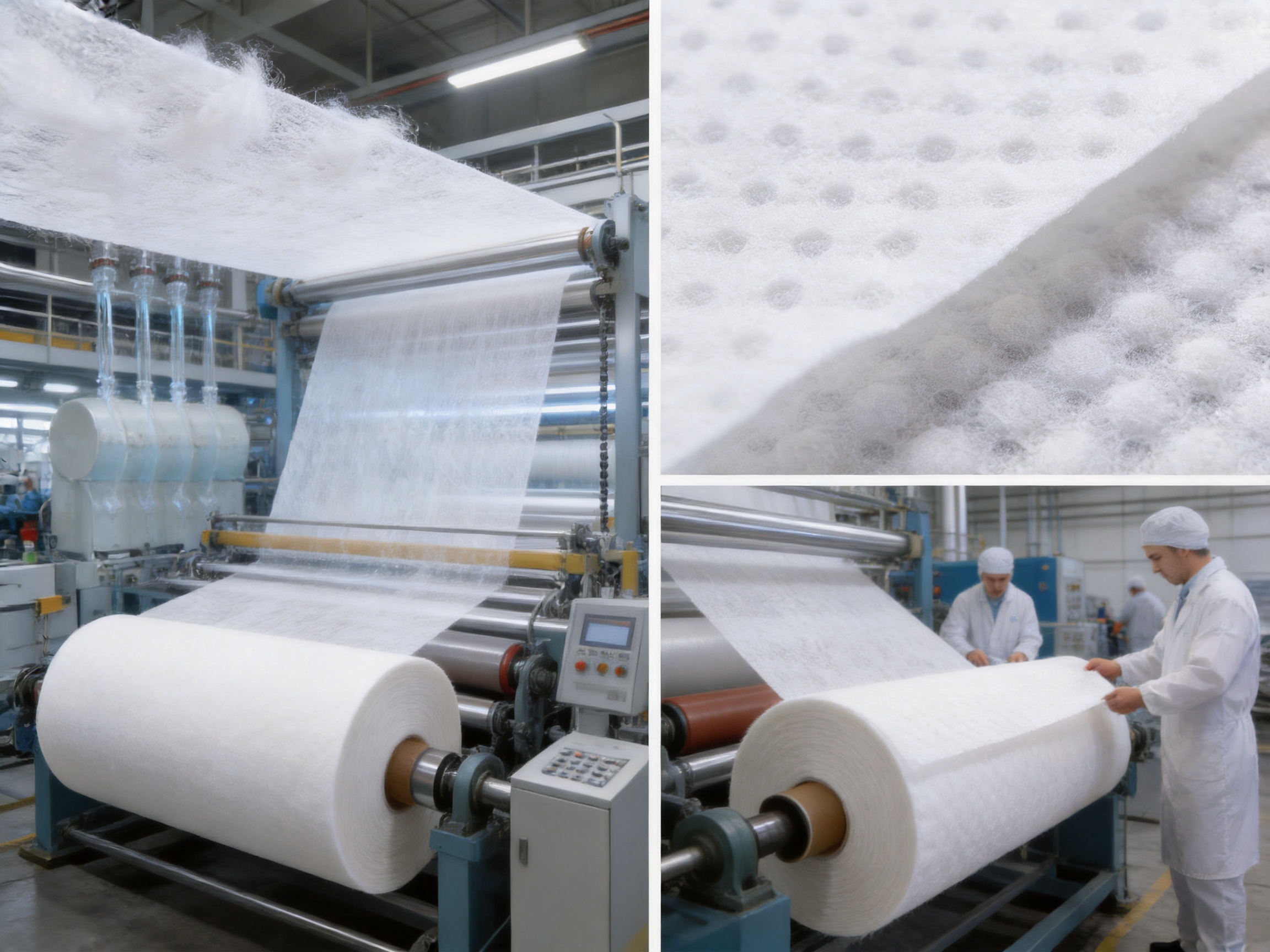
The material is produced using a spunlace process with double carding and parallel fiber placement. Spunlace nonwoven production forms a web of fibers and uses high-pressure water jets to entangle those fibers mechanically. Unlike products that rely primarily on adhesives or thermal bonding, spunlace materials can provide a textile-like feel, softness, and flexibility while maintaining useful strength.
Double carding supports the preparation and distribution of fibers before hydroentanglement. A well-controlled carding process helps create a more consistent web, which is important for uniform basis weight, stable thickness, even absorbency, and reliable conversion. Parallel fiber orientation can also contribute to directional strength and predictable handling characteristics.
For a B2B customer, the manufacturing process matters because material consistency affects every stage of the supply chain. Variations in fiber distribution can create differences in thickness, absorbency, surface appearance, or tensile performance. Such differences may cause problems during slitting, folding, wetting, sealing, packaging, or high-speed production. A controlled spunlace process helps reduce these risks.
Key Manufacturing Stages
The production of the nonwoven substrate generally involves several controlled stages. Fibers are selected and blended according to the required composition. The blend is then opened and prepared for carding. Through double-carding, the fibers are formed into a web with the required weight and orientation. The web is hydroentangled to create a coherent nonwoven structure. The material may then be dried, patterned, finished, inspected, wound, and prepared for shipment.
Each stage influences final performance. Fiber preparation affects cleanliness and blending uniformity. Carding affects web formation. Hydroentanglement affects strength and softness. Drying affects moisture content and dimensional stability. Patterning affects surface appearance and wiping behavior. Finishing affects wettability, static behavior, and compatibility with downstream processes.
When the material is supplied for restaurant wipe production, manufacturing control is especially important because customers may operate continuous converting lines. A roll that feeds smoothly and performs consistently can reduce downtime, waste, and manual adjustments. Stable material quality also makes it easier for a brand to maintain the same product experience across different production batches.
Absorption, Grease Removal, and Cleaning Efficiency
One of the main reasons restaurant operators select nonwoven wipes is the need to remove both liquid and solid contamination. A wipe that only absorbs water may perform poorly on grease. A wipe that lifts grease but cannot hold liquid may spread wet residue. The combination of fiber composition and raised-dot texture is intended to support both functions.
Viscose fibers help absorb water-based liquids, while the textured surface can increase contact with oily or particulate contamination. Polyester supports the wipe when it is pulled across a surface or used with repeated strokes. Together, these features can improve the practical cleaning experience compared with a thin, flat, weak sheet.
The 5mm raised dots may also help distribute pressure across the wiping surface. Rather than concentrating all contact on one smooth plane, the pattern creates a structured interface between the wipe and the surface. This can assist with the removal of dried droplets, food particles, and light grease films. The exact performance will depend on the cleaning solution, surface condition, pressure, and wiping method, but the material is designed to support efficient physical cleaning.
For restaurants, improved wiping efficiency can have operational benefits. A wipe that absorbs quickly may reduce the number of sheets needed for a spill. A wipe that remains intact when wet may be less likely to leave fragments behind. A wipe that picks up food residue effectively may reduce repeat passes. These advantages can contribute to lower labor use and more predictable consumable costs.
Wet and Dry Wipe Compatibility
The material can be converted into both wet wipes and dry wipes. This flexibility gives manufacturers the ability to serve multiple product categories using one core substrate family.
For wet wipes, the nonwoven can be combined with a suitable lotion or cleaning solution. Hydrophilic finishing can be used when faster and more uniform wetting is required. The material can then be folded, cut, stacked, flow-wrapped, tub-packed, or placed into other packaging formats, depending on the customer's production system.
For dry wipes, the material can be supplied without added liquid and used as a ready-to-use cloth or as a substrate for customers who apply their own solution at the point of use. Dry restaurant wipes may be preferred for general wiping, polishing, spill absorption, or applications where the operator wants to select a separate cleaning chemical.
The ability to use the same general material platform for wet and dry products simplifies product development. A brand may launch a dry kitchen wipe for food preparation areas and a pre-moistened version for front-of-house cleaning. A distributor may offer separate grades for restaurants, hotels, catering businesses, and industrial kitchens.
Advantages Compared with Conventional Alternatives
Restaurant wipe manufacturers often compare spunlace nonwoven substrates with paper towels, low-weight nonwovens, woven reusable cloths, and other disposable materials. Each option has a place, but the 5mm Big Dot material offers a combination of features that can be advantageous for commercial product development.
Compared with Paper Towels
Paper towels can be economical and highly absorbent for certain tasks, but they may tear easily when wet and may not provide the desired scrubbing texture. A 5mm Big Dot spunlace wipe can offer better wet integrity, greater flexibility, and a more substantial hand feel. Its textured surface may also be more effective for grease and residue removal.
Compared with Thin Flat Nonwovens
Thin flat nonwovens can be suitable for lightweight wiping, but they may feel less durable and may require more sheets for demanding tasks. The 70gsm format provides additional substance, while the raised dots create more active surface texture. Customers can still select lower basis weights when cost or lightweight packaging is the primary objective.
Compared with Reusable Woven Cloths
Reusable cloths can be durable, but they require collection, washing, drying, inspection, and replacement. If laundering is incomplete or poorly managed, hygiene risks may arise. A disposable or single-use spunlace wipe can simplify workflow and help operators use a fresh material for specific cleaning tasks. It can also reduce the labor associated with cloth management.
Compared with Highly Abrasive Cleaning Pads
Abrasive pads may be useful for heavy-duty scouring, but they can be unsuitable for delicate surfaces or routine food service wiping. The raised-dot spunlace structure offers cleaning texture without being positioned as a harsh scouring pad. It is intended for general restaurant and kitchen wipe applications where absorbency, softness, and surface compatibility are important.
Compared with Low-Strength Blended Materials
Some low-cost blends may provide acceptable absorbency but fail during wet handling or high-speed conversion. The polyester component and hydroentangled fiber network help provide a more stable material that can support commercial production and routine use.
Customized Specifications for Different Markets
One of the strongest advantages of this product platform is specification flexibility. Customers can request different parameters to match their equipment, brand positioning, and end-use requirements.
Basis weight: The available range of approximately 40gsm to 100gsm allows customers to choose between lightweight economy products and heavier-duty wipes. A 40gsm grade may be appropriate for basic dry wiping, while a 70gsm grade can provide a balance of strength and absorbency. Heavier grades may be selected for industrial kitchens, high-absorption applications, or premium product lines.
Roll width: Width options from approximately 10cm to 320cm can support narrow rolls, multi-lane converting, and broad master rolls. The correct width can help improve material utilization and reduce trimming waste.
Composition: Customers can discuss viscose-polyester ratios and other fiber combinations, including wood pulp blends, bamboo fiber, and other customized materials where technically suitable. The objective is to align the material with the required absorbency, strength, softness, sustainability positioning, and cost structure.
Pattern: The standard 5mm big dot pattern provides a distinctive textured surface. Other embossing or pattern options may be evaluated when a customer needs a different appearance, wiping feel, or product identity.
Finishing: Hydrophilic treatment can improve wetting behavior. Coating can be considered for selected functional requirements. Antistatic treatment may be useful for applications where static control is important. Finishing choices should be assessed according to the intended use, chemical compatibility, regulatory requirements, and downstream process.
Packaging and roll format: Roll diameter, core size, winding direction, roll length, pallet arrangement, and protective packaging can be discussed to suit converting equipment and logistics requirements.
Private-label support: The material can be incorporated into branded restaurant wipes, food service supplies, hospitality products, industrial cleaning products, and distributor programs. Customers can evaluate sample rolls before moving to regular production.
Designed for Commercial Wipe Manufacturers
This product is primarily intended for B2B customers rather than individual consumers purchasing isolated wipes. It is a production material for companies that convert, package, distribute, or use large quantities of wiping products.
- Wet wipe manufacturers can use it as a substrate for pre-moistened kitchen wipes.
- Restaurant wipe brands can develop private-label products with a distinctive large-dot surface.
- Food service suppliers can offer customized wiping products to restaurant groups and catering businesses.
- Hygiene product factories can integrate the material into broader cleaning product portfolios.
- Private-label companies can select basis weight, roll width, packaging, and composition according to market positioning.
- Importers and distributors can source a versatile material for multiple customer segments.
- Converting factories can process the rolls through slitting, folding, cutting, stacking, and packaging equipment.
- Industrial cleaning manufacturers can evaluate heavier grades for more demanding wiping environments.
The product supports automated production lines and a range of folding, slitting, and converting processes. This is important for customers seeking to scale output without changing the entire production system. Before mass production, sample rolls can be used to verify feed performance, folding accuracy, wetting behavior, sealing compatibility, and final wipe dimensions.
Manufacturing Strengths and Integrated Supply Capability
The manufacturer behind the product has a long history in nonwoven materials, nursing products, and hygiene manufacturing. Founded in 1987, the organization has developed production capabilities covering spunlace nonwovens, spunmelt materials, hot-air nonwovens, flushable and degradable nonwovens, wet wipes, dry wipes, baby diapers, training pants, wet toilet paper, cleansing wipes, and related products.
This broader manufacturing background is relevant to restaurant wipe customers because it demonstrates experience across both material production and downstream converting. A supplier that understands only raw material production may not fully appreciate the processing challenges faced by wipe manufacturers. An integrated manufacturer can provide more practical support from fiber selection and web formation through to finished wipe conversion and packaging.
The company operates multiple production bases in China and is developing additional overseas capacity. Its manufacturing network is designed to support stable supply for international customers and provide greater production flexibility. Multiple bases can also help support different product categories, capacity planning requirements, and customer delivery schedules.
Advanced equipment and production technologies introduced from Germany, France, and Italy support the company's nonwoven and hygiene product operations. International equipment experience can contribute to process control, automation, production efficiency, and consistent product quality. The specific equipment used for each product should be confirmed during technical discussions, but the overall manufacturing structure is designed for large-scale industrial supply.
Quality Control and Testing
Quality control is important at every stage of nonwoven and wipe production. The manufacturing network includes an in-house testing center for quality control throughout production. Testing may cover basis weight, thickness, tensile strength, elongation, absorbency, wetting behavior, surface appearance, roll dimensions, and other parameters relevant to the customer's specification.
For restaurant wipe materials, quality checks can help verify that the raised pattern is formed consistently and that the roll remains suitable for downstream processing. A stable surface pattern is important for product appearance and wiping performance. Consistent basis weight helps ensure that finished wipes have a predictable feel and absorbency. Controlled moisture content and winding quality help reduce problems during storage and conversion.
Customers may also establish their own incoming inspection requirements. The supplier can work with customers to define technical specifications, sampling methods, acceptance criteria, and documentation. This collaborative approach is especially useful for private-label brands and international buyers that need consistent quality across repeat orders.
Clean Manufacturing Environment
The company operates clean manufacturing standards and has a purified water system suitable for hygiene product manufacturing. This infrastructure is relevant when the nonwoven is converted into wet wipes or other hygiene products. Water quality can influence lotion preparation, microbial control, product stability, and finished wipe performance.
Although a material supplier cannot replace the customer's own hygiene management system, a clean manufacturing foundation helps support reliable production. Customers should evaluate the complete quality and compliance documentation according to their intended market, product claims, and local regulations.
Application Areas Beyond Restaurant Wipes
The material is optimized for restaurant and kitchen wiping, but its structure can support additional applications. The combination of a textured surface, balanced fiber blend, and customizable weight makes it adaptable to several commercial cleaning categories.
In hospitality, the material can be converted into wipes for hotel kitchens, dining areas, housekeeping operations, breakfast service areas, and catering facilities. In retail, it may be used for private-label cleaning wipes sold through supermarkets, professional supply stores, and online channels. In industrial environments, heavier versions may be evaluated for general maintenance, equipment wiping, and workshop cleaning.
The material may also be used for dry cleaning cloths, pre-moistened surface wipes, food service cleaning systems, and other applications where a disposable textile-like substrate is preferred. Each application requires a separate technical assessment, particularly when the wipe will contact sensitive surfaces, food-contact areas, disinfectants, solvents, or aggressive chemicals.
For food-related environments, the finished wipe, cleaning formulation, packaging, labeling, and intended claims should all be reviewed for compliance with applicable requirements. A substrate described as suitable for food service cleaning does not automatically mean that every finished product is approved for direct food contact. Customers should confirm the intended use and complete any required testing before commercial launch.
OEM and ODM Cooperation
OEM and ODM services enable customers to develop products that match their own market strategy. An OEM project may involve supplying the specified material and converting it according to the customer's brand, dimensions, packaging, and labeling requirements. An ODM project may involve greater cooperation in product design, material selection, pattern development, performance optimization, and final packaging.
The technical team can work with customers from the initial material selection stage through production. This may include reviewing the target application, selecting a suitable basis weight, evaluating the fiber ratio, deciding between wet and dry formats, and confirming roll specifications. The team can also assist with processing considerations such as folding, slitting, cut length, sealing, stacking, and packaging.
For a restaurant wipe brand, this cooperation can shorten the path from concept to production. Instead of evaluating unrelated materials from multiple suppliers, the customer can discuss the full product requirement with a manufacturer experienced in both nonwoven substrates and hygiene products. This can help identify possible manufacturing risks early and improve the compatibility between the raw material and the finished product.
Supply Stability for International Buyers
International customers need more than an attractive product specification. They also need predictable lead times, consistent quality, export experience, technical communication, and responsive after-sales service. A stable supply network is particularly important for restaurant wipe manufacturers because their customers may rely on uninterrupted deliveries for daily operations.
The company's production bases, broad product portfolio, and international export experience support a supply model for long-term cooperation. Customers can discuss forecast planning, production capacity, order scheduling, packaging requirements, and shipment arrangements according to their individual needs.
Supply stability also benefits brands that want to expand gradually. A customer may begin with sample testing, proceed to a trial order, and then increase volume after market validation. A supplier with experience across multiple product lines can support this progression while helping the customer maintain consistent material specifications.
For importers and distributors, a broad product portfolio can create opportunities to combine restaurant wipes with other hygiene products, including wet wipes, dry wipes, baby care products, medical nonwovens, industrial cleaning wipes, and related materials. This can simplify supplier management and support a more complete product offering.
Recommended Product Development Process
A structured development process helps customers obtain the most suitable material. The first step is to define the end-use environment. Customers should identify whether the wipe will be used for tables, kitchen equipment, food preparation areas, front-of-house surfaces, industrial kitchens, or general commercial cleaning.
The next step is to determine whether the final product will be wet or dry. Wet wipes may require attention to liquid add-on, lotion compatibility, preservation, packaging, and sealing. Dry wipes may require stronger emphasis on dust pickup, liquid absorption, softness, and dry tensile strength.
Customers should then evaluate the required basis weight and composition. A standard 70gsm 50/50 viscose-polyester grade is a practical starting point, but different applications may justify a lighter, heavier, softer, or stronger option. The 5mm pattern should also be assessed for wiping feel, appearance, and processing compatibility.
Sample rolls should be converted on the customer's actual or representative equipment whenever possible. Testing should include roll unwinding, slitting, folding, cutting, sealing, stacking, and packaging. Finished wipes should then be evaluated under realistic use conditions.
Performance testing may include:
- Water absorption rate and total absorption capacity.
- Oil and grease pickup under controlled conditions.
- Wet and dry tensile strength.
- Resistance to tearing and stretching.
- Lint release after repeated wiping.
- Surface texture and pattern consistency.
- Wipe dimensions and folding accuracy.
- Compatibility with cleaning solutions.
- Storage stability and package integrity.
- Consumer or professional user feedback.
After testing, the specification can be finalized and documented. Clear documentation should identify the fiber composition, basis weight, roll width, pattern, finishing treatment, roll length, core requirements, packaging, and quality standards. This creates a reliable reference for future orders.
Environmental and Disposal Considerations
Disposable wipes can support hygiene and operational efficiency, but responsible disposal remains important. The appropriate disposal method depends on the composition, contamination level, local waste regulations, and whether the material has been exposed to chemicals or food residue. Restaurant wipe products should not be described as flushable unless they have been specifically engineered, tested, and approved for that purpose.
Customers interested in environmental positioning can discuss alternative fibers, reduced packaging, optimized basis weight, and other product-development options. Bamboo fiber, wood pulp blends, and other material combinations may be considered when technically appropriate. However, environmental claims should be supported by relevant testing and documentation rather than based solely on a fiber name.
Material efficiency is another important consideration. Selecting the correct basis weight and roll width can reduce unnecessary waste during converting. Accurate slitting and nesting can improve yield. Packaging optimization can reduce excess material during transport and storage. These factors can contribute to a more efficient overall product system.
Frequently Asked Questions
1. What is the standard composition of the material?
The standard composition is approximately 50% viscose and 50% polyester. The blend ratio can be customized according to requirements for absorbency, softness, strength, dimensional stability, cost, and application performance.
2. What does the 5mm Big Dot pattern do?
The raised-dot pattern creates a textured wiping surface. It can improve contact with dirt, food residue, moisture, and grease while providing a more substantial wiping feel than a completely flat nonwoven. It is designed to support cleaning efficiency without functioning as a harsh scouring pad.
3. Is the material suitable for restaurant kitchen wipes?
Yes. It is designed for restaurant wipes, kitchen cleaning wipes, food service wiping products, wet wipes, and dry wipes. The finished product should still be evaluated for its specific cleaning solution, surface type, packaging, and intended claims.
4. Can it be used for wet wipes and dry wipes?
Yes. The material can be converted into both formats. Hydrophilic finishing may be considered for applications requiring faster wetting, while dry versions can be supplied for direct use or for customers who apply their own cleaning solution.
5. What basis weights are available?
The general available range is approximately 40gsm to 100gsm. The standard product described for restaurant wipes is approximately 70gsm. The final selection depends on required absorbency, strength, cost, product feel, and machine performance.
6. What roll widths can be supplied?
Roll widths can generally range from approximately 10cm to 320cm. The most suitable width depends on the customer's slitting, folding, cutting, and packaging equipment.
7. Can the fiber composition be changed?
Yes. Customers can discuss different viscose and polyester ratios as well as other material combinations, including wood pulp blends, bamboo fiber, and customized options. Technical evaluation is recommended before final approval.
8. Can the embossing or surface pattern be customized?
The standard pattern is a 5mm big dot design. Other surface patterns may be discussed according to the desired appearance, wiping performance, texture, and production requirements.
9. Are finishing treatments available?
Available options include hydrophilic treatment, coating, antistatic treatment, and other finishing technologies subject to technical evaluation. The selected finish should match the intended application and downstream process.
10. Can the material be processed on automated production lines?
It is designed to support automated folding, slitting, cutting, and converting processes. Customers should conduct sample testing on their own equipment to confirm feed behavior and final product compatibility.
11. Are samples available?
Yes. Sample rolls can be arranged for material evaluation, machine testing, and product development before mass production. Customers should provide their desired dimensions, composition, basis weight, pattern, and application details where possible.
12. Who can purchase this product?
The product is intended for wet wipe manufacturers, restaurant wipe brands, food service suppliers, hygiene factories, private-label companies, importers, distributors, converting factories, and industrial cleaning product manufacturers.
13. Can the supplier provide OEM and ODM services?
Yes. OEM and ODM services can cover material selection, composition, basis weight, roll format, converting, packaging, and finished wipe development. The scope depends on the customer's project requirements.
14. Is the material directly approved for food contact?
The material is positioned for food service and restaurant cleaning applications, but direct food-contact approval depends on the complete finished product, applicable regulations, test results, and the intended market. Customers should request and verify the relevant documentation for their specific use.
15. Why choose an integrated manufacturer?
An integrated manufacturer can support both nonwoven material production and downstream hygiene product manufacturing. This may simplify technical communication, improve coordination between substrate and finished wipe production, and provide broader options for OEM, ODM, quality control, and supply planning.
Conclusion
The 5mm Big Dot Spunlace Nonwoven for Restaurant Wipes is a versatile material platform for manufacturers seeking a stronger, more absorbent, and more functional alternative to basic flat wiping substrates. Its 5mm raised-dot texture supports dirt and grease pickup, while the 50% viscose and 50% polyester composition balances liquid absorption, softness, strength, and shape retention.
The approximately 70gsm standard weight gives the material a substantial hand feel without losing the convenience of a disposable wipe. A broad basis-weight range, customizable composition, flexible roll widths, optional finishing treatments, and compatibility with wet and dry wipe production allow customers to develop products for different commercial markets.
Behind the material is an integrated manufacturing organization with experience in spunlace nonwovens, hygiene products, clean manufacturing, purified water systems, testing, OEM, ODM, and international supply. Its production network and technical capabilities are suited to customers that need more than a one-time material purchase. They support long-term cooperation based on consistent specifications, production flexibility, quality control, and reliable delivery.
For restaurant wipe manufacturers, food service suppliers, private-label brands, distributors, and industrial cleaning companies, the product offers a practical starting point for developing high-performance commercial wipes. Through sample testing and specification customization, customers can adapt the material to their equipment, target market, cleaning application, and brand positioning.
References
1. International Nonwovens Association. Technical principles of spunlace and hydroentangled nonwoven materials.
2. Association for the Advancement of Medical Instrumentation. General considerations for the manufacture and quality control of hygiene-related nonwoven products.
3. International Organization for Standardization. Textile testing principles for mass per unit area, tensile strength, absorbency, and dimensional stability.
4. Standard textile engineering references on viscose fiber properties, polyester fiber performance, and blended nonwoven structures.
5. Professional cleaning industry guidance on commercial wiping procedures, surface cleaning, grease removal, and responsible disposable wipe management.
6. Food service hygiene guidance concerning cleaning procedures, surface compatibility, chemical use, and separation of cleaning tools from direct food-contact materials.
7. Technical documentation for hydroentanglement, double-carding, parallel-laid fiber webs, embossing, and nonwoven converting processes.