中文简体
中文简体 English
 日本語
日本語 русский
 Español
Non-alcohol remover wipes represent a practical evolution in beauty care, especially for users, salons, distributors, and private-label brands that want a safer, cleaner, and more convenient alternative to traditional bottled removers. Designed as pre-moistened nonwoven wipes, this product combines removal performance, controlled dosage, portability, and nail-care benefits in one ready-to-use format. Instead of pouring liquid remover onto cotton pads, the user opens a pack, removes one wipe, applies it to the nail surface, and completes the removal process with minimal mess and reduced waste.
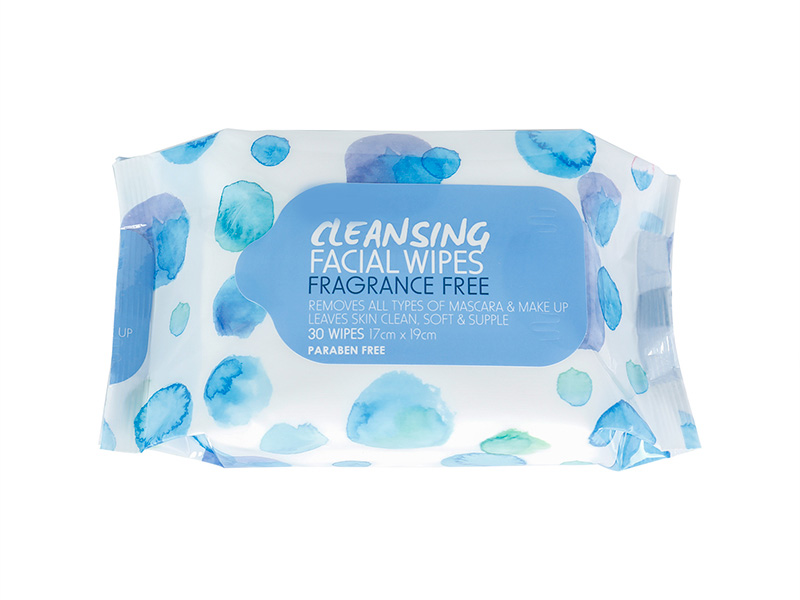
Non alcohol makeup remover wipes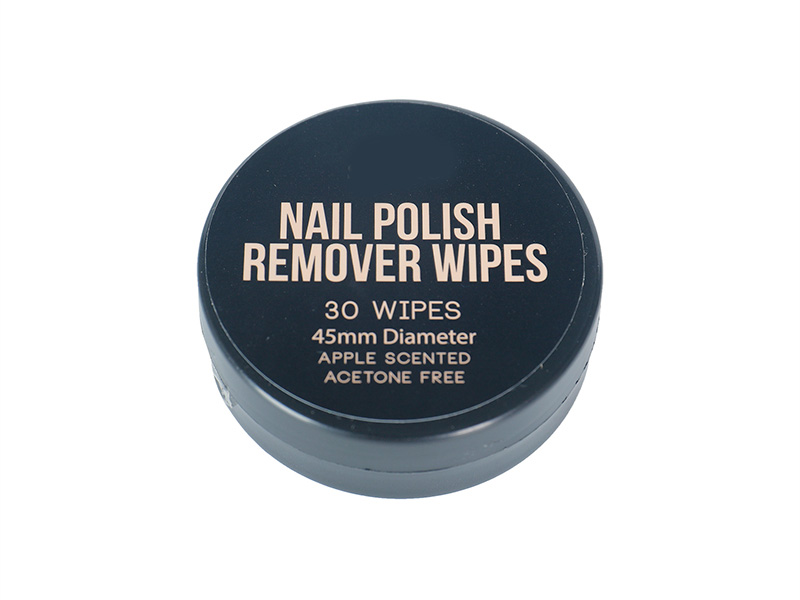
The product is positioned within the makeup remover wipes category while also serving the specialized function of nail polish removal. Its core value comes from a non-alcoholic formulation and an engineered nonwoven substrate. This combination allows the wipe to dissolve nail lacquer effectively while avoiding many disadvantages associated with conventional liquid removers, such as strong odors, spillage, excessive volatility, and difficult transport conditions. For professional beauty businesses, this means a more standardized service process. For retailers and brand owners, it means a consumer-friendly product with high market adaptability.
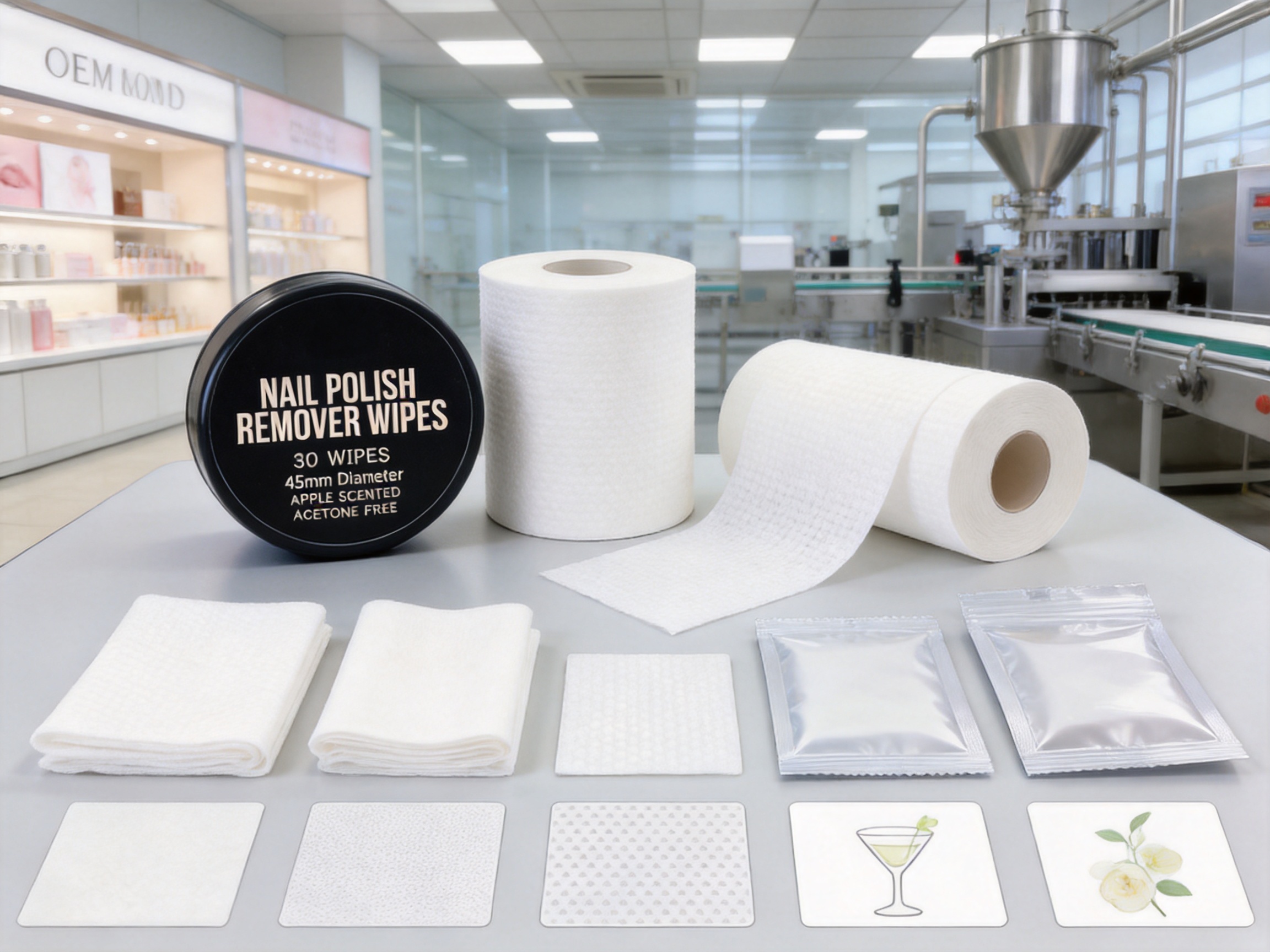
The wipe is made for practical daily use, travel, beauty salons, e-commerce distribution, private-label customization, and OEM or ODM programs. It can be customized in material, size, thickness, texture, fragrance, and packaging quantity. Available options include polyester, viscose, bamboo, lyocell, and cotton blends, with weights ranging from 30 to 100 gsm and sizes from 12 to 22 cm in width and 12 to 30 cm in length. Surface textures may include plain, mesh, dot-embossed, flower, or star patterns. These choices allow brands to position the product for value, premium, eco-conscious, professional, or travel-focused markets.
Product Concept and Market Need
Traditional nail polish removers are often sold as liquids. Although effective, liquid formats can create several user problems. They may spill during handling, evaporate quickly, release irritating odors, and require separate cotton pads or tissues. In professional salons, liquid removers may also increase product waste because each technician may use a different amount. During travel and storage, liquid packaging can create concerns related to leakage, volatility, and safety compliance.
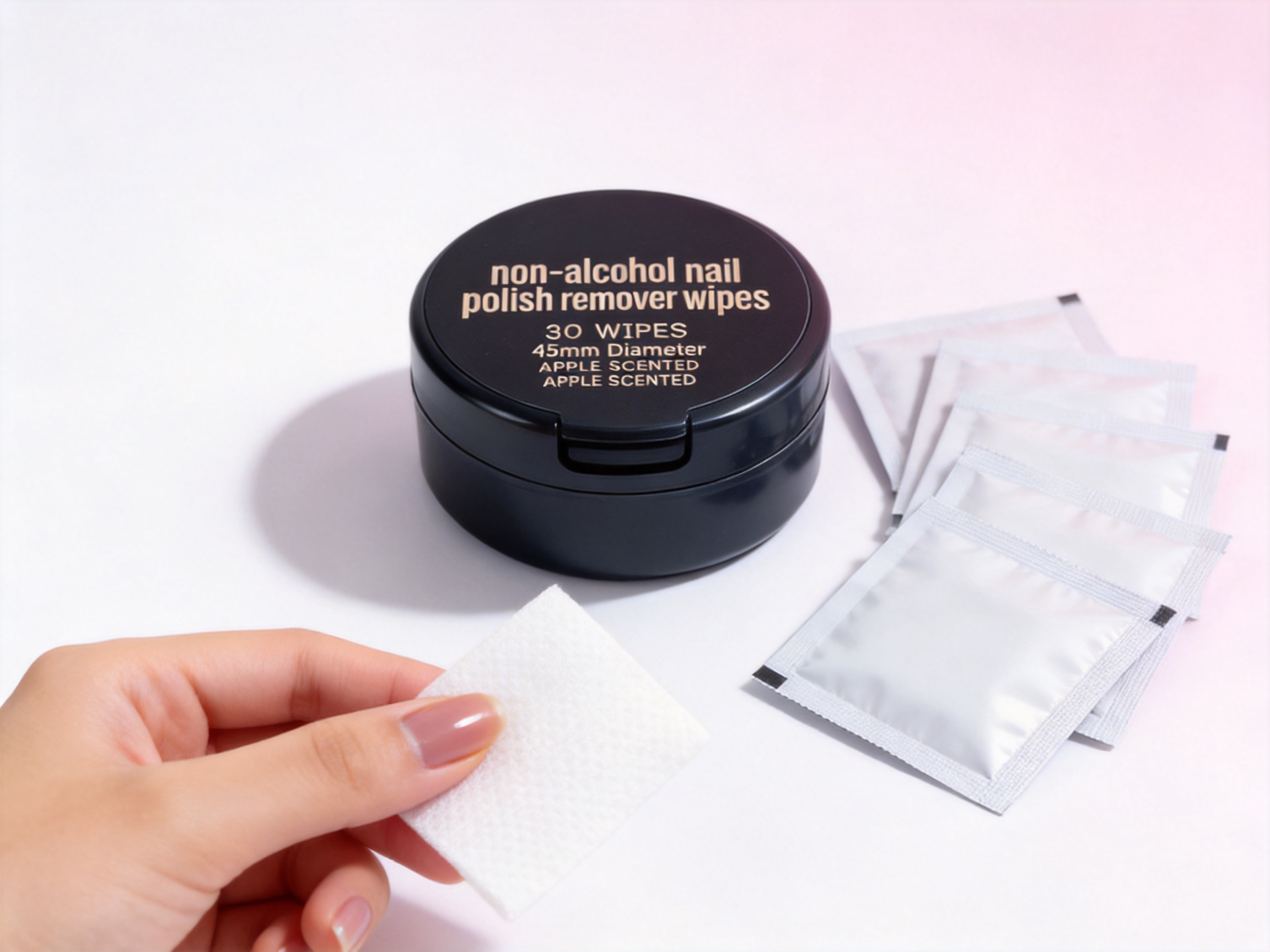
Non-alcohol remover wipes solve these problems by integrating the active liquid and the wiping material into a single disposable unit. Each wipe delivers a consistent dose, helping users apply an appropriate amount every time. The wipe format also improves portability because it can be packed in sachets, flow packs, canisters, or multi-count resealable packs. The user does not need to carry a bottle, cotton pads, or additional tools. This convenience is one of the strongest competitive advantages of the product.
The market for beauty wipes continues to expand because consumers increasingly prefer simple, hygienic, and travel-ready products. Nail care is no exception. Many users want a remover that works effectively but does not leave nails feeling dry, brittle, or uncomfortable. A non-alcohol formula can be developed with moisturizing agents to support nail comfort after polish removal. By combining cleaning power with a gentler user experience, the product addresses both performance and care expectations.
Core Product Advantages
The main advantage of these remover wipes is their balance between performance, safety, convenience, and nail-friendly care. The wipe is intended to remove nail lacquer without relying on the harsh user experience commonly associated with strong liquid solvents. It is designed to be non-alcoholic, easy to use, drip-free, portable, and suitable for high-frequency use.
Compared with bottled removers, a wipe provides better dosage control. A user does not accidentally pour too much liquid, and a salon can better estimate consumption per service. This helps reduce waste and supports cost management. In retail channels, the wipe format is also easier to explain to consumers because the use process is intuitive: open, press, wipe, rinse if desired, and dispose.
Another important advantage is odor control. Conventional removers can produce strong, pungent smells that may be uncomfortable in small rooms, beauty counters, salons, dormitories, or travel settings. A well-designed non-alcohol remover wipe can reduce unpleasant vapor perception and improve the overall beauty-care experience. Fragrance options such as unscented, fresh, lavender, lemon, lotus, fruit, coconut, cucumber, and other profiles allow brand owners to match different consumer preferences.
The nonwoven substrate provides physical strength and cleaning efficiency. Parallel and semi-cross nonwoven technologies help maintain tensile strength, preventing the wipe from tearing, shredding, or leaving visible lint during use. This is essential when removing darker colors, glitter polish, or multiple layers, because weak wipes may disintegrate and create additional cleanup work.
Technical Specifications
| Specification | Available Options | Product Benefit |
|---|---|---|
| Pieces per Pack | 1 to 200 pieces | Suitable for single-use sachets, travel packs, salon packs, and retail family packs |
| Nonwoven Technology | Parallel, semi-cross | Improves tensile strength, shape stability, and wiping durability |
| Material | Polyester, viscose, bamboo, lyocell, cotton | Allows adjustment of softness, absorbency, cost, sustainability, and premium feel |
| Pattern | Plain, mesh, dot embossed, flower, stars | Provides different friction levels, visual styles, and removal efficiency |
| Grams | 30 to 100 gsm | Supports lightweight travel products through to thicker professional wipes |
| Size | Width 12 to 22 cm; length 12 to 30 cm | Can be customized for finger nails, salon use, or broader beauty applications |
| Fragrance | Unscented, fresh, lavender, lemon, lotus, fruit, coconut, cucumber, and more | Enables different market positioning and consumer sensory experiences |
How the Nonwoven Substrate Improves Performance
A remover wipe is only as effective as the fabric and formula working together. The nonwoven substrate holds the liquid, transfers it to the nail surface, and creates the mechanical action needed to lift softened polish. If the material is too weak, it may tear. If it is too rough, it may feel uncomfortable. If it is too thin, it may dry out quickly or fail to provide enough contact time. Therefore, the nonwoven structure is central to product quality.
Parallel nonwoven technology creates a stable fiber orientation that can deliver smooth wiping and reliable strength. Semi-cross technology improves multidirectional resistance, helping the wipe withstand rubbing from different angles. These structures are particularly important for nail polish removal because users often apply pressure to a small surface area. The wipe must resist deformation while still feeling soft on skin around the nail.
Material selection further changes product performance. Polyester contributes durability and dimensional stability. Viscose provides softness and absorption. Bamboo and lyocell can support eco-oriented positioning and a smoother hand feel. Cotton appeals to consumers who associate natural fibers with gentleness and comfort. By blending these fibers, the manufacturer can create wipes for different market tiers, from cost-effective everyday products to premium private-label beauty wipes.
Surface pattern also matters. A plain surface may be suitable for gentle removal and a clean visual style. Mesh and dot-embossed textures increase friction, helping lift thicker or multi-layered polish. Decorative patterns such as flowers or stars can support retail differentiation, especially for younger consumer segments, gift packs, seasonal products, or boutique beauty brands. In competitive retail environments, visual and tactile details can influence repeat purchase behavior.
Formula Benefits: Cleaning, Comfort, and Care
The formula is developed to dissolve nail lacquer while reducing the discomfort often associated with strong removers. The non-alcoholic positioning is especially important for consumers seeking a gentler experience. While the exact formulation can be adjusted according to customer requirements and regulatory markets, the product concept emphasizes efficient pigment removal, reduced irritating odor, moisturizing support, and nail-care compatibility.
Moisturizing agents can help protect the nail plate from feeling overly dry after use. This matters because frequent polish removal may leave nails looking dull, brittle, or uncomfortable if the remover is too aggressive. A wipe that supports hydration and comfort can help users maintain a better nail-care routine. For salons, this can improve perceived service quality because clients notice not only whether the polish is removed, but also how their nails feel afterward.
The drip-free nature of wipes also improves formula control. Liquid removers may run onto surrounding skin, table surfaces, tools, or clothing. With a pre-saturated wipe, the formula remains largely within the substrate until pressure is applied. This controlled transfer can reduce mess and make the product more suitable for use in public, travel, and quick-touch-up scenarios.
In addition, a wipe format can reduce cross-contamination risks compared with shared bottles and loose cotton supplies. Individually packed wipes are especially hygienic because each unit is protected until opening. Multi-count packs with resealable closures can also maintain moisture integrity when used correctly. For professional and retail markets, hygiene perception is a major selling point.
Recommended Application Procedure
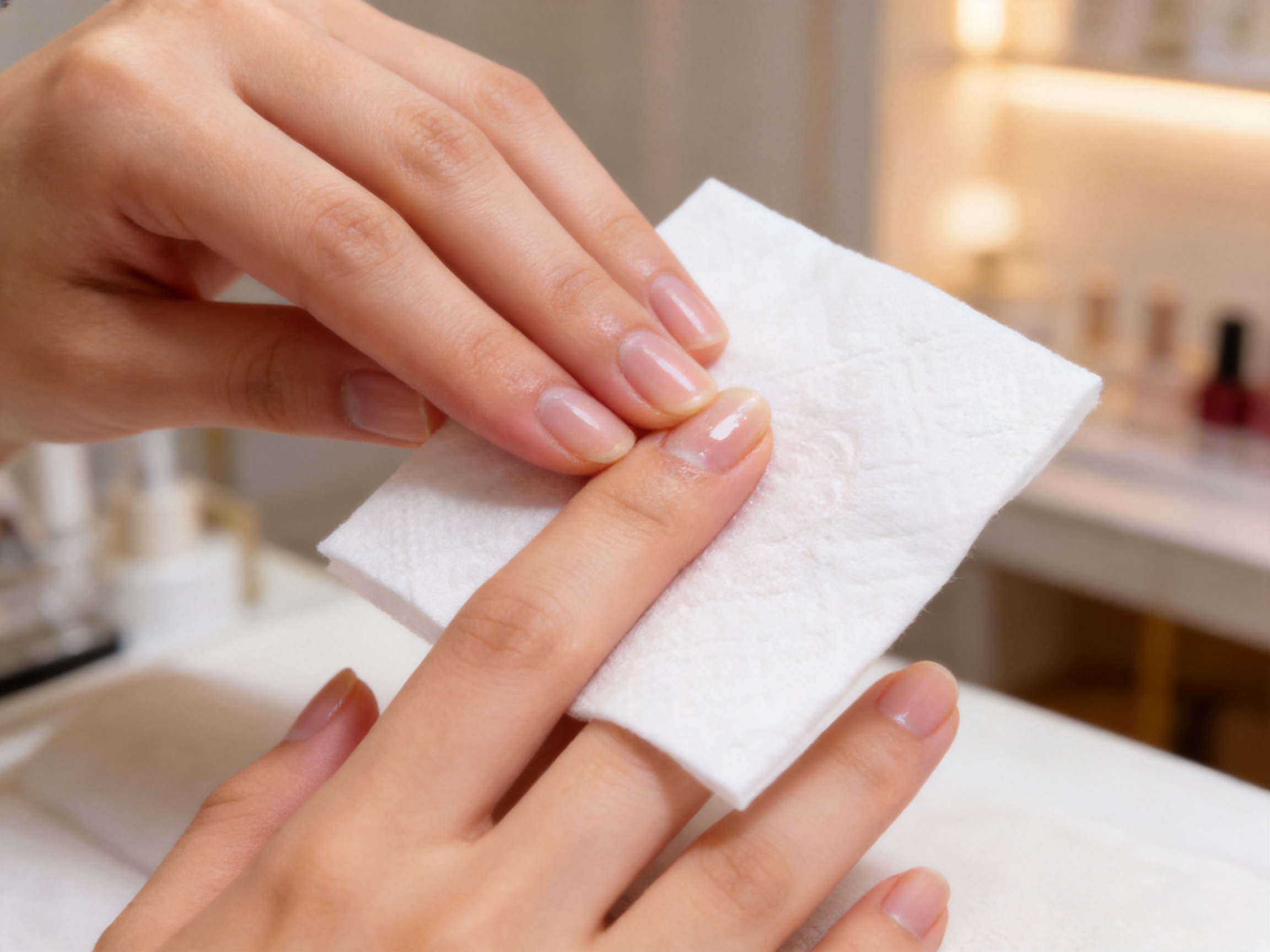
For best results, users should begin with clean hands and dry nail surfaces. After opening the package, one wipe should be removed, and the remaining package should be resealed immediately if it is a multi-count pack. This helps preserve moisture and ensures that later wipes retain their intended performance.
The wipe should be placed on the nail surface and held for approximately 5 to 60 seconds, depending on polish thickness, number of layers, and polish type. This dwell time allows the active liquid to penetrate and soften the lacquer film. For ordinary polish, a shorter contact time may be enough. For dark colors, glitter, or multiple layers, a longer contact time can improve removal efficiency.
After the formula has had time to act, the user should wipe gently from the cuticle area toward the free edge of the nail. This direction helps reduce the chance of pushing residue into the nail folds. If needed, the wipe can be folded to expose a clean surface and used again on the same or another nail. After removal, the user may rinse with water and continue with hand care, nail strengthening, polishing, or other manicure steps.
This standardized procedure is valuable for salons because it creates a repeatable service method. It also helps reduce unnecessary rubbing, which can irritate skin or weaken the nail surface. By combining proper dwell time with textured nonwoven friction, the wipe can deliver efficient removal with less effort.
Advantages Over Conventional Liquid Removers
One of the clearest advantages over conventional liquid removers is portability. Bottled removers are less convenient to carry, especially in handbags, travel kits, dorm rooms, hotel rooms, and professional mobile beauty cases. Wipes can be packaged in small, lightweight formats that are easy to distribute through retail shelves, online stores, subscription boxes, travel sets, and beauty kits.
Another advantage is reduced leakage risk. Liquid products require reliable bottle caps and careful storage. Even then, leakage can occur if a cap loosens or a bottle is squeezed during transport. Wipes greatly reduce this problem because the liquid is absorbed into the substrate and sealed within flexible packaging. For air travel, storage, and shipping, this can make the product more consumer-friendly.
Waste control is also superior. With a bottle, users often over-pour remover onto cotton pads. Excess liquid evaporates or drips away. Wipes provide measured saturation, which helps control usage and product cost. Salons can estimate how many wipes are required per service, while consumers can understand how many uses remain in a pack.
User comfort is another differentiator. Strong liquid removers can release intense odors and may feel harsh on nails and skin. A non-alcohol wipe format can be designed to reduce pungency and support a more pleasant sensory profile. Optional fragrances allow brands to create a clean, spa-like, refreshing, or neutral experience.
Finally, the wipe format improves convenience. Consumers do not need to buy cotton pads separately. The product is ready to use at home, at work, while traveling, or before a last-minute event. This convenience supports impulse purchases and repeat use.
Advantages Over Low-Quality Remover Wipes
Not all remover wipes perform equally. Low-quality wipes may dry out quickly, tear during use, have uneven saturation, leave lint, or require excessive rubbing. The product described here is designed to overcome those weaknesses through controlled nonwoven technology, customizable gsm, stable fiber selection, and reliable manufacturing processes.
High tensile strength helps the wipe stay intact during repeated rubbing. This is particularly important when removing stubborn polish. A weak wipe may shred, leaving fibers on the nail surface and forcing the user to use additional wipes. Stronger nonwoven materials reduce frustration and improve perceived value.
Even liquid distribution is another important quality factor. A wipe must be wet enough to soften polish but not so wet that it drips. Professional production controls can support consistent saturation from piece to piece. This consistency matters greatly in private-label programs because consumers expect the same performance every time they open a pack.
Texture optimization also separates premium wipes from basic alternatives. Mesh or embossed patterns increase contact points between the wipe and lacquer, improving removal efficiency without requiring harsh scraping. A thoughtful texture can reduce user effort and help protect the surrounding skin.
Packaging quality is equally important. If a seal is weak, wipes may lose moisture before purchase or between uses. A manufacturer with experience in wet wipes and hygiene products understands the need for packaging compatibility, moisture retention, seal reliability, and shelf stability. These factors strongly influence retail success.
Manufacturing Strength and Industrial Capability
Zhejiang Uniquality Nursing Products Technology Co., Ltd., associated with Kingsafe and Uniquality manufacturing resources, is supported by decades of experience in nonwoven materials and hygiene products. Founded in 1987, the enterprise has developed from a specialized manufacturer into a major industrial textile and nursing products producer. Its long history gives it practical knowledge in fiber selection, web formation, fabric treatment, converting, wet wipe production, and quality control.
The company is recognized as a national high-tech enterprise focused on research, development, production, and sales of medical and hygienic nonwoven materials, nursing products, and high-end clothing interlining. This technical background is highly relevant to remover wipes because the product requires both material engineering and liquid-handling expertise. A reliable wipe must combine nonwoven strength, absorbency, softness, formula compatibility, packaging integrity, and hygienic production.
Headquartered in Changxing, Huzhou, in the Yangtze River Delta region, the company benefits from convenient land, sea, and air transportation. This location supports efficient supply-chain coordination, domestic distribution, and international export activity. The company has also established multiple production bases in different regions of China, including Foshan in Guangdong, Nantong in Jiangsu, and Wuhan in Hubei. This multi-base structure strengthens production resilience and provides flexibility for large orders.
The company has introduced advanced production equipment and technology from Germany, France, and Italy. This international equipment foundation supports stable output, high efficiency, and process precision. For remover wipes, advanced production lines can help maintain uniform fabric formation, accurate cutting, controlled wetting, reliable folding, and tight packaging. These process advantages become especially important for OEM and private-label projects where customers require consistency across large batches.
Research, Development, and Customization
One of the most important strengths of an advanced manufacturer is the ability to customize products for different brands and markets. Non-alcohol remover wipes can be adapted in many ways, including substrate material, sheet size, gsm, texture, fragrance, liquid loading, packaging count, and exterior design. This flexibility allows customers to create products for mass retail, professional salons, travel kits, premium nail care, eco-conscious ranges, or promotional gift sets.
Research and development capacity helps convert a market idea into a practical product. For example, a distributor may want a compact single-piece sachet for travel retail. A salon supplier may prefer a 100-piece or 200-piece pack with thicker material and stronger texture. A premium beauty brand may request bamboo or lyocell fiber, a soft fragrance, and elegant packaging. A value brand may prioritize cost control while still requiring acceptable strength and moisture stability.
The manufacturer’s experience in wet wipes, dry wipes, baby care products, wet toilet paper, cleansing wipes, diapers, pull-ups, medical nonwovens, and industrial cleaning products gives it a broad technical base. Knowledge from baby wipes can support skin-feel optimization. Knowledge from medical and hygiene nonwovens can support cleanliness and quality control. Knowledge from industrial cleaning wipes can support strength and durability. This cross-category experience is an advantage when developing remover wipes with balanced performance.
Customization also supports regulatory and market adaptation. Different regions may have different expectations for labeling, ingredients, fragrance intensity, packaging claims, and consumer instructions. An experienced OEM or ODM partner can help customers select appropriate specifications and produce stable goods for their target channels.
Quality Control and Consistency
Quality control is essential for remover wipes because consumers evaluate the product immediately during use. If the wipe is dry, weak, too wet, harsh-smelling, or ineffective, the consumer may not repurchase. Therefore, consistent quality across batches is a major competitive factor.
Key quality factors include fabric weight, sheet dimensions, folding accuracy, liquid loading, seal integrity, fragrance consistency, appearance, tensile strength, and packaging cleanliness. Advanced production management can monitor these points throughout the manufacturing process. Raw materials must be inspected before use, and finished products must be checked to confirm they meet agreed specifications.
Moisture retention is particularly important. A remover wipe must remain sufficiently wet through storage and distribution. Packaging materials must be compatible with the formula, and sealing must be strong enough to prevent evaporation. In multi-count packs, resealable labels or closures must perform reliably after repeated openings. These details may seem small, but they determine the consumer’s actual experience.
For private-label customers, consistency also protects brand reputation. When a consumer buys a product under a retailer or beauty brand name, they associate performance with that brand, not only the factory. A manufacturer with long-term nonwoven and hygiene production experience helps reduce risk by providing technical stability and process discipline.
Applications in Professional Salons
Professional salons can benefit significantly from non-alcohol remover wipes. In a salon, time, cleanliness, and client comfort are essential. Pre-moistened wipes simplify workstation management because technicians do not need to handle remover bottles and cotton pads repeatedly. The service becomes cleaner and more standardized.
Each wipe provides a predictable amount of remover, helping salons control usage costs. It also reduces the risk of spills on manicure tables, towels, client clothing, or equipment. Because the wipe format is portable, technicians can use it at fixed stations, mobile beauty appointments, events, and training sessions.
Odor reduction is another important salon benefit. Strong remover smells can affect both staff and clients, especially in enclosed spaces. A gentler sensory profile can improve the salon atmosphere. Fragrance options allow salons to match their service identity, whether fresh, floral, tropical, or unscented.
For salons offering premium manicure services, a wipe with moisturizing support can be positioned as part of a more careful nail-care routine. Instead of simply stripping polish, the service can emphasize nail comfort, cleanliness, and preparation for the next treatment. This creates an opportunity for salons to differentiate themselves in a competitive market.
Applications in Retail and E-Commerce
In retail and e-commerce, the product is attractive because it is easy to demonstrate, easy to package, and easy to bundle. Single-use sachets can be sold near nail polish displays, travel accessories, checkout counters, or beauty sample kits. Multi-count packs can be sold as home-use products. Larger packs can target frequent users and professional customers.
E-commerce brands can use customization to create visually distinctive products. Packaging can highlight portability, non-alcohol formulation, easy removal, moisturizing support, and drip-free use. Because wipes are lightweight and compact, they can be suitable for online fulfillment and subscription beauty boxes. The format also supports trial sizes, which are useful for new brand launches.
Consumers often look for products that reduce steps in their routine. A remover wipe eliminates the need for separate cotton pads and bottles. This simple value proposition can be communicated clearly in product images, short videos, product descriptions, and instructions. For digital marketing, convenience and before-and-after performance are strong selling points.
Retailers can also develop segmented product lines. For example, an unscented version can target sensitive users, a lavender version can target relaxation and self-care, a lemon version can target freshness, and a bamboo-fiber version can target eco-conscious consumers. The same manufacturing platform can support multiple market identities.
Packaging and Private-Label Opportunities
Packaging is not only a container; it is part of the product experience. For remover wipes, packaging must protect moisture, communicate benefits, provide instructions, and create shelf appeal. Available piece counts from 1 to 200 pieces allow a wide variety of formats.
Single-piece sachets are ideal for travel, hotels, airlines, gift sets, promotional sampling, and emergency beauty kits. Small packs of several wipes can target handbags and weekend travel. Medium packs can serve regular household use. Large packs can serve salons and professional distributors. Each format has different priorities for packaging film, opening design, resealing method, and branding space.
Private-label customers can select materials and specifications that match their brand strategy. A premium brand may choose a thicker gsm, embossed texture, elegant fragrance, and soft-touch packaging. A mass-market brand may choose efficient material combinations and practical pack sizes. A salon brand may choose larger sheets with strong tensile strength and professional instructions.
OEM and ODM support is especially valuable because customers may have different levels of product development experience. Some customers may provide complete specifications, while others may need guidance from concept to finished goods. A manufacturer with extensive nonwoven and wipe experience can help optimize performance, cost, packaging, and production feasibility.
Safety, Storage, and Transport Benefits
Safety and convenience are important reasons for the growing interest in remover wipes. Traditional liquid removers may be associated with flammability, strong vapors, and handling inconvenience. A non-alcohol wipe format can reduce some of these concerns by controlling the liquid inside the nonwoven substrate and sealed packaging.
For consumers, the product is easier to store in drawers, handbags, luggage, and cosmetic organizers. For distributors, the compact format can help improve storage efficiency. For retailers, wipes can be displayed in smaller spaces than bottles and can be bundled with related products.
The wipe format also reduces the chance of accidental overexposure. Users apply the product directly to the nail with a controlled sheet rather than pouring liquid into the open air. This can make the experience more comfortable in shared living spaces, offices, travel environments, and small beauty rooms.
Proper storage remains important. Packs should be sealed after opening, kept away from excessive heat, and used according to instructions. When handled correctly, the product offers a practical balance of cleaning power and storage convenience.
Sustainability and Material Choices
Modern consumers and brand owners increasingly pay attention to material choices. While all disposable wipes require responsible use and disposal, substrate selection can help brands develop more thoughtful product lines. Bamboo, lyocell, cotton, viscose, and selected blends can support different sustainability narratives and tactile experiences.
Bamboo and lyocell are often associated with softness and modern eco-conscious positioning. Cotton can support a natural comfort message. Viscose can provide absorbency and softness. Polyester can improve strength and durability. The best choice depends on the target market, price level, desired hand feel, and performance requirements.
Manufacturing experience is important when working with different fibers because each material behaves differently during production, wetting, folding, and packaging. A substrate that performs well when dry may change after liquid saturation. Therefore, technical evaluation is needed to ensure that the final wipe remains strong, soft, and stable.
Brands can also consider responsible pack sizing. Single-use sachets provide convenience but use more packaging per wipe. Larger packs may reduce packaging per piece but require effective resealing. A thoughtful product portfolio can offer both travel convenience and regular-use efficiency.
Why Advanced Manufacturing Matters
Consumers may see a remover wipe as a simple product, but high-quality production requires many controlled steps. The nonwoven must be produced or selected to meet target specifications. It must be cut accurately, folded consistently, saturated evenly, and sealed in compatible packaging. The formula must remain stable and effective during storage. The final product must arrive to the consumer without leakage, dryness, contamination, or performance loss.
Advanced manufacturing helps manage these details at scale. High-speed equipment can improve output efficiency, but precision and quality systems are equally important. For international customers, manufacturing reliability affects delivery schedules, product launch plans, and long-term market trust. A supplier with multiple production bases and extensive industry experience can better support large-volume orders and repeated programs.
The company’s broader nonwoven product portfolio also reinforces its capability. Producing spunlace nonwovens, spunmelt nonwovens, hot air through nonwovens, flushable and degradable nonwovens, wet wipes, dry wipes, diapers, pull-ups, wet toilet paper, cleansing wipes, and industrial cleaning products requires a wide range of material and converting knowledge. This knowledge directly supports the development of specialized beauty wipes.
For brand owners, choosing a manufacturer is not only about unit price. It is about product stability, communication, customization, delivery, technical guidance, and long-term cooperation. A high-quality remover wipe can help a brand earn repeat purchases, while inconsistent products can damage customer trust. Manufacturing strength is therefore a strategic advantage.
Competitive Positioning
Non-alcohol remover wipes compete with bottled removers, basic cotton-pad solutions, low-cost wipes, and premium nail-care removers. The product’s strongest positioning combines safety, convenience, formula comfort, and customizable professional quality. It is not merely a replacement for liquid remover; it is a more controlled beauty-care format.
Against bottled removers, the wipe wins on portability, reduced mess, dosage control, and convenience. Against low-quality wipes, it wins on substrate strength, texture options, moisture consistency, and manufacturing support. Against premium removers, it can compete by adding moisturizing benefits, attractive packaging, and private-label customization.
The product can also be positioned for specific consumer lifestyles. Busy professionals may value quick use. Travelers may value leak resistance and compact packs. Students may value affordability and convenience. Salons may value cleanliness and service consistency. Beauty enthusiasts may value nail comfort and decorative packaging. This versatility creates broad commercial potential.
Because the manufacturer can support a wide range of specifications, customers can avoid a one-size-fits-all product. Instead, they can develop a remover wipe that matches their channel, consumer, price point, and brand identity.
Q&A Section
What are non-alcohol remover wipes used for?
They are pre-moistened nonwoven wipes designed to remove nail polish and support convenient beauty cleanup. They can be used at home, in salons, during travel, or as part of retail nail-care kits.
How are they different from bottled nail polish remover?
They combine the remover liquid and wiping material in one ready-to-use sheet. This reduces spills, improves dosage control, eliminates the need for separate cotton pads, and makes the product easier to carry and store.
Do the wipes help reduce harsh odor?
Yes, the product concept emphasizes a non-alcohol formulation and reduced pungent odor compared with many conventional removers. Fragrance options such as unscented, lavender, lemon, coconut, cucumber, and fresh profiles can be customized.
Can one wipe remove all nail polish?
Usage depends on polish type, color depth, number of layers, and wipe size. One wipe may be enough for simple polish, while glitter, dark colors, or multi-layer coatings may require longer contact time or additional wipes.
Why should the wipe be held on the nail before wiping?
Holding the wipe on the nail for 5 to 60 seconds allows the formula to soften the lacquer film. This reduces rubbing effort and improves removal efficiency.
What materials are available?
Available materials include polyester, viscose, bamboo, lyocell, and cotton. These fibers can be used alone or in blends to adjust softness, absorbency, strength, sustainability positioning, and cost.
What surface patterns can be selected?
Options include plain, mesh, dot embossed, flower, and star patterns. Mesh and embossed textures can increase friction for stronger cleaning action, while decorative patterns can improve product appearance.
Are these wipes suitable for private-label brands?
Yes. The product is highly suitable for OEM and ODM private-label development. Customers can customize size, gsm, material, fragrance, sheet count, packaging style, and market positioning.
What pack sizes are possible?
Pack sizes can range from 1 to 200 pieces. This supports single-use sachets, travel packs, household packs, salon packs, promotional kits, and professional distribution formats.
Why is manufacturing experience important for this product?
Manufacturing experience ensures stable nonwoven quality, accurate liquid loading, reliable packaging, consistent texture, and dependable shelf performance. These factors directly influence consumer satisfaction and repeat purchase.
Conclusion
Non-alcohol remover wipes offer a modern solution for nail polish removal and beauty-care convenience. By integrating a carefully designed formula with a durable nonwoven substrate, the product addresses major limitations of conventional liquid removers, including mess, odor, dosage inconsistency, portability concerns, and storage inconvenience. It provides a cleaner, easier, and more controlled experience for consumers and professionals alike.
The product’s customizable structure makes it especially valuable for private-label brands, distributors, salons, and retailers. With options in material, gsm, size, texture, fragrance, and packaging count, it can be adapted to many market segments. Whether positioned as a travel essential, salon professional item, premium nail-care product, or everyday retail wipe, it offers strong commercial flexibility.
The manufacturing foundation behind the product adds further value. Decades of nonwoven experience, advanced equipment, multiple production bases, and broad hygiene-product expertise support stable quality and scalable supply. For customers seeking a reliable OEM or ODM partner, these strengths can reduce development risk and help create competitive products in a demanding beauty market.
As consumers continue to seek safer, simpler, and more comfortable beauty routines, non-alcohol remover wipes are well positioned for growth. They transform a basic removal step into a cleaner, portable, and more pleasant care experience, making them a practical choice for today’s beauty industry.
References
1. Smith, J. Cosmetic Wipe Technologies and Consumer Convenience in Modern Beauty Care. Personal Care Science Review.
2. Brown, L. Nonwoven Substrates in Hygiene and Cosmetic Applications. Journal of Industrial Textiles and Care Materials.
3. Chen, M. Wet Wipe Manufacturing: Process Control, Liquid Loading, and Packaging Stability. Applied Nonwoven Engineering.
4. Davis, R. Nail Care Product Development: Removers, Moisturizers, and User Experience. International Cosmetic Formulation Handbook.
5. Green, A. Private Label Beauty Products: Customization, Quality Assurance, and Retail Strategy. Global Beauty Business Studies.