中文简体
 English
 日本語
 русский
 Español
Introduction: A Better Standard for Everyday Baby Care
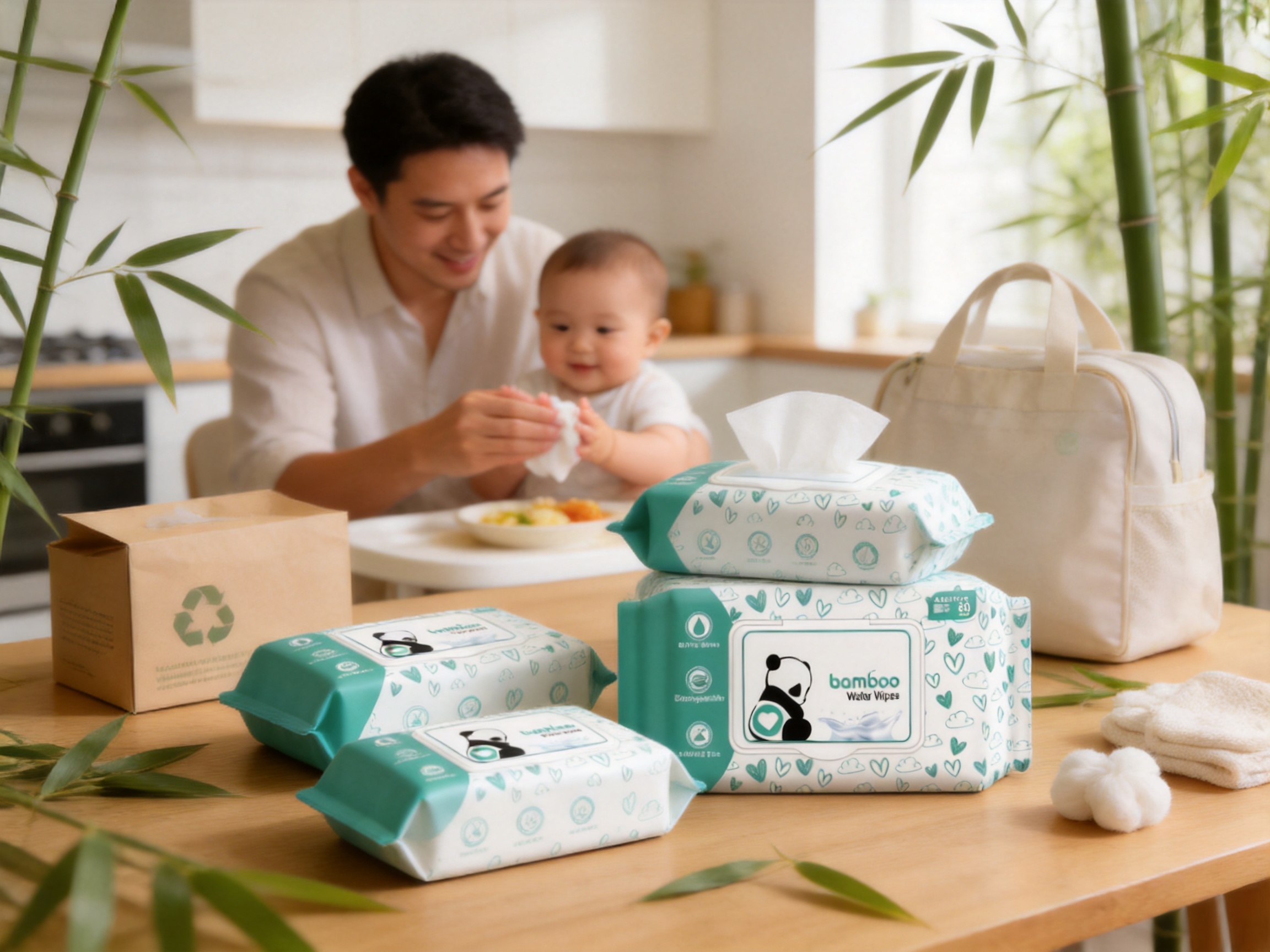
Baby wipes are used many times every day, often on the most delicate areas of a child’s skin. For parents, caregivers, retailers, and childcare professionals, a wipe must do more than remove dirt. It should feel soft, hold together during use, absorb moisture efficiently, support convenient cleaning, and fit naturally into a responsible approach to environmental care. The 100% Bamboo Fibers Soft Baby Wipes are designed to meet these expectations through a combination of plant-based material selection, carefully engineered nonwoven construction, skin-conscious formulation options, and flexible private-label manufacturing.
Made with 100% bamboo fibers in the featured product configuration, these wipes offer a naturally soft and cloth-like hand feel. Bamboo-based fibers are known for their smooth surface, comfortable touch, and useful moisture-handling characteristics. When combined with parallel and semi-cross nonwoven technologies, they can provide a wipe that is gentle enough for routine baby care while remaining strong enough for practical cleaning tasks.
The product is positioned as an alternative to conventional wipes made primarily from synthetic fibers. Traditional synthetic wipes can provide strength and low cost, but they may contribute to long-term plastic waste when discarded. Bamboo fibers offer a renewable raw-material option and can support the development of more environmentally considerate wipes, particularly when the complete wipe structure, lotion formula, packaging, and disposal instructions are properly evaluated.
For manufacturers, importers, retailers, and brand owners, the value of this product extends beyond the individual wipe. The manufacturing partner behind the product combines decades of experience in nonwoven materials, hygiene products, medical applications, maternal and baby care, and customized OEM and ODM production. This industrial foundation allows customers to develop products according to market requirements, including different sizes, weights, patterns, fragrances, packaging formats, and material combinations.
The result is a baby wipe concept that brings together four important priorities: softness for sensitive skin, dependable functional performance, sustainability-oriented material selection, and scalable professional manufacturing.
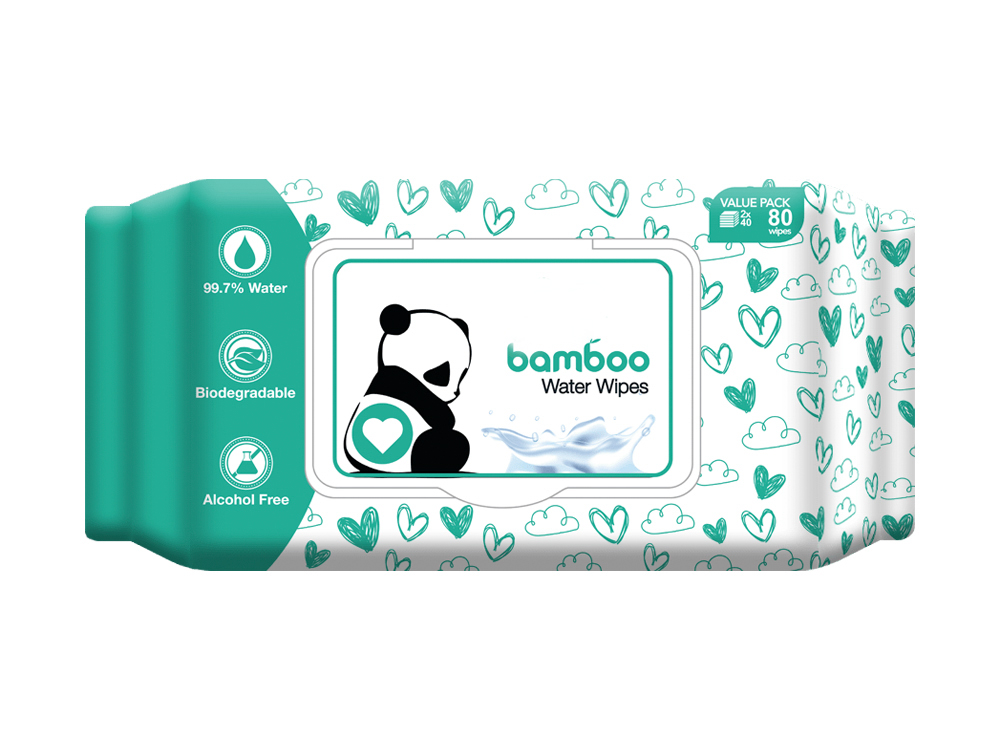
100% Bamboo Fibers Soft Baby Wipes
Product Overview
The 100% Bamboo Fibers Soft Baby Wipes are designed for newborn care, diaper changes, mealtime cleanup, hand cleaning, and general daily hygiene. The featured construction uses bamboo fibers as the primary and defining material. Bamboo provides a natural-feeling alternative to ordinary plastic-based wipe substrates and gives the finished product a smooth, soft, and comfortable texture.
The wipes can be produced in a range of specifications to serve different markets and product positioning strategies. Available options include approximately 30 to 100 grams per square meter, widths from 12 to 22 centimeters, and lengths from 12 to 30 centimeters. Pack quantities may range from 1 to 200 pieces, depending on the intended application and packaging design.
Customers may also select from several surface patterns and textures. Plain wipes are suitable for brands seeking a particularly smooth and silky appearance. Mesh structures can create a distinctive surface and support practical cleaning. Dot-embossed wipes may provide improved grip and a more textured touch, while flower and star patterns can add a visual or tactile feature for consumer-facing baby-care products.
Fragrance selection can be customized according to the target market. Unscented wipes are often preferred for newborns and consumers who seek a minimal formulation. Other available fragrance directions may include fresh, lavender, lemon, lotus, fruit, coconut, cucumber, and similar options. Any fragranced product should be assessed for skin compatibility, regulatory compliance, and suitability for its intended age group before commercial release.
Featured product |
100% Bamboo Fibers Soft Baby Wipes |
Primary application |
Baby care, diaper changes, face and hand cleaning, mealtime cleanup |
Material option for featured version |
100% bamboo fiber |
Available material portfolio |
Polyester, viscose, bamboo, lyocell, cotton, and combinations subject to specification |
Nonwoven technologies |
Parallel and semi-cross structures |
Basis weight range |
Approximately 30–100 gsm |
Width range |
Approximately 12–22 cm |
Length range |
Approximately 12–30 cm |
Piece-count range |
Approximately 1–200 pieces per pack, depending on format |
Surface patterns |
Plain, mesh, dot embossed, flower, and stars |
Fragrance options |
Unscented and selected fresh or botanical-inspired options |
Why Bamboo Is an Attractive Wipe Material
Bamboo has become increasingly relevant in personal-care and household products because it grows rapidly and can be cultivated as a renewable resource. Compared with slower-growing raw materials, bamboo can provide a high-yield plant source for fiber production. Its use in nonwoven products may help brands respond to consumer interest in renewable materials and reduced dependence on conventional plastic substrates.
The appeal of bamboo is not limited to sustainability messaging. Properly processed bamboo fibers can contribute to a soft and pleasant surface. The fibers are suitable for products that come into frequent contact with skin, especially when the finished wipe is engineered with an appropriate basis weight and a balanced lotion level.
Bamboo fiber can also provide useful liquid absorption and retention. A wipe that absorbs moisture effectively can remove residues with fewer passes and may reduce the amount of product required for a particular cleaning task. In baby care, this can be especially helpful during diaper changes, when the wipe must clean efficiently without excessive rubbing.
Another advantage is the possibility of creating a thicker, cloth-like wipe without relying exclusively on a plastic-rich substrate. The final hand feel depends on fiber quality, web formation, bonding, embossing, basis weight, moisture level, and packaging. However, a well-designed bamboo wipe can offer a combination of softness and substance that consumers often associate with premium baby-care products.
The product information also emphasizes the natural characteristics of bamboo, including the presence of a bamboo-associated substance commonly referred to as “Bamboo Kun.” Such descriptions may support consumer education, but commercial claims should be worded carefully and substantiated according to the regulations of the destination market. A wipe should not be presented as a medical treatment or as a guaranteed method of preventing diaper rash unless appropriate clinical and regulatory evidence exists.
Softness and Sensitive-Skin Considerations
Newborn and infant skin requires thoughtful product design. The skin barrier is still developing, and repeated cleaning can cause discomfort when products are rough, overly fragranced, or formulated with unsuitable ingredients. A soft wipe can help reduce mechanical friction during everyday use, while a carefully selected lotion can support a more comfortable cleaning experience.
The 100% Bamboo Fibers Soft Baby Wipes are designed around a smooth and gentle surface. Bamboo fibers can create a silky touch that is appropriate for cleaning a baby’s hands, face, and diaper area. The choice of surface pattern allows brands to balance softness and grip. A plain surface may be preferred for very gentle contact, while a dot-embossed surface may help lift residues more effectively.
The product can be supplied with an unscented formula for consumers who prefer a simple and neutral wipe. It can also be customized with selected fragrance options when market research indicates that a light scent is desirable. For newborn-focused products, unscented or minimally fragranced formulations are often considered a prudent direction, although the final choice should be guided by safety assessments and applicable regulations.
The stated formulation direction excludes alcohol, parabens, and chlorine. Plant-based ingredients may also be incorporated according to the customer’s requirements. These features can help brand owners develop a product positioned around gentle, uncomplicated care. Nevertheless, the complete formula must be evaluated as a finished product. Individual ingredients, preservatives, fragrances, pH, microbial limits, and packaging conditions all influence the product’s suitability.
Responsible communication is important in the sensitive-skin category. The wipe may be described as soft, hypoallergenic-oriented, alcohol-free, or designed for delicate skin when those claims are supported by appropriate testing and documentation. It is better to present the product as a carefully engineered daily-care option than to make absolute promises about every baby’s response.
Strength, Absorption, and Cleaning Efficiency
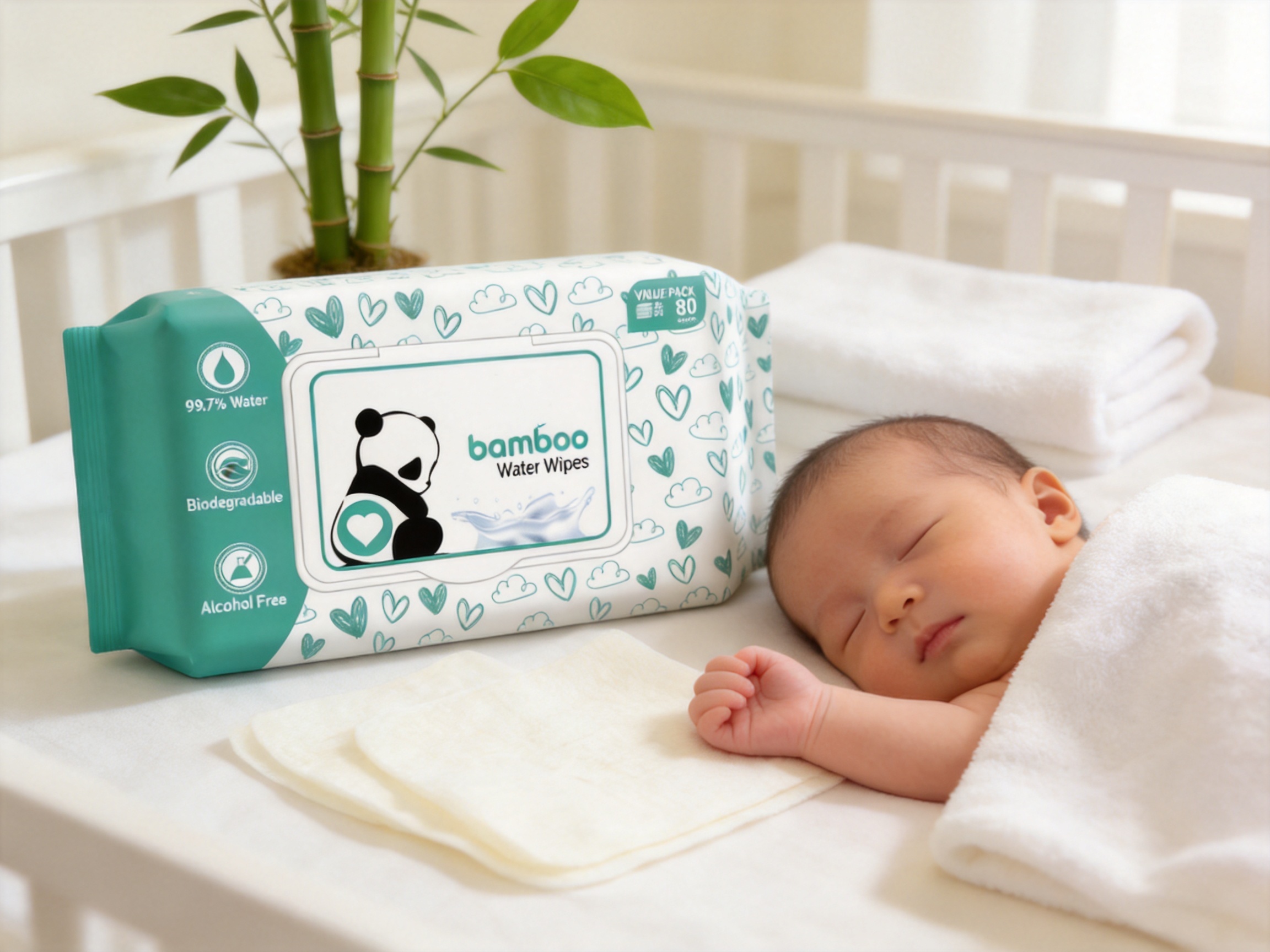
Softness alone is not enough for a high-quality baby wipe. A wipe that tears easily can create frustration, require multiple sheets, and reduce consumer confidence. For this reason, the product uses parallel and semi-cross technologies to create a durable nonwoven web that resists tearing during normal use.
Parallel fiber arrangements can contribute to a consistent web structure and directional strength. Semi-cross structures can help distribute fiber orientation and improve integrity in more than one direction. The exact performance depends on the production parameters, fiber blend, basis weight, bonding conditions, and converting process, but the combined approach is intended to produce a strong wipe with a flexible and comfortable feel.
Durability is particularly useful during diaper changes. Caregivers may need to wipe several times, fold the sheet, or apply moderate pressure while cleaning. A stable wipe remains intact rather than breaking apart or leaving loose fragments. This improves handling and can help the user complete the task with fewer sheets.
Absorption is another significant performance factor. Bamboo-based fibers can hold and distribute liquid effectively when properly processed. A well-balanced wet wipe should deliver lotion evenly across the sheet, remain moist during its intended shelf life, and release enough liquid during use to support comfortable cleaning without excessive dripping.
The combination of moisture absorption and sheet strength supports the idea of “one-sheet efficiency.” This does not mean that one wipe will always be sufficient for every task. Instead, it indicates that the wipe is designed to provide enough body, liquid capacity, and cleaning surface to handle ordinary messes effectively. The result may be a more satisfying experience compared with thin, weak, or overly dry alternatives.
Different patterns can further influence performance. Dot embossing may create small raised areas that improve contact with residues. Mesh can provide a distinctive surface structure and may be selected for more active cleaning. Plain material can prioritize smoothness. These choices allow private-label customers to create differentiated products without changing the entire category concept.
Advantages Compared with Conventional Synthetic Wipes
Many conventional wipes use polyester or other synthetic fibers because they offer strength, processability, and cost efficiency. Synthetic substrates can perform well mechanically, but they may remain in the environment for a very long time after disposal. This has increased interest in wipes made from renewable or biodegradable fibers.
The bamboo version offers several potential advantages over a standard plastic-based wipe:
Renewable Raw-Material Positioning
Bamboo is a rapidly growing plant resource and can support a renewable-material story. For brands seeking to reduce their reliance on conventional synthetic substrates, bamboo provides a recognizable and marketable alternative. It can also appeal to consumers who look for plant-based materials in baby and household products.
Soft, Natural Hand Feel
Bamboo fibers can produce a smooth and comfortable surface. Compared with some low-cost synthetic wipes that feel thin or harsh, a bamboo wipe can be developed with a more premium cloth-like texture. This sensory difference is important because consumers often judge baby-care quality through touch as well as visual packaging.
Potentially Lower Plastic Content
A wipe made with 100% bamboo fibers in the substrate can reduce dependence on plastic-based fibers in the sheet itself. The overall product still needs to be assessed, including lotion ingredients, packaging films, labels, closure systems, and any elastic or composite components. Even so, the substrate represents an important part of the product’s environmental profile.
Biodegradation-Oriented Product Development
Bamboo-based wipes may be developed for biodegradation or compostability claims when the substrate, lotion, packaging, and relevant processing conditions meet the required standards. The product information identifies the wipes as biodegradable and compostable. For commercial use, these claims should be confirmed through suitable testing and certification for the destination market, because biodegradability and compostability depend on the exact composition and disposal environment.
Premium Differentiation
A bamboo baby wipe can help a retailer or brand owner establish a more distinctive market position. Instead of competing solely on price, the product can communicate softness, renewable material selection, responsible manufacturing, and modern baby-care values. This positioning may be especially suitable for premium supermarkets, maternity retailers, e-commerce brands, eco-conscious stores, and subscription-based baby-care services.
Environmental Responsibility and Claim Management
Environmental performance is increasingly important, but responsible product communication requires more than using a natural-sounding material name. A complete evaluation should consider raw-material sourcing, fiber processing, production energy, water consumption, lotion chemistry, packaging, transport, consumer use, and disposal.
Bamboo can be a valuable part of a lower-impact product strategy when it is responsibly sourced and processed. The manufacturer and brand owner should maintain clear records regarding fiber origin, supplier documentation, chemical processing, and product testing. Customers may also request information about restricted substances, safety assessments, biodegradation, and packaging recyclability.
The product information describes the wipes as fully biodegradable and compostable. These are important claims that should be verified for the precise commercial specification. A wipe may be biodegradable under particular industrial or natural conditions, while home compostability may require a different standard. Similarly, a biodegradable sheet placed in a sealed landfill may not degrade in the same way as it would in a managed composting environment.
Clear disposal instructions can improve consumer understanding. If the product is not designed and certified to be flushable, it should not be promoted for toilet disposal. Even a biodegradable wipe can create plumbing problems when flushed. The packaging should direct users to dispose of used wipes according to local waste-management rules.
Environmental responsibility also includes avoiding unnecessary over-packaging. A well-designed private-label format can balance moisture protection, product shelf life, shipping efficiency, and material reduction. Resealable packs, refill formats, and appropriately sized bundles may help brands reduce unnecessary packaging while maintaining hygiene and convenience.
Advanced Nonwoven Manufacturing Technologies
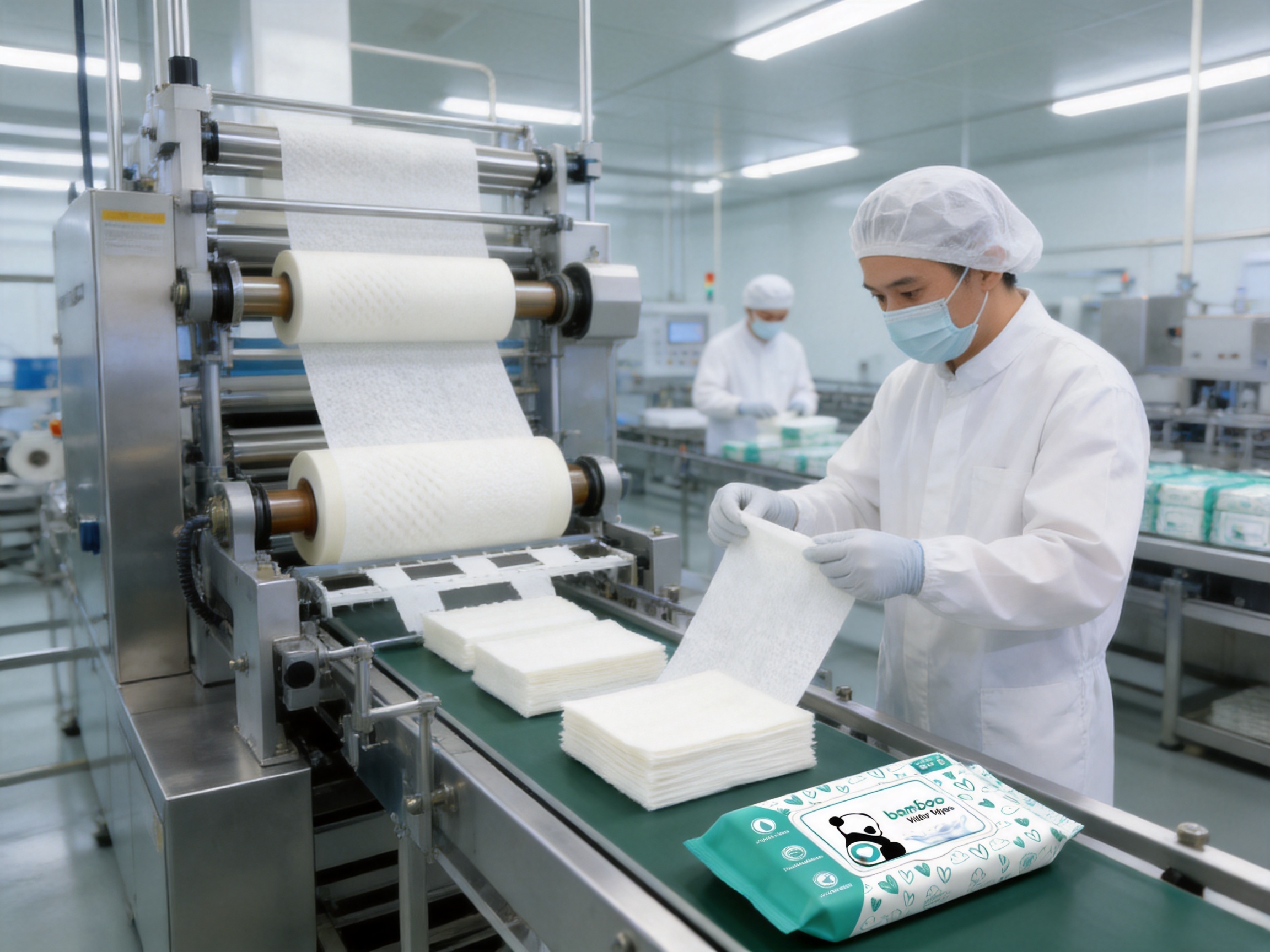
The manufacturing quality of a wipe depends heavily on the formation of the nonwoven web. Nonwoven production differs from woven textile production because fibers are arranged and bonded without conventional yarn interlacing. This allows manufacturers to control softness, strength, absorbency, basis weight, and surface appearance in a highly flexible way.
The featured product uses parallel and semi-cross technologies. These technologies influence how fibers are oriented within the web. Fiber orientation affects tensile strength, tear resistance, liquid distribution, drape, and tactile properties. By selecting a suitable configuration, the manufacturer can create a wipe that remains soft while resisting damage during handling.
Parallel technology can support a uniform web with controlled directional performance. Semi-cross technology can help create a more balanced structure and reduce weakness across the sheet. The combination is useful for products that must be folded, pulled from a pack, unfolded, and used in different directions without falling apart.
Manufacturing control also involves raw-material preparation. Fibers must be opened, blended where applicable, and distributed consistently. Variations in fiber length, fineness, moisture, or contamination can affect the final sheet. Professional production requires controls at the material-receiving stage, during web formation, and after bonding and finishing.
Basis weight is adjusted according to the target product. A lighter wipe may be economical and suitable for quick cleaning, while a heavier wipe may offer a more substantial feel and higher liquid capacity. The range of approximately 30 to 100 gsm provides room for different brand strategies, from practical everyday formats to premium thick wipes.
Embossing and pattern design are additional manufacturing considerations. Patterns may improve grip, create a recognizable appearance, or support the tactile identity of a product line. The embossing process must be controlled so that it enhances the surface without causing excessive weakening or uneven lotion distribution.
Manufacturing Strengths and Industrial Experience
The manufacturing organization behind the product was founded in 1987 and has developed extensive experience in medical and hygienic nonwoven materials, nursing products, high-end clothing interlining, and consumer-care goods. This long operating history provides a foundation for understanding both raw-material technology and finished-product requirements.
The company’s product portfolio covers spunlace nonwovens, spunmelt nonwovens, hot-air-through nonwovens, flushable and degradable nonwovens, wet wipes, dry wipes, baby diapers, pull-ups, wet toilet paper, cleansing wipes, and related products. This breadth is valuable because a baby-wipe customer can work with a supplier that understands multiple stages of the hygiene-product value chain.
The organization has established production bases in several regions of China, including Zhejiang, Guangdong, Jiangsu, and Hubei. A multi-site production structure can support capacity planning, supply continuity, regional logistics, and the ability to serve customers with different order volumes. It also provides a platform for transferring technical experience across product categories.
Internationally sourced production equipment and technology from Germany, France, and Italy contribute to the company’s manufacturing capabilities. Advanced equipment can improve web uniformity, process stability, converting precision, and quality consistency. In a high-volume hygiene category, reliable equipment is essential because small variations in sheet weight, moisture, sealing, or folding can become noticeable across large production runs.
The company states that it has ranked among leading enterprises in China’s industrial textile and nonwoven sectors and has maintained a position among major global nonwoven manufacturers. These credentials suggest substantial production experience and industrial scale. Buyers should still conduct their own supplier qualification, factory audits, product testing, and documentation review before placing commercial orders.
The company’s research and development capabilities are also relevant to private-label customers. Baby wipes are not a one-size-fits-all product. Different markets may require different pH levels, preservatives, lotion systems, fragrance policies, packaging structures, certifications, and labeling formats. A supplier with experience in both materials and finished goods is better positioned to help a brand move from an initial concept to a manufacturable specification.
OEM and ODM Customization Opportunities
Private-label customers increasingly expect more than a standard catalog product. They want a wipe that reflects their brand identity, target price, retail channel, and consumer profile. The manufacturing platform supports OEM and ODM development for customers seeking customized wet wipes, dry wipes, diapers, growing-up pants, training pants, and related hygiene products.
For the bamboo baby wipes, customization may include material selection, sheet dimensions, basis weight, piece count, lotion formula, fragrance, surface pattern, folding method, packaging style, label design, and carton configuration. Customers can choose a plain, mesh, dot-embossed, flower, or star surface depending on the desired market presentation.
Material customization should be handled carefully. The featured product is based on 100% bamboo fibers, while the broader material portfolio includes polyester, viscose, bamboo, lyocell, and cotton. This allows the manufacturer to develop different constructions for different performance, cost, and sustainability objectives. Any change in fiber composition should be reflected accurately in product claims and packaging.
Formula customization can include unscented or fragranced options and the use of selected plant-based ingredients. The formula should be assessed for microbial stability, compatibility with the substrate, skin safety, odor, pH, and shelf life. A formula that performs well in a laboratory sample must also remain stable through filling, sealing, storage, shipping, and consumer use.
Packaging is another key area for private-label development. A brand may choose a soft pack with a resealable label, a rigid tub, a travel-size pouch, a refill pack, or a multi-pack format. Packaging must protect moisture, prevent contamination, support convenient dispensing, and provide sufficient space for ingredient declarations, warnings, batch information, usage instructions, and disposal guidance.
OEM development can also support different consumer segments. A newborn line may emphasize unscented softness and minimal ingredients. A family-care line may use larger sheets and a more robust texture. A premium eco line may focus on bamboo fibers, reduced plastic content, recyclable packaging, and independently verified environmental claims. A value line may optimize basis weight and pack count while preserving essential performance.
Quality Control from Fiber to Finished Pack
Quality control should cover every stage of production. Incoming fiber inspection helps confirm material identity, cleanliness, moisture, and consistency. During web formation, manufacturers can monitor basis weight, thickness, width, tensile strength, and visual uniformity. After lotion application, moisture distribution and pick-up levels should be checked to ensure consistent performance throughout the roll or batch.
Finished wipes can be evaluated for sheet dimensions, tear resistance, absorbency, wet tensile strength, pH, odor, appearance, and package integrity. Microbiological testing is especially important for wet wipes because the combination of water and organic ingredients can support microbial growth if the preservation system or manufacturing hygiene is inadequate.
Packaging inspections should confirm seal quality, closure performance, label adhesion, coding, and pack count. A package that does not reseal properly may allow the wipes to dry out before use. A weak seal may lead to leakage or contamination during transportation. Consistent folding and dispensing are also important because consumers expect each sheet to be easy to remove.
For international customers, product documentation may include technical data sheets, safety information, ingredient lists, certificates of analysis, test reports, factory audit records, and regulatory declarations. The exact documentation depends on the destination country and the product claims. Brands should work with qualified regulatory professionals when launching baby-care products in new markets.
Quality systems are particularly important for baby products because consumers expect reliable performance and strong safety controls. A manufacturer with experience in medical and hygienic nonwovens can apply disciplined processes to material handling, production hygiene, traceability, testing, and corrective action.
Use Cases and Consumer Benefits
Diaper Changes
The primary use of the product is routine diaper changing. The wipe’s softness helps support comfortable cleaning, while its strength helps it remain intact during use. A sufficiently thick sheet can provide a more substantial hand feel and may reduce the need to layer several thin wipes.
Newborn and Infant Care
For newborn-focused products, the unscented version can be positioned around simple daily care. Parents may appreciate a smooth bamboo surface and a formulation that avoids alcohol, parabens, and chlorine. The final product should always be supported by appropriate safety assessments and age-appropriate labeling.
Mealtime Cleanup
Babies and toddlers often need quick cleaning after meals. A wipe with a balanced combination of absorbency and surface texture can help remove food residues from hands, cheeks, and other areas. The plain version may be suitable for gentle facial cleaning, while a lightly textured version may be useful for hands and high-chair surfaces.
Travel and Outdoor Use
Portable wet wipes are convenient for family travel, stroller storage, diaper bags, and outdoor activities. Customized smaller packs can support on-the-go use, while larger packs can be designed for home use. Packaging selection should consider portability, resealing, temperature exposure, and the risk of drying during extended storage.
Retail and Hospitality Applications
Hotels, childcare centers, maternity facilities, and family-oriented service providers may use private-label baby wipes as part of a broader customer-care program. Customized packaging can reinforce a hospitality brand while providing a useful product for parents. Bulk pack formats may be appropriate for institutional customers, provided that hygiene, storage, and dispensing procedures are carefully managed.
How the Product Supports Brand Differentiation
The baby-wipe category includes many competing products, and brands need a clear reason for consumers to choose one product over another. The bamboo wipe concept provides several possible points of differentiation: renewable plant-based fiber, silky softness, cloth-like thickness, customized surface patterns, flexible fragrance choices, and professional nonwoven manufacturing.
Brand owners can use the material story as an entry point, but the strongest positioning combines material benefits with measurable product performance. A package can communicate bamboo content, softness, sheet size, lotion features, and verified environmental information. Claims should be specific and clear rather than broad or absolute.
Premium presentation can be supported by a heavier basis weight, larger sheet dimensions, dot embossing, refined packaging, and an unscented or carefully selected lotion. A value-oriented product may focus on efficient pack counts and practical dimensions. Because the product can be customized, the same manufacturing platform can serve different price levels without losing the central bamboo identity.
Retailers may also appreciate the opportunity to build a coordinated family-care range. Bamboo baby wipes can be paired with dry wipes, diapers, training pants, wet toilet paper, cleansing wipes, and other products from the same manufacturing partner. A coordinated range can simplify supplier management and create consistent visual and functional standards across a brand portfolio.
Recommended Product Development Process
A successful OEM or ODM project usually begins with a detailed product brief. The customer should define the intended age group, application, market, sheet size, pack count, target price, material claims, fragrance policy, packaging format, and required certifications.
The next step is sample development. The manufacturer can provide different basis weights, patterns, textures, lotion levels, and packaging formats. Customers should evaluate softness, wet strength, absorption, dispensing, odor, and overall consumer experience. Testing should be performed not only on a single sample but across multiple batches when the specification is close to approval.
After sample selection, the parties should confirm the technical specification. This document should identify the fiber composition, basis weight tolerance, dimensions, folding method, moisture range, lotion ingredients, fragrance, microbiological limits, packaging materials, labeling requirements, and acceptance criteria.
Pilot production helps confirm that the selected specification can be produced consistently at commercial speed. It also provides an opportunity to verify packaging machinery, sealing, coding, carton loading, and shipping durability. Any environmental or performance claims should be reviewed at this stage to ensure that the actual commercial product matches the marketing language.
Before mass production, the buyer should approve a reference sample and establish a quality-control plan. The plan may specify inspection frequency, laboratory testing, retention samples, defect classification, and procedures for handling nonconforming goods. Clear expectations reduce misunderstandings and help protect both the manufacturer and the brand owner.
Q&A: Frequently Asked Questions
What makes these baby wipes different from ordinary wipes?
The featured version uses 100% bamboo fibers and is designed with a soft, cloth-like feel. It also uses parallel and semi-cross nonwoven technologies to combine softness with practical strength. The bamboo substrate provides a renewable-material alternative to wipes made primarily from synthetic fibers.
Are the wipes suitable for newborns?
The wipes are designed for delicate baby skin and can be developed in an unscented, skin-conscious formulation. However, suitability for newborns depends on the final formula, preservative system, fragrance policy, pH, packaging, and regulatory testing. Parents and buyers should review the final product documentation and follow the label instructions.
Are the wipes hypoallergenic?
The product is positioned around hypoallergenic-oriented care, but “hypoallergenic” is not a universal guarantee that no user will experience a reaction. The claim should be supported by appropriate formulation review and testing in the destination market. Customers should request relevant technical and safety documentation before making the claim on packaging.
Do the wipes contain alcohol, parabens, or chlorine?
The stated product direction is free from alcohol, parabens, and chlorine. The exact commercial formula should be confirmed through the approved ingredient list and product specification. Customers should also verify whether fragrances, preservatives, and other ingredients meet the requirements of their intended market.
Are the wipes completely biodegradable?
The product information presents the wipes as biodegradable and compostable. These claims depend on the precise substrate, lotion, manufacturing process, packaging, and disposal conditions. Before making an absolute claim, buyers should request relevant test reports or certification and use wording that complies with local environmental-marketing rules.
Can the wipes be flushed down the toilet?
They should not be flushed unless the exact product has been specifically designed, tested, and labeled as flushable according to recognized standards. Biodegradability does not automatically mean that a wipe is suitable for sewer systems. Used wipes should generally be disposed of according to local waste-management instructions.
What sizes are available?
The stated range is approximately 12 to 22 centimeters in width and 12 to 30 centimeters in length. Final dimensions can be discussed during product development and should be selected according to the intended application, packaging format, and target market.
What basis weights are available?
The available range is approximately 30 to 100 grams per square meter. Lower basis weights may support economical formats, while higher basis weights can provide a thicker and more substantial feel. The best choice depends on the desired softness, absorbency, strength, cost, and pack size.
Can the surface pattern be customized?
Yes. Available patterns include plain, mesh, dot embossed, flower, and star designs. Plain surfaces emphasize smoothness, while textured patterns can provide a distinctive appearance or improved grip. Pattern selection should be evaluated together with softness and cleaning performance.
Can the wipes be scented?
Yes. Unscented wipes are available, along with selected fragrance directions such as fresh, lavender, lemon, lotus, fruit, coconut, and cucumber. For newborn products, many brands prefer unscented or lightly fragranced formulations. All fragrances should be assessed for safety, stability, and regulatory compliance.
Can the manufacturer produce other hygiene products?
The company’s product portfolio includes wet wipes, dry wipes, baby diapers, pull-ups, growing training pants, wet toilet paper, cleansing wipes, and several nonwoven material categories. This allows customers to explore coordinated product lines and related private-label programs.
What information should a buyer provide when requesting a quotation?
A buyer should provide the desired material, sheet size, basis weight, piece count, fragrance, lotion requirements, surface pattern, packaging type, target market, estimated order quantity, and any required certifications. Artwork requirements, shipping destination, and delivery expectations are also useful for accurate planning.
How should buyers evaluate the product before a large order?
Buyers should request samples, compare different specifications, conduct user evaluations, review laboratory reports, confirm packaging performance, and assess the final product against local regulatory requirements. A factory audit or supplier qualification review may also be appropriate for major programs.
Conclusion: A Balanced Solution for Modern Baby-Care Brands
The 100% Bamboo Fibers Soft Baby Wipes combine a renewable plant-based substrate with the practical performance expected from a modern hygiene product. Their soft surface, moisture absorption, tear resistance, customizable patterns, and flexible size range make them suitable for diaper changes, newborn care, mealtime cleanup, travel, and family hygiene.
Compared with conventional synthetic wipes, the bamboo version can offer a more distinctive sustainability profile and a premium natural hand feel. Its environmental advantages should be communicated accurately and supported by testing, especially when using terms such as biodegradable, compostable, or plastic-free.
The manufacturing platform adds value through long-term experience in nonwoven materials, advanced production equipment, multiple production bases, broad hygiene-product expertise, and OEM and ODM development capabilities. These strengths allow brand owners to move beyond a standard catalog item and create a product that matches their target consumers, retail channel, price point, packaging strategy, and regulatory market.
For companies seeking a dependable private-label baby wipe, the product offers a useful balance of softness, strength, customization, and sustainability-oriented design. With careful formulation, quality control, responsible sourcing, and accurate claims, bamboo baby wipes can become a credible and competitive addition to a modern maternal and baby-care portfolio.
References
1. General technical literature on bamboo fiber properties, renewable cellulosic materials, and nonwoven hygiene applications.
2. General industry guidance on spunlace nonwoven web formation, fiber orientation, bonding, embossing, and wet-wipe converting.
3. International and regional guidance concerning cosmetic and personal-care product safety, ingredient evaluation, preservation, and microbiological quality.
4. Technical standards and certification guidance for biodegradability, compostability, environmental labeling, and responsible product claims.
5. General research literature concerning infant skin-barrier development, cleansing practices, and the evaluation of products intended for sensitive skin.
6. Manufacturer-provided product specifications for 100% Bamboo Fibers Soft Baby Wipes, including material options, sizes, basis weights, patterns, fragrance choices, and production technologies.
7. Manufacturer-provided corporate information concerning nonwoven material research, hygiene-product manufacturing, production locations, OEM and ODM capabilities, and product categories.
Product: 100% Bamboo Fibers Soft Baby Wipes