中文简体
中文简体 English
 日本語
日本語 русский
 Español
In the competitive world of dry wipes, wet wipes, personal care substrates, and specialty cleaning materials, the quality of the nonwoven fabric determines much more than appearance. It affects softness, strength, liquid absorption, friction performance, conversion efficiency, brand positioning, and the final user experience. Viscose and polyester ginkgo dot style spunlace nonwoven fabric is designed to answer these needs with a balanced combination of comfort, durability, visual distinction, and functional adaptability.
This product is a semi-cross spunlace nonwoven made from a typical composition of 50% viscose and 50% polyester, with blending ratios available for customization. It uses double-carding and semi-cross technology to create a thicker hand feel and superior strength compared with ordinary parallel-lapped spunlace fabrics. Its distinctive ginkgo dot pattern gives the substrate an attractive pearl-like surface texture while improving friction and wiping performance. For brands seeking a wipe material that looks premium, feels comfortable, and performs reliably in wet or dry applications, this fabric offers a strong foundation.
Viscose And Polyester Ginkgo Dot Style Spunlace Nonwoven For Dry Or Wet Wipes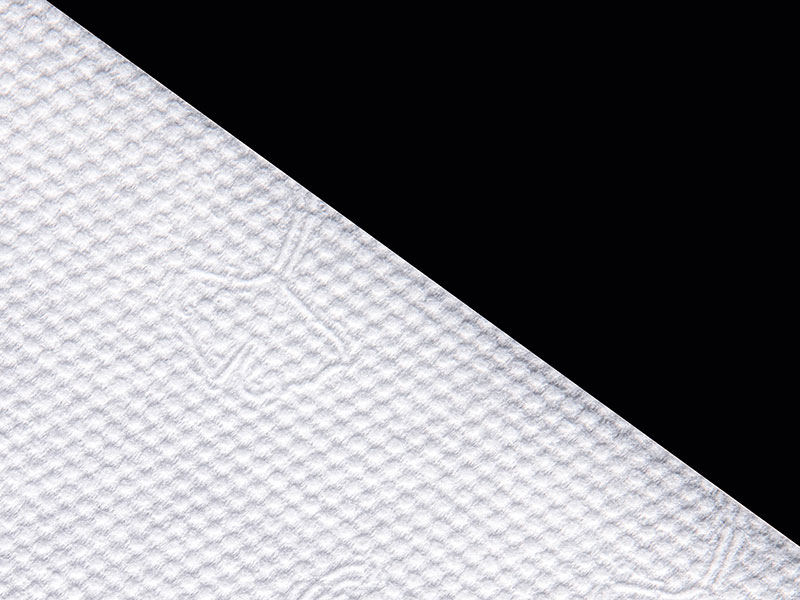
Product Overview
Viscose and polyester ginkgo dot style spunlace nonwoven is developed for dry wipes, wet wipes, and related hygiene or cleaning products. It combines the hydrophilic comfort of viscose with the dimensional stability and tensile contribution of polyester. The result is a substrate that can be tailored for different wiping tasks, from gentle skin cleansing to household surface cleaning and industrial light-duty wiping.
The fabric is produced through a double-carding, semi-cross spunlace process. In spunlace technology, high-pressure water jets entangle fibers into a coherent web without the need for chemical binders. This makes the substrate suitable for applications where softness, cleanliness, and skin compatibility are important. The semi-cross structure improves web uniformity and enhances multidirectional strength, helping the fabric resist tearing, deformation, and excessive elongation during converting and use.
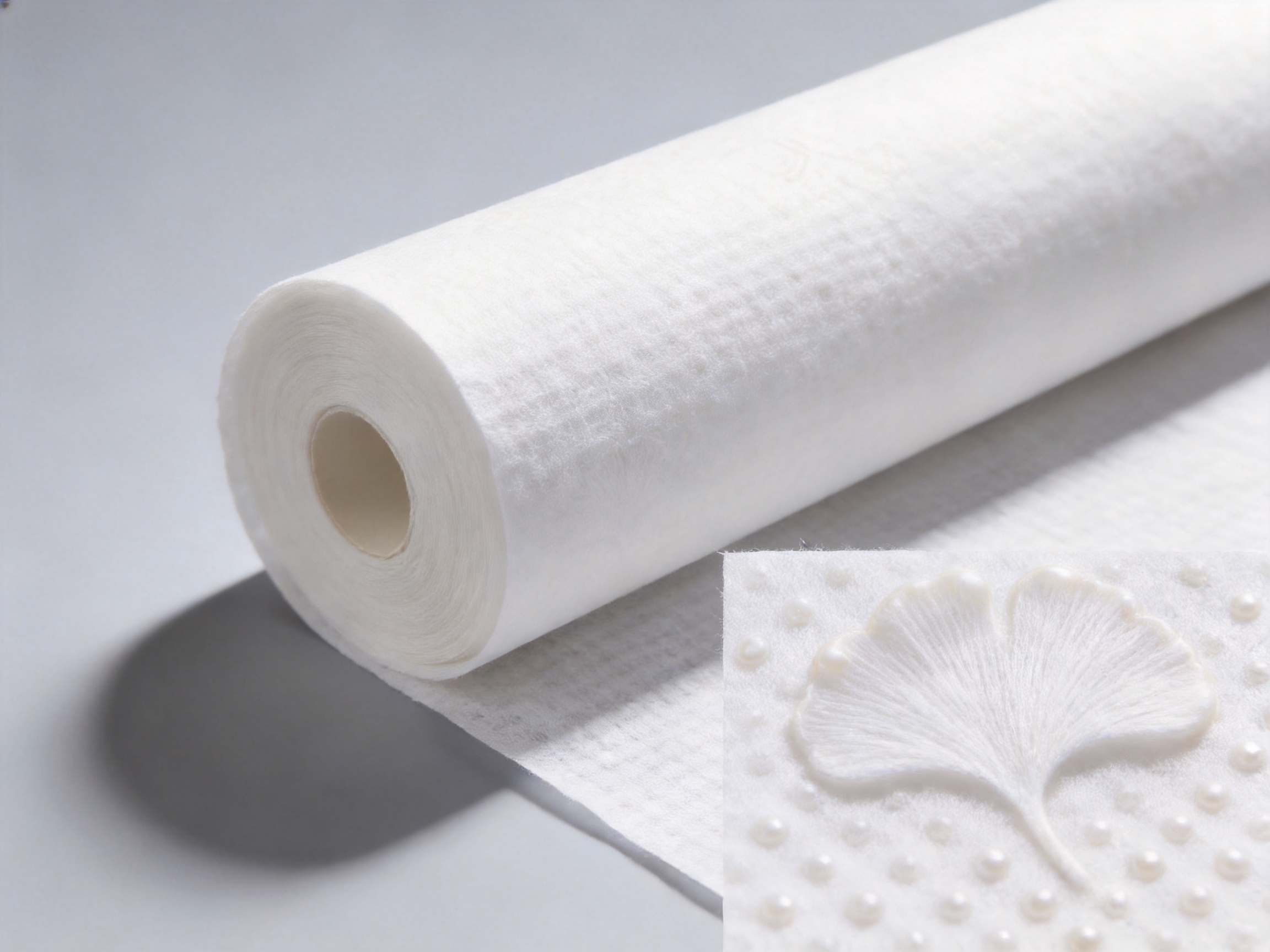
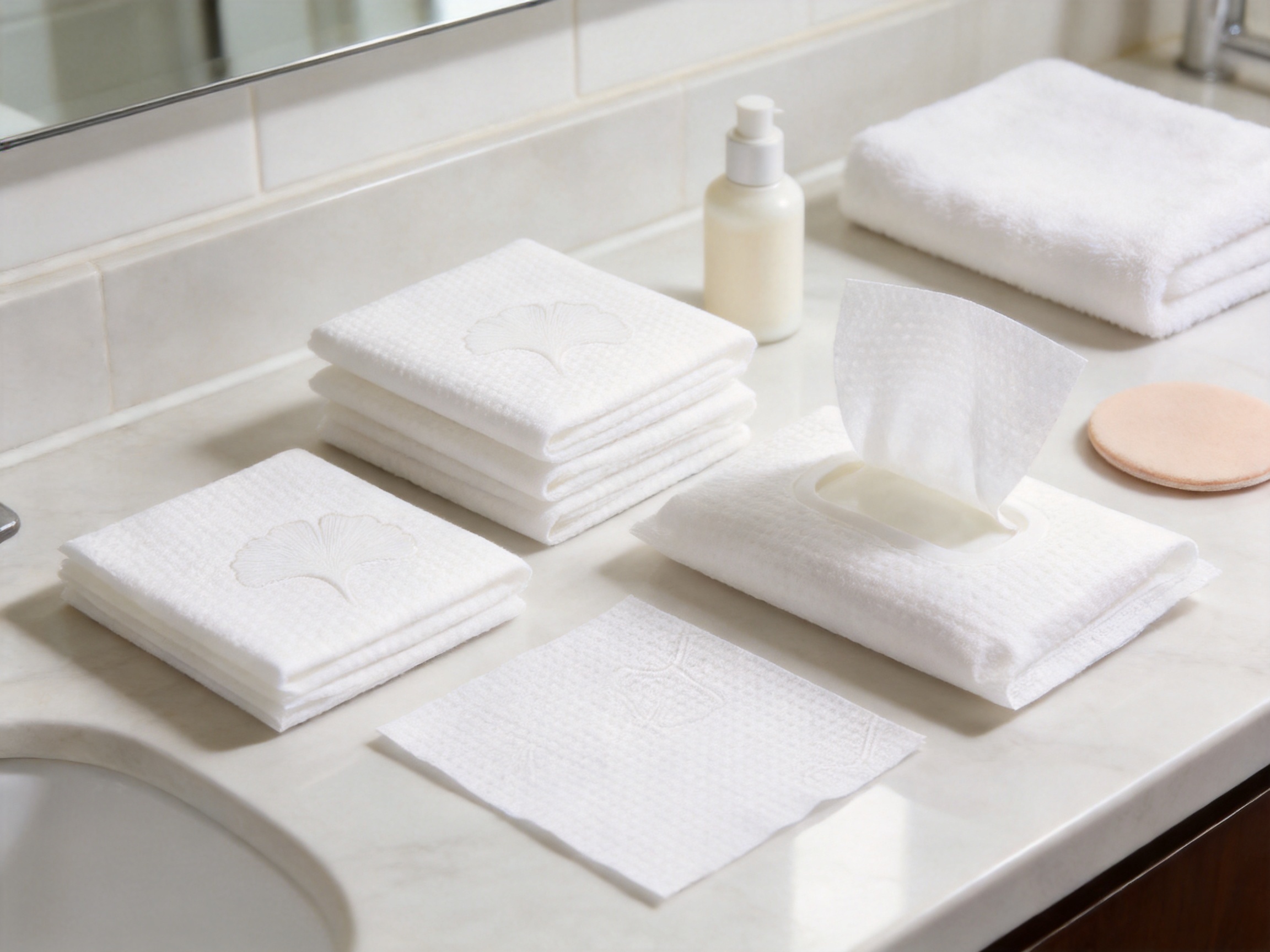
The ginkgo dot pattern is one of the defining characteristics of this product. It is not merely decorative. Surface texture influences how a wipe contacts skin, equipment, glass, countertops, baby care surfaces, and cosmetic areas. A patterned surface can improve pickup of residues, offer controlled friction, and create a recognizable brand feel. The ginkgo leaf pearl pattern provides a refined visual identity and a tactile wiping experience that is different from plain flat substrates.
Key Product Specifications
Item |
Specification |
Practical Value |
Composition |
50% viscose and 50% polyester, with customizable blending ratio |
Balances softness, absorbency, strength, and cost control |
Technology |
Double-carding, semi-cross spunlace |
Improves thickness, uniformity, and strength over ordinary parallel-lapped structures |
Pattern |
Ginkgo dot |
Creates premium appearance, enhanced friction, and brand differentiation |
Gram Weight |
40 gsm to 100 gsm |
Supports lightweight facial wipes through heavier cleaning or care wipes |
Roll Width |
10 cm to 320 cm |
Compatible with diverse converting lines and packaging formats |
Finishing Options |
Hydrophilic, coating, antistatic, and other functional treatments |
Allows application-specific customization |
Applications |
Wet wipes, dry wipes, and related wiping products |
Suitable for personal care, baby care, beauty, household, and cleaning markets |
Why the Viscose and Polyester Blend Matters
The 50% viscose and 50% polyester blend is a proven choice for wipes because the two fibers complement each other. Viscose is a regenerated cellulose fiber valued for softness, moisture absorption, and a pleasant touch against the skin. Polyester is a synthetic fiber known for strength, resilience, dimensional stability, and resistance to deformation. When these fibers are properly opened, carded, laid, and hydroentangled, the final fabric achieves a balance that neither fiber could provide alone.
For wet wipes, viscose helps the substrate absorb and hold liquid lotion evenly. This contributes to a moist and comfortable user experience. Polyester helps prevent the wipe from becoming weak when saturated, which is critical during dispensing, unfolding, and wiping. A wipe that stretches too much, tears easily, or loses integrity can damage consumer confidence. The polyester component helps maintain structure, while viscose improves softness and absorbency.
For dry wipes, the blend offers a different set of advantages. Viscose contributes to a soft, skin-friendly feel and good dust or residue pickup. Polyester supports mechanical strength and helps the wipe maintain shape during repeated strokes. In applications such as cosmetic cleansing, baby care, healthcare-related wiping, or household cleaning, the user expects both comfort and reliability. The fiber blend supports these expectations.
The ability to customize the blending ratio is also important. A higher viscose content may be selected when absorbency and softness are the primary requirements. A higher polyester content may be preferred when tensile strength, durability, and cost efficiency are prioritized. This flexibility allows product developers to match substrate performance with market positioning, product formula, packaging type, and target consumer needs.
Advantages of Semi-Cross Technology
One of the major advantages of this product is its semi-cross structure. Ordinary parallel-lapped spunlace fabrics often show strong machine-direction orientation. They may perform adequately in one direction but have weaker cross-direction strength. In practical wiping applications, however, force is rarely applied in one direction only. Consumers pull wipes from packages, unfold them, stretch them, scrub surfaces, and use them at different angles. A substrate with improved multidirectional integrity is therefore more reliable.
Semi-cross technology improves the orientation distribution of fibers. Compared with simple parallel lapping, it helps create a more balanced web structure. The fabric feels thicker and stronger, with improved resistance to tearing and deformation. This can be particularly valuable for wipes packed in canisters, flow packs, soft packs, or refill bags, where wipes need to pass through dispensing openings without breaking or excessive elongation.
A thicker style also influences perceived quality. Consumers often associate body, loft, and surface texture with premium performance. A wipe that feels too thin may be perceived as low value, even if it meets basic technical requirements. The semi-cross process helps create a more substantial hand feel without necessarily requiring excessive basis weight. This supports brand owners who want to improve consumer perception while maintaining practical manufacturing economics.
In wet applications, semi-cross structure can also contribute to better liquid distribution and handling. A more uniform web helps reduce weak spots and uneven wetting. During converting, winding, slitting, folding, and packaging, uniformity is essential for efficiency. Materials with inconsistent structure can cause breaks, wrinkles, poor folding accuracy, or variable product count. A stable semi-cross substrate supports smoother downstream production.
The Function of the Ginkgo Dot Pattern
The ginkgo dot pattern gives this spunlace nonwoven an identity that is immediately visible and tactile. In a market crowded with plain, mesh, pearl, and embossed wipe materials, surface differentiation matters. The ginkgo-inspired dot pattern creates an elegant and recognizable appearance that can help a finished wipe stand out on shelves, in online product photos, and during consumer use.
Beyond appearance, the pattern affects wiping mechanics. A flat nonwoven surface can be soft, but it may not always provide the desired level of friction for residue removal. A textured surface increases the contact complexity between the wipe and the target surface. The ginkgo dot pattern can help lift and trap particles, distribute lotion, and create a more satisfying wiping sensation. This is useful for applications such as facial cleansing wipes, baby wipes, hand wipes, household cleaning wipes, and surface polishing wipes.
Texture must be carefully balanced. If a wipe is too abrasive, it may feel uncomfortable on skin. If it is too smooth, it may be less effective for cleaning. The ginkgo dot style provides an attractive middle ground: a patterned tactile experience that enhances performance while maintaining the softness expected from viscose-rich spunlace materials. The pattern also helps communicate premium positioning without relying only on packaging design.
For private label and OEM customers, this type of pattern can support product segmentation. A brand may use plain fabric for entry-level products, pearl pattern for mid-range products, and ginkgo dot semi-cross fabric for premium or specialized lines. This creates a clear structure in the product portfolio and gives consumers a reason to upgrade.
Performance Advantages Over Common Competing Substrates
Competing wipe substrates may include ordinary parallel-lapped spunlace, thermal bonded nonwovens, airlaid paper, traditional cotton fabrics, and lower-grade blended nonwovens. Each material has its place, but the viscose and polyester ginkgo dot semi-cross spunlace fabric offers a compelling combination of properties.
Compared with ordinary parallel-lapped spunlace, the semi-cross structure delivers better thickness and strength balance. Parallel-lapped materials can be cost-effective, but they may show limited cross-direction performance. This can lead to tearing during pulling, folding, or scrubbing. The semi-cross product improves durability while keeping the soft and clean characteristics of spunlace technology.
Compared with thermal bonded nonwovens, spunlace fabrics generally offer better softness and drape. Thermal bonding relies on heat-melt fibers or bonding points, which can create a stiffer hand feel. For baby care, facial care, intimate care, and sensitive skin wiping, softness is a major purchasing factor. Hydroentangled viscose-polyester fabric provides a textile-like touch without the harshness that can occur in some thermally bonded materials.
Compared with airlaid paper, this spunlace fabric offers stronger wet integrity and a more fabric-like feel. Airlaid substrates can be absorbent, but they may generate lint or lose strength when heavily wetted, depending on the binder system and structure. The hydroentangled web is designed to maintain fiber entanglement under wet conditions, making it suitable for wipes that must remain intact during use.
Compared with woven cotton or knitted fabrics, spunlace nonwoven provides better cost efficiency, consistent roll supply, and high-speed converting compatibility. Traditional textile fabrics can be soft and strong, but they are often more expensive and may not be ideal for disposable applications. Spunlace nonwoven creates a balance between performance and disposability, which is essential for modern wipes markets.
Compared with low-grade nonwoven blends, this product offers a more refined surface, stronger process control, and customizable finishing options. The ginkgo dot pattern, controlled basis weight range, and wide roll width capability support different product designs. For brands competing in crowded retail categories, the ability to combine performance and visual uniqueness is a major advantage.
Applications in Wet Wipes
Wet wipes require a substrate that can absorb lotion, retain moisture, release liquid during wiping, resist tearing, and remain pleasant to the touch. This product is well suited for wet wipes because the viscose component supports absorbency while polyester improves wet strength. The ginkgo dot surface can help spread lotion smoothly and enhance contact with skin or surfaces.
In baby wipes, softness and safety perception are essential. Parents expect a wipe that is gentle enough for frequent use, yet strong enough for effective cleaning. A semi-cross viscose-polyester spunlace substrate provides a balance of softness and durability. The patterned surface may improve cleaning efficiency, reducing the need for excessive rubbing. This is important when wipes are used on delicate skin.
In cosmetic and facial cleansing wipes, the fabric must feel refined. Users often judge quality by touch before they evaluate cleaning performance. A thick, soft, patterned wipe can create a spa-like impression. The ginkgo dot texture can help remove makeup, sebum, and residues while maintaining a comfortable glide. With appropriate finishing and lotion formulation, the substrate can support premium skincare positioning.
In hand wipes and personal hygiene wipes, strength and lotion compatibility are key. Wipes may contain cleansing agents, moisturizers, mild disinfecting ingredients, or refreshing formulations. The substrate must remain stable and must not easily deform during use. The semi-cross structure helps support reliable performance across different liquid loads.
In household wet wipes, users may apply more pressure to remove dirt, oil, or stains. The polyester content and semi-cross orientation improve mechanical resistance, while the textured surface adds friction. This makes the fabric suitable for kitchen wipes, bathroom wipes, multipurpose cleaning wipes, and surface refreshment products.
Applications in Dry Wipes
Dry wipes are often overlooked, but they require carefully engineered substrates. A dry wipe may be used for personal care, medical-related cleaning, beauty salons, household dusting, industrial light cleaning, or as a carrier for liquids added by the user. In all cases, the fabric must be soft, low-linting, strong, and easy to convert.
The viscose and polyester ginkgo dot style spunlace nonwoven is suitable for dry wipes because it offers a comfortable dry hand feel and dependable strength. The viscose component contributes absorbency, so the wipe can pick up moisture, oils, and residues. Polyester provides stability, reducing the chance of tearing or excessive fiber shedding.
In beauty and salon environments, dry wipes may be used for facial treatment, nail care, hair care, or surface preparation. A premium patterned substrate can elevate the service experience. In home cleaning, the textured surface can help collect dust and particles more effectively than a completely smooth fabric. In professional cleaning, consistent roll width and basis weight options make it easier to design wipes for dispensers and specific workflows.
Dry wipes are also used as customizable platforms. Customers may add water, cleansing solution, alcohol-based liquid, or specialized formulations depending on the application. A substrate with good absorbency and wet integrity can perform well in these scenarios, making it more versatile than materials designed only for dry contact.
Customization Options for Product Developers
One of the strongest advantages of this product is its adaptability. The standard composition is 50% viscose and 50% polyester, but the blending ratio can be customized. This gives product developers a practical way to adjust softness, absorbency, tensile strength, thickness, drape, and cost structure.
The gram weight range from 40 gsm to 100 gsm supports many applications. A lighter 40 gsm fabric may be used for economical wipes, facial sheets, or applications where compact folding and lower material usage are important. Mid-range weights may be selected for baby wipes, personal care wipes, and everyday cleaning wipes. Heavier weights closer to 100 gsm may be suitable for premium wipes, professional cleaning, or products requiring stronger body and higher liquid capacity.
Roll widths from 10 cm to 320 cm support diverse converting requirements. Narrow rolls may be suitable for specialized strips, small-format wipes, or trial production. Wide rolls are useful for high-volume converting operations where efficiency and yield optimization matter. The ability to supply different widths helps reduce waste and improves compatibility with customer equipment.
Finishing technologies further expand the product’s potential. Hydrophilic finishing can improve liquid absorption and wetting speed. Coating can add specific functional properties depending on the formulation and target application. Antistatic treatment can be valuable where dust control, electronic cleaning, or dry handling stability is important. Other functional treatments may be developed according to customer requirements, allowing the same base technology to serve multiple markets.
This flexibility is particularly valuable for OEM and private label programs. Brands may need different product tiers, packaging formats, lotion systems, and performance claims. A customizable nonwoven substrate allows manufacturers and brand owners to develop unique products without starting from zero for every project.
Manufacturing Strength Behind the Product
The quality of a spunlace nonwoven is not determined only by fiber selection. It depends on the entire manufacturing chain: raw material control, fiber opening, blending, carding, web formation, hydroentanglement, drying, patterning, finishing, inspection, winding, slitting, packaging, and logistics. Zhejiang Uniquality Nursing Products Technology Co., Ltd., together with Kingsafe, brings long-term industrial experience and large-scale manufacturing capability to this process.
Founded in 1987, the company has grown into a national high-tech enterprise specializing in the research, development, production, and sale of medical and hygienic nonwoven materials, nursing products, and high-end clothing interlining. With more than 30 years of development, it has become a leading enterprise in China’s industrial textile industry and has ranked among the top companies in the nonwovens sector for many consecutive years. It has also been recognized among major global nonwoven manufacturers over multiple years.
The company’s manufacturing foundation is strengthened by advanced equipment and technology introduced from Germany, France, and Italy. These international production systems support precision, consistency, efficiency, and product innovation. For a substrate such as ginkgo dot semi-cross spunlace nonwoven, equipment capability is essential. The process must maintain uniform fiber distribution, stable water-jet entanglement, accurate pattern formation, and consistent roll quality across large production volumes.
The company operates multiple production bases in China, including locations in Zhejiang, Guangdong, Jiangsu, and Hubei. This manufacturing network supports stable supply, scalable production, and flexible response to customer demand. For international buyers and large private label customers, supply reliability is as important as product performance. A strong production network helps reduce risk and supports long-term procurement planning.
Advanced Process Control and Quality Consistency
In nonwoven production, small variations can lead to major differences in final wipe performance. Uneven basis weight may cause weak areas. Poor fiber blending may create inconsistent absorbency. Inadequate hydroentanglement may reduce strength. Excessive entanglement may make the fabric too stiff. Pattern instability may affect appearance and converting performance. Therefore, process control is central to product quality.
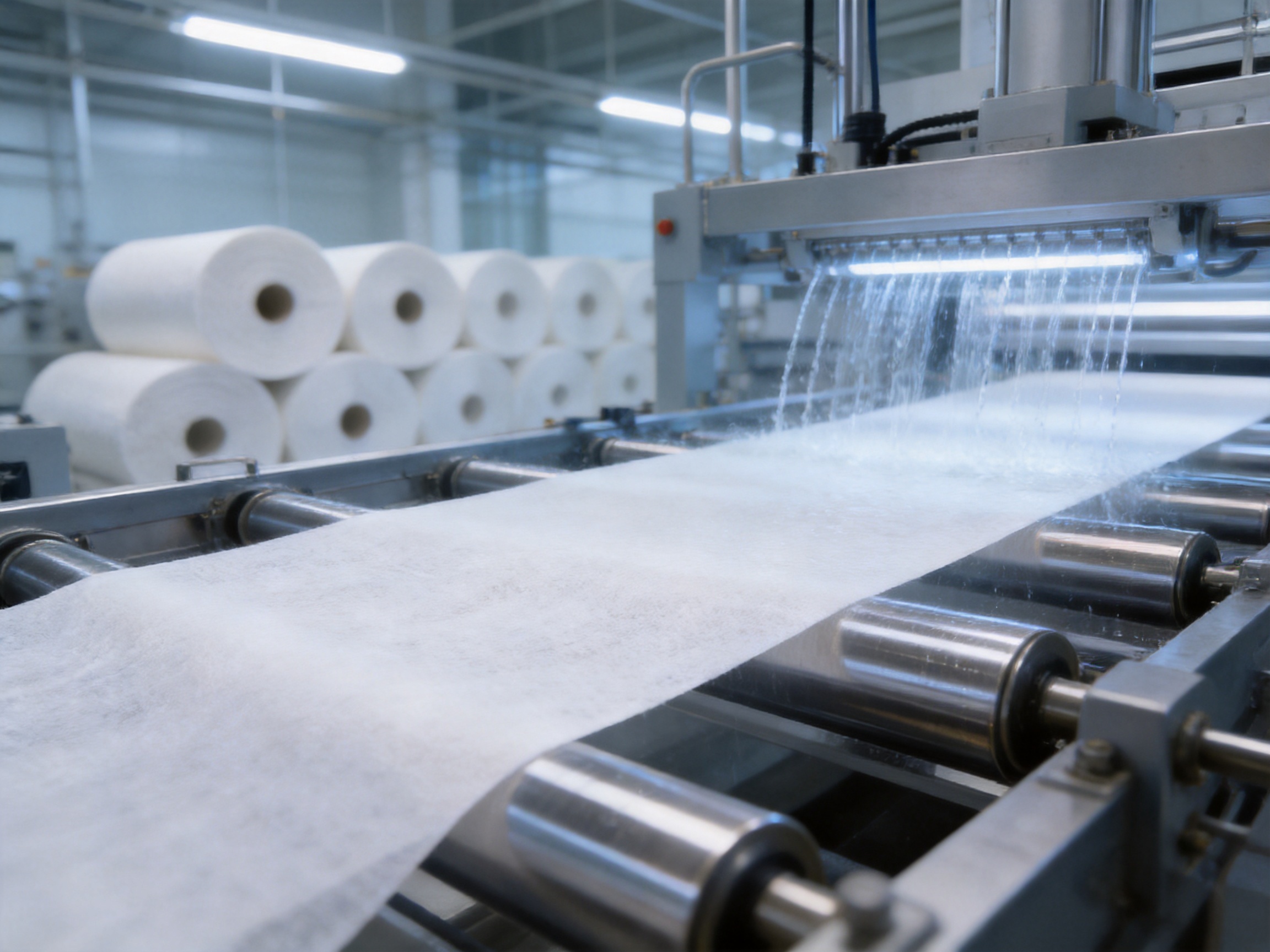
Double-carding helps create a more uniform fiber web before hydroentanglement. Uniform web formation improves strength consistency, surface appearance, and thickness control. Semi-cross laying then contributes to a better balance between machine-direction and cross-direction properties. The hydroentanglement stage bonds the fibers mechanically using high-pressure water jets, avoiding the need for chemical binders and preserving softness.
Drying and finishing must also be carefully managed. Moisture content, fabric shrinkage, surface feel, and roll stability can all be influenced by drying conditions. Finishing treatments such as hydrophilic or antistatic functions must be applied uniformly to avoid performance variation. The final winding and slitting process must deliver rolls that are clean, stable, and compatible with customer converting lines.
Quality consistency is especially important for wet wipe manufacturers. During high-speed converting, even minor substrate inconsistency can cause production stoppages. A reliable fabric reduces downtime, waste, and customer complaints. It also helps finished product manufacturers maintain stable product claims, such as softness, thickness, absorbency, and sheet strength.
Support for OEM and Private Label Wipe Programs
Many customers in the wipes market are not simply buying fabric; they are building finished consumer products. OEM and private label programs require technical communication, product development support, stable supply, and the ability to match market trends. This is where an integrated manufacturer with experience in both nonwoven materials and finished nursing products provides an advantage.
Zhejiang Uniquality Nursing Products Technology Co., Ltd. is active in OEM and ODM manufacturing for wet wipes, dry wipes, diapers, growing training pants, wet toilet paper, cleansing wipes, and related hygiene products. This practical downstream experience gives the company insight into how nonwoven substrates behave during converting, packaging, storage, and consumer use. Material development is therefore connected to real product performance, not limited to laboratory specifications.
For private label customers, the ginkgo dot semi-cross spunlace fabric can serve as a premium substrate for differentiated wipes. The material can be paired with different lotion formulations, packaging formats, sheet sizes, and fragrance or fragrance-free concepts. It can support product lines for baby care, beauty care, household cleaning, travel, personal hygiene, and professional wiping.
The company’s ability to meet differentiated, functional, and customized needs allows customers to develop products for multiple price points. A retailer may need a value line, a mid-tier family care line, and a premium sensitive-skin line. A brand may want a distinctive fabric pattern to distinguish its products from generic competitors. A distributor may require custom roll widths or basis weights to match regional converting equipment. The flexibility of this product supports these commercial needs.
Market Differentiation Through Material Design
In modern wipes markets, differentiation is increasingly difficult. Many products claim softness, strength, purity, or convenience. Consumers may not understand the technical details of nonwoven materials, but they can immediately feel differences in thickness, wet strength, texture, and cleaning efficiency. The ginkgo dot semi-cross fabric gives brands a physical way to express quality.
Material design influences brand perception before a consumer reads detailed claims. When a wipe is pulled from a package, the user notices whether it tears, stretches, unfolds easily, feels wet enough, and has a pleasant surface. The ginkgo dot pattern adds a visual cue of refinement. The semi-cross structure adds body and strength. The viscose-polyester blend contributes softness and reliability. Together, these characteristics help create a wipe that feels intentionally designed rather than generic.
For e-commerce brands, product images and close-up videos are important selling tools. A patterned fabric photographs better than a plain surface and can be used to communicate premium positioning. For retail brands, tactile experience encourages repeat purchase. If the wipe performs well in daily use, consumers are more likely to trust the brand and recommend it.
For professional buyers, differentiation also means fewer complaints and stronger product identity. A substrate that is attractive, stable, and customizable can reduce the pressure to compete only on price. Instead, the brand can compete on user experience, functional performance, and consistent quality.
Environmental and Practical Considerations
Disposable wipe materials are increasingly evaluated for both performance and environmental responsibility. While this product is a viscose and polyester blend rather than a fully cellulosic or fully biodegradable substrate, it offers practical performance advantages that can reduce waste during production and use. Stronger substrates may reduce sheet breakage, converting waste, and the need for users to consume multiple wipes for a single task.
Viscose is derived from cellulose, offering absorbency and a natural-feeling touch. Polyester contributes durability, helping the wipe maintain integrity. The balance between these fibers can be adjusted depending on customer priorities. In some applications, a well-engineered blended substrate may provide a more efficient use of material than a weaker substrate that requires higher basis weight or multiple sheets per use.
The manufacturer’s broader product portfolio includes spunlace nonwoven fabrics, spunmelt nonwoven fabrics, hot air through nonwoven fabrics, flushable and degradable nonwoven fabrics, wet wipes, dry wipes, baby diapers, pull-ups, wet toilet paper, and cleansing wipes. This wide technical background allows customers to discuss sustainability goals, performance needs, and alternative material options within a broader development framework.
Practical sustainability also includes supply chain reliability, quality consistency, and reduced production loss. Materials that run smoothly on converting lines reduce scrap. Products that meet user expectations reduce returns and negative feedback. A durable wipe substrate can contribute to responsible product design when used appropriately and communicated honestly.
How to Select the Right Grade
Selecting the right grade of viscose and polyester ginkgo dot spunlace nonwoven begins with the final application. A baby wipe, facial cleansing wipe, kitchen cleaning wipe, and dry industrial wipe may all use the same general material family, but they require different specifications. Buyers should consider basis weight, fiber ratio, softness target, absorbency requirement, tensile strength, lotion compatibility, packaging type, and cost positioning.
For skin-contact wipes, softness and skin comfort should be prioritized. A balanced or viscose-rich blend may be preferred, depending on the lotion and wipe thickness. For cleaning wipes, strength and friction may be more important, making polyester contribution and semi-cross integrity especially valuable. For premium products, a higher basis weight and pronounced patterned surface may support a luxury feel. For economy products, a lighter basis weight with efficient structure may provide a competitive balance.
Roll width should be selected according to converting equipment and sheet layout. Proper roll width helps reduce trimming waste and improves production efficiency. The manufacturer’s width range from 10 cm to 320 cm provides strong flexibility for both small-format and large-scale production. Customers should also confirm roll diameter, core requirements, packaging preferences, and storage conditions.
Finishing treatment should be matched with liquid formulation or dry-use requirements. Hydrophilic finishing is helpful when rapid liquid absorption is needed. Antistatic treatment may be relevant for dry wiping or dust-sensitive environments. Coatings can be discussed for special functions, but they must be evaluated for safety, compatibility, regulatory needs, and end-use performance.
Quality Evaluation Criteria for Buyers
Professional buyers should evaluate this substrate through both laboratory testing and practical trials. Important laboratory properties may include basis weight, thickness, tensile strength in machine and cross directions, elongation, absorbency, liquid retention, linting, softness, opacity, and pattern consistency. For wet wipes, lotion pickup and wet tensile strength are especially important. For dry wipes, dust pickup, lint control, and hand feel may be key factors.
Converting trials are equally important. A substrate may look good in a sample roll but behave differently on high-speed production lines. Buyers should evaluate unwinding stability, folding accuracy, cutting quality, stacking, wetting uniformity, packaging compatibility, and dispensing performance. If the wipe is used in a pop-up pack, interfolding and pull-out resistance must be tested. If it is used in a canister, dispensing through the cap should be evaluated.
Consumer-use testing can reveal details not captured by instruments. Users can compare softness, thickness perception, friction, cleaning efficiency, residue pickup, and overall satisfaction. The ginkgo dot pattern may provide a noticeable advantage in these sensory evaluations because it affects both visual appeal and tactile experience.
Stability testing should also be considered for wet wipes. The substrate must remain compatible with lotion ingredients over shelf life. Changes in odor, color, strength, or surface feel should be monitored. A stable manufacturing process and experienced technical support can help reduce development risk.
Why This Product Is Well Suited for Competitive Wipe Brands
The strongest value of this product lies in its combination of technical performance and market appeal. It is not simply a standard nonwoven with a decorative pattern. It is a semi-cross, double-carded spunlace material designed to feel thicker, resist stress, improve surface interaction, and support customization. These qualities directly address the challenges faced by wipe brands.
In crowded categories, brands must deliver a product that consumers can feel immediately. A wipe that looks elegant, feels soft, performs strongly, and cleans efficiently creates a memorable experience. The ginkgo dot pattern creates visual and tactile distinction. The viscose-polyester blend supports comfort and durability. The semi-cross structure improves strength compared with ordinary parallel-lapped alternatives.
From the manufacturing side, the company’s long history, advanced equipment, multiple production bases, and broad product portfolio provide confidence. Buyers can work with a supplier that understands both raw material production and finished hygiene product requirements. This reduces communication gaps and supports efficient product development.
From the commercial side, customizable composition, basis weight, roll width, and finishing treatments allow the material to serve multiple market segments. Whether the goal is a premium baby wipe, a beauty cleansing wipe, a household cleaning wipe, or a versatile dry wipe, the substrate can be adapted to the intended use.
Frequently Asked Questions
What is viscose and polyester ginkgo dot style spunlace nonwoven?
It is a hydroentangled nonwoven fabric made from viscose and polyester fibers, usually in a 50% viscose and 50% polyester blend. It uses double-carding and semi-cross technology and features a distinctive ginkgo dot pattern. It is designed for dry wipes, wet wipes, and related wiping products.
What makes it different from ordinary parallel-lapped spunlace fabric?
The semi-cross structure provides a thicker hand feel and better strength balance than ordinary parallel-lapped spunlace. Parallel-lapped fabrics may have stronger machine-direction properties but weaker cross-direction performance. Semi-cross technology improves multidirectional integrity, making the wipe more durable during converting, dispensing, and use.
Why use a 50% viscose and 50% polyester blend?
Viscose provides softness, absorbency, and a comfortable skin touch. Polyester provides strength, dimensional stability, and durability. A 50/50 blend offers a balanced solution for many wet and dry wipe applications. The ratio can also be customized for specific needs.
Can the fiber composition be customized?
Yes. The blending ratio can be adjusted according to the target application. More viscose may improve softness and absorbency, while more polyester may improve strength and durability. Customization allows buyers to design products for different market positions.
What is the benefit of the ginkgo dot pattern?
The ginkgo dot pattern improves appearance and provides a textured wiping surface. It can enhance friction, help residue pickup, and create a premium user experience. It also gives finished wipes a distinctive look that helps differentiate them from plain materials.
What basis weights are available?
The product is available from 40 gsm to 100 gsm. Lighter weights may be suitable for economical or compact wipes, while heavier weights can support premium, stronger, or higher-absorbency products.
What roll widths can be supplied?
Roll widths are available from 10 cm to 320 cm. This wide range supports different converting equipment, sheet sizes, folding formats, and production layouts.
What finishing treatments are available?
Available finishing technologies include hydrophilic treatment, coating, antistatic treatment, and other functional options. The suitable finish depends on the final application, lotion formulation, and performance requirements.
Is this fabric suitable for baby wipes?
Yes. The softness of viscose, strength of polyester, and stable semi-cross structure make it suitable for baby wipes. For baby care applications, customers should also evaluate lotion formula, skin compatibility, regulatory requirements, and final product testing.
Is this fabric suitable for household cleaning wipes?
Yes. The polyester component, semi-cross strength, and textured ginkgo dot surface make it suitable for many household cleaning wipes. It can help improve durability and friction during wiping.
Can it be used for dry wipes?
Yes. It is suitable for dry wipes because it offers softness, strength, absorbency, and a textured surface. It may be used in beauty, personal care, household, professional cleaning, and other dry wiping applications.
Why is the manufacturer’s production capability important?
Spunlace nonwoven quality depends on stable fiber blending, carding, web formation, hydroentanglement, finishing, and roll handling. A manufacturer with advanced equipment, long experience, and multiple production bases can provide more consistent quality and reliable supply.
Conclusion
Viscose and polyester ginkgo dot style spunlace nonwoven for dry or wet wipes is a strong material choice for brands that want to combine performance, comfort, and product differentiation. Its double-carding and semi-cross technology provide a thicker style and superior strength compared with ordinary parallel-lapped spunlace fabrics. Its 50% viscose and 50% polyester blend balances softness, absorbency, and durability. Its ginkgo dot pattern enhances appearance, friction, and user experience.
The product’s customization options make it suitable for many applications, including baby wipes, facial wipes, personal care wipes, household cleaning wipes, dry wipes, and professional wiping products. With gram weights from 40 gsm to 100 gsm, roll widths from 10 cm to 320 cm, and finishing options such as hydrophilic, coating, and antistatic treatments, it can be tailored to diverse market needs.
Behind the product is the manufacturing strength of Zhejiang Uniquality Nursing Products Technology Co., Ltd. and Kingsafe, supported by decades of experience, advanced international equipment, multiple production bases, and a broad portfolio in nonwoven materials and hygiene products. For OEM, ODM, and private label customers, this combination of material innovation and production capability provides a practical path to developing wipes that stand out in both performance and consumer appeal.
References
1. Russell, S. J. Handbook of Nonwovens. Woodhead Publishing.
2. EDANA. Nonwovens Standard Procedures and Industry Guidelines.
3. INDA, Association of the Nonwoven Fabrics Industry. Nonwoven Materials: Fundamentals and Applications.
4. Albrecht, W., Fuchs, H., and Kittelmann, W. Nonwoven Fabrics: Raw Materials, Manufacture, Applications, Characteristics, Testing Processes. Wiley-VCH.
5. Krcma, R. Manual of Nonwovens. Textile Trade Press.
6. Company product materials and technical specifications for viscose and polyester ginkgo dot style spunlace nonwoven.